

For the inaugural installment in a new series of artist conversations for Bear Review, Claressinka Anderson speaks to artist Fay Ray.
—
Claressinka: Your work has always been visceral and of the body, and at the same time, quite austere and contained in terms of its visual aesthetics. I’m interested in this interplay and why it might be taking place.
Fay: I believe you are talking about my large scale hanging metal works. They represent a larger, tougher, adaptable, more resilient version of me. They are stand-ins for my bigness, my boldness, and my sharpness. Think Ripley in the Power Loader in the movie Aliens (1986).

Fay Ray in her studio, 2025 / Photo Credit: Claudia Lucia
C: I love this reference! I don’t think I've ever heard you mention that before. So in a way, they could also be seen as a type of armor? The collages too, have an austerity to them despite the individual components being anything but. Eggs, body parts, crystals, and plants—ghosts of the desert—become luminous geometries in black and white. Is there are reason, too, that you are drawn to working in greyscale?
F: Yes…armor, tools, weapons, protection, function, transportation. I see myself as a being that transmutes matter from metal to human flesh. Is that creepy? I don't care! Nothing makes sense anymore, so I'm leaning into the metaphysical, and declaring more of my own power as a creator. Art can do so many things. Women can do everything. Put them together and you get me.
I find color very seductive and generous. I do not trust it, so I do not use it. If the work can stand in a low chromatic vibration, it can stand in high chromatic vibration. But that does not work the other way around. I think the grey scale of the collages makes them function more like text.
C: It’s funny but this reminds me of something I was once told about writing poems: put them in an ugly font and see if they still hold up. We are often seduced by the way something looks. As a visual artist, aesthetics are paramount, but like you say, the seductive aspects of an image can be untrustworthy, almost like a veil. I understand how working in a low chromatic vibration removes those particular layers of seduction. And yet, your work is very seductive. It doesn’t lose its seduction through a lack of color. I would almost argue that the work is more seductive because the removal of color creates a distance between the object and reality. It creates a type of built in space or liminality in which the viewer must exist. Perhaps longing is just the lens through which I read most things, but I don’t think this is just my own personal bias. I am curious if you have any thoughts on this?
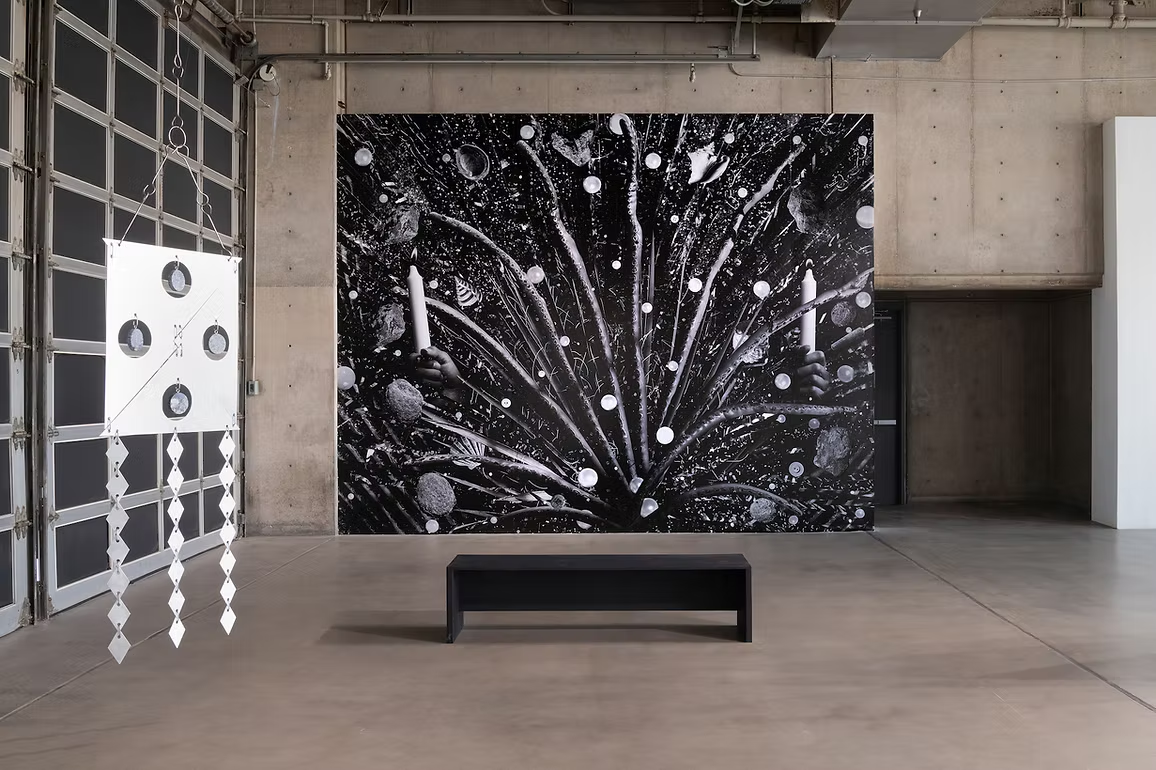
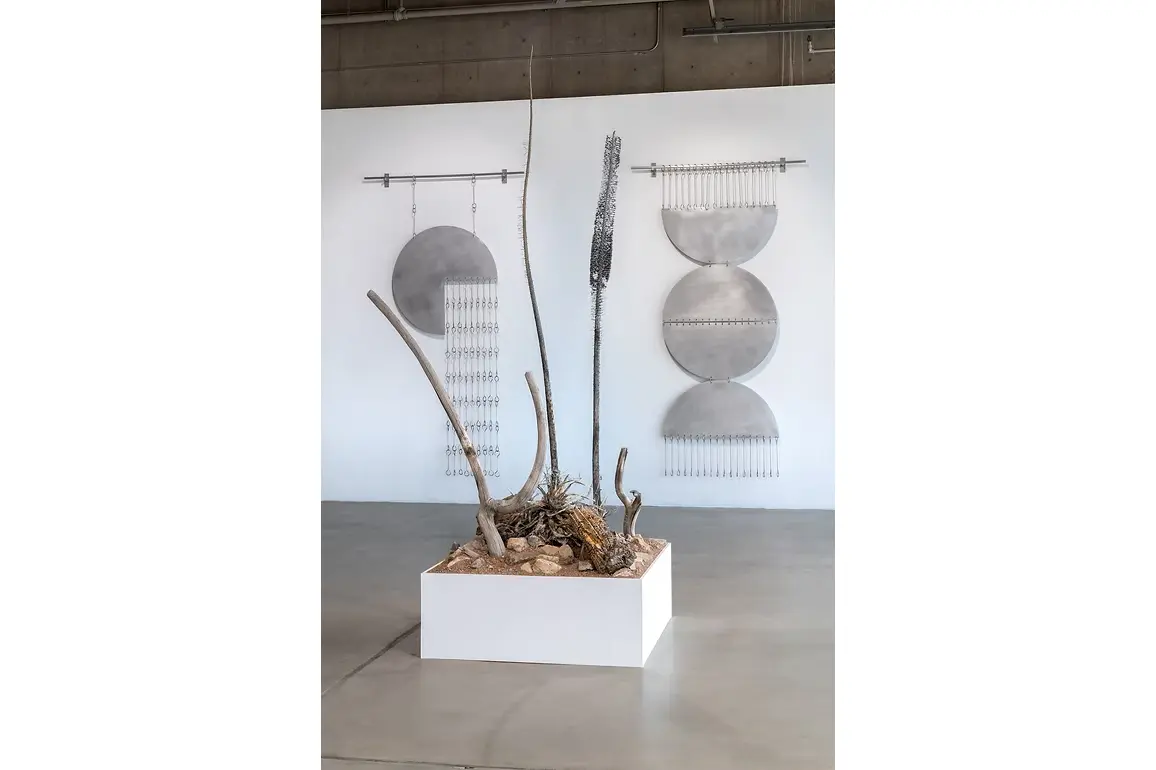
Installation Views, PORTALS, 2024, Museum of Contemporary Art, Tucson, AZ / Photo Credit: Maya Hawk
F: Color is imagined, color is not reality. Our range of color perception is so tiny compared to all of the life on earth that can perceive it. Darkness and light are what is real and deeply symbolic. When I see color in art, I immediately feel positioned in the artist’s world of taste. I don't care about other artists’ taste. So I squint my eyes and then I see what I can see. If there is still a thought there for me—for the viewer—I stay with the work a while longer. That is why sculpture is so powerful. Even in color, it will always have a silhouette and shape in space. Then I can start to have the next conversation in my mind about the work and then the next and the next…
I purposefully take color out of the conversation in my collage work so I can work faster. I am in a race with myself to make as much work as possible in this short lifetime—to say as much as I can. Color slows me down. If you ever see color in my work, know that it was the very last thought. And know that if it was gone, it would still be a work of art I thought worthy of another person’s precious time.
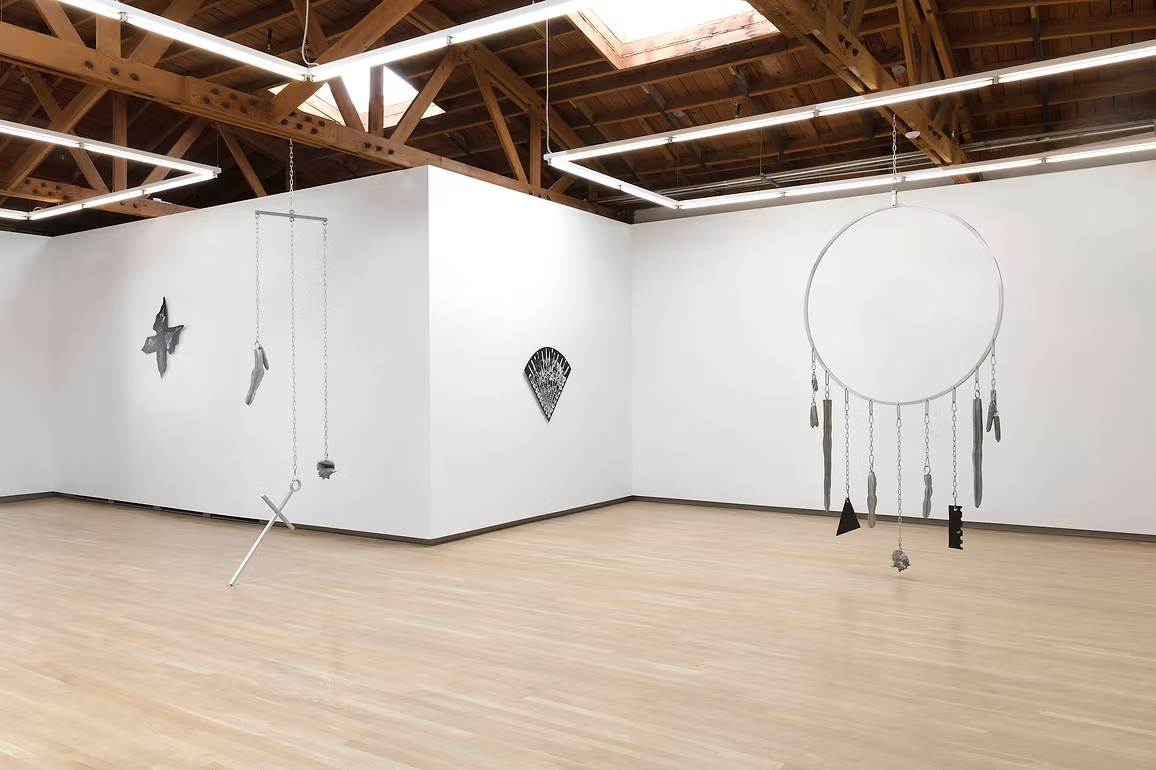
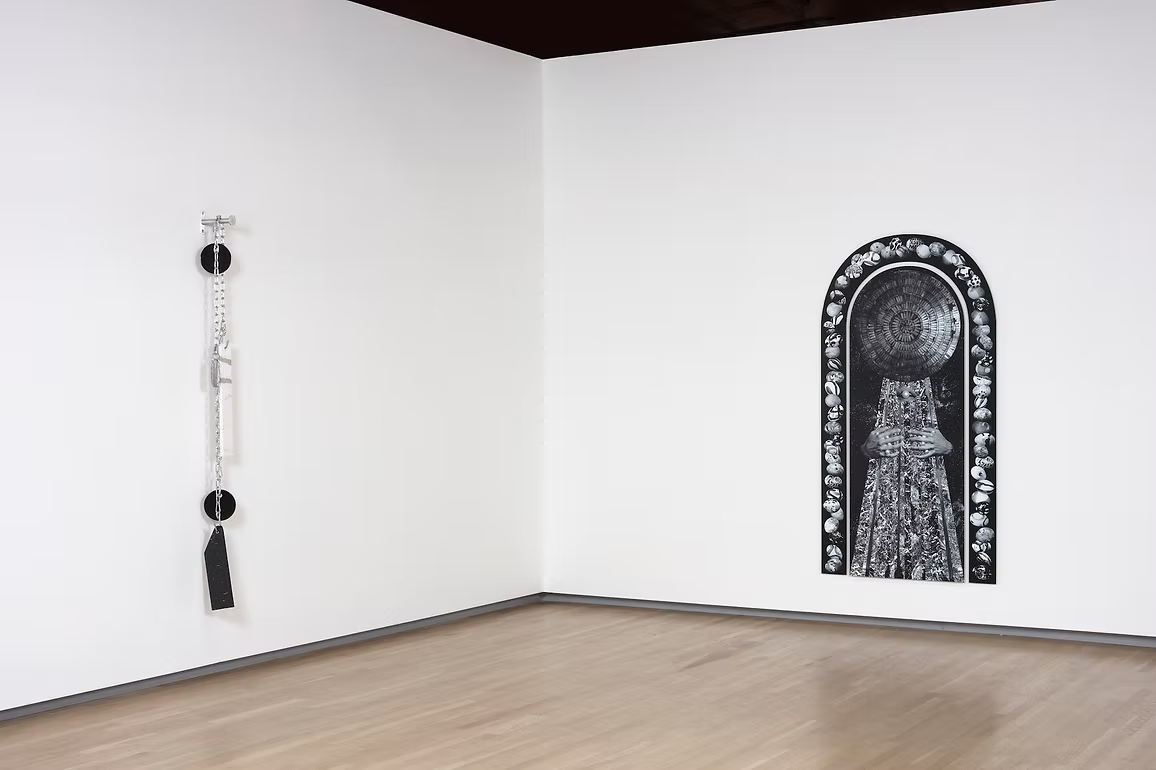
Installation Views, I AM THE HOUSE, 2018, Shulamit Nazarian, Los Angeles, CA
C: I love your consideration of time, both for yourself and in the context of offering one’s art to the world. In terms of the collages functioning more like text, I can also see how the collages could be viewed as stand-ins for language. But isn’t all art, essentially, a stand in for language? Or are you trying to get at something beyond language? I think what I love most about visual art and music is that in terms of emotion, there is more room to allow something to wash over us in a more abstract manner. There is an openness which the specificity of language does not allow for.
F: I agree about the openness, but because of that openness there is a lot of pollution, destruction and violation in the visual arts world. The written word—poetry—is more female energy. You have to go to it. You can measure the doses in which you receive it. Visual arts language will come to you, sometimes uninvited, expose itself, and run away without any sort of consent or contract. Fun! This conversation is starting to get loaded.
[Laughter]
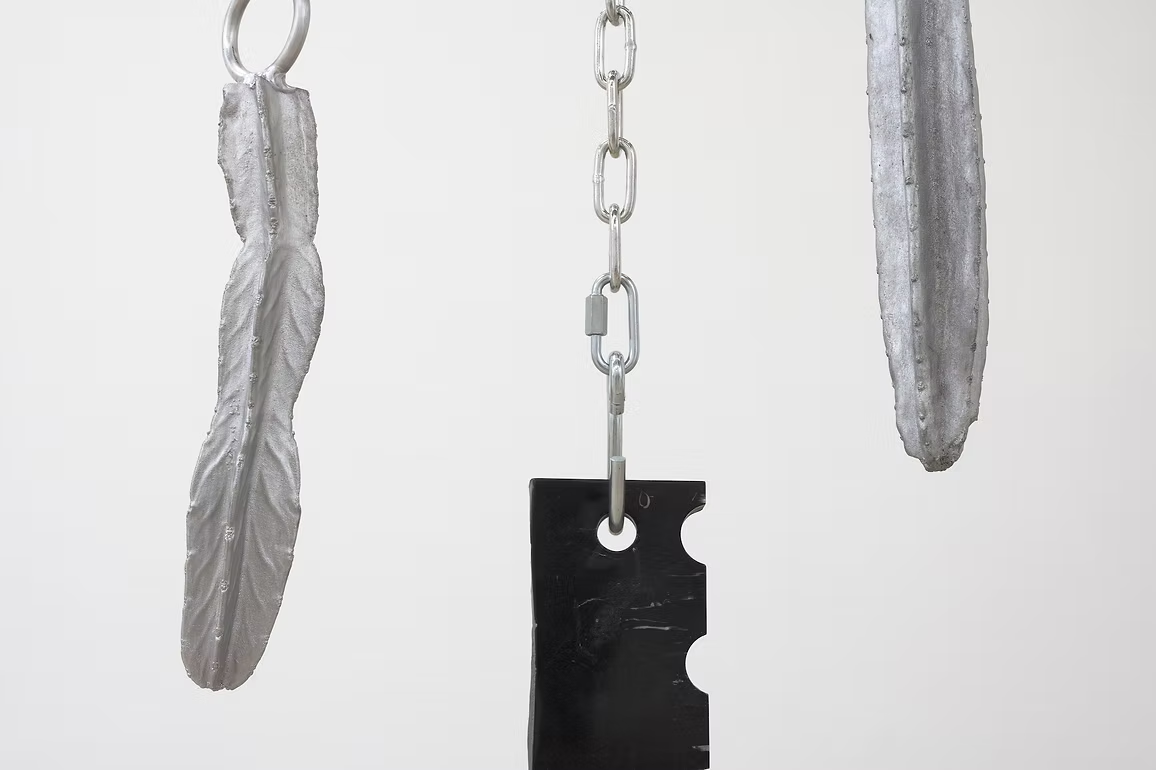
Desert Shore (detail view), 2018, Aluminum, zinc plated fixtures, and black Monterey marble, 138 x 63 x 5 inches
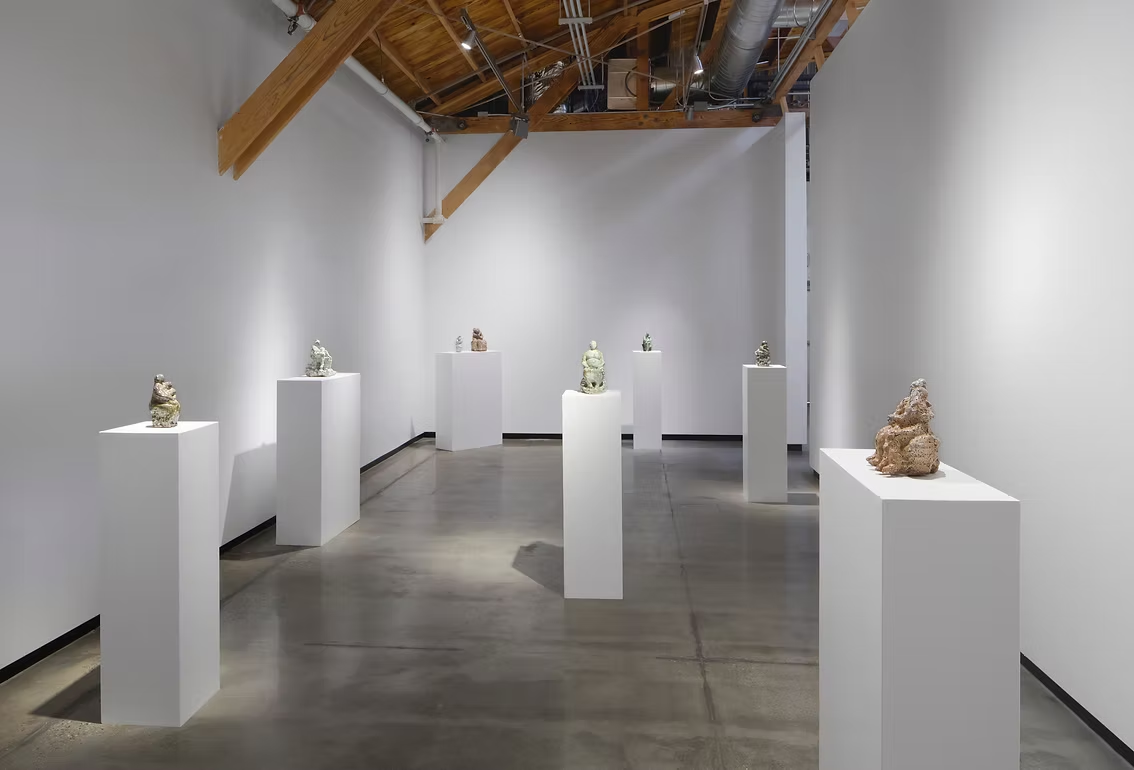
Installation View, PUERPERAL, Compound, Long Beach, CA, 2025
C: I would not expect anything else! I understand what you are saying in terms of engaging with the written word versus visual art. There is an immediacy or quickness in the way that we consume something visual that has more potential to be violent or overwhelming, but language can be an onslaught and words often carry overwhelming violence too. There is so much to unpack here, and I know we are trying to keep this conversation within the realms of visual art—and for the sake of time, we must!—but I suppose I’m saying that I’m not sure I agree with you that the energy of poetry and the written word is more female than visual art. But I am intrigued by the fact that it feels that way to you. That is interesting to me. With all this in mind, I’m curious about your new The Mothers project and how you came to it. The sculptures are made in clay and their energy is softer, rounder, more tender. They appear to come from a different place in your practice.
F: I’m all up in my head about the masculine and the feminine, my energy, my intuition, my impulses, what’s authentic versus what’s a reaction and on and on and on. Like so many mothers whose children have newly arrived at the age when they are all able to feed themselves, dress themselves, use the bathroom and go to school, I’ve been taking stock of what matters to me and how I use my time. But because I happen to be doing that at a time in our history when it seems the whole world is reconsidering everything they once believed about the way things work, the load is a lot heavier. It’s as if our collective preservation medium is failing and we are losing suspension in the specimen jar—think Neo’s disconnected body emerging from the goop filled fluid pod in the battery field in the Matrix.
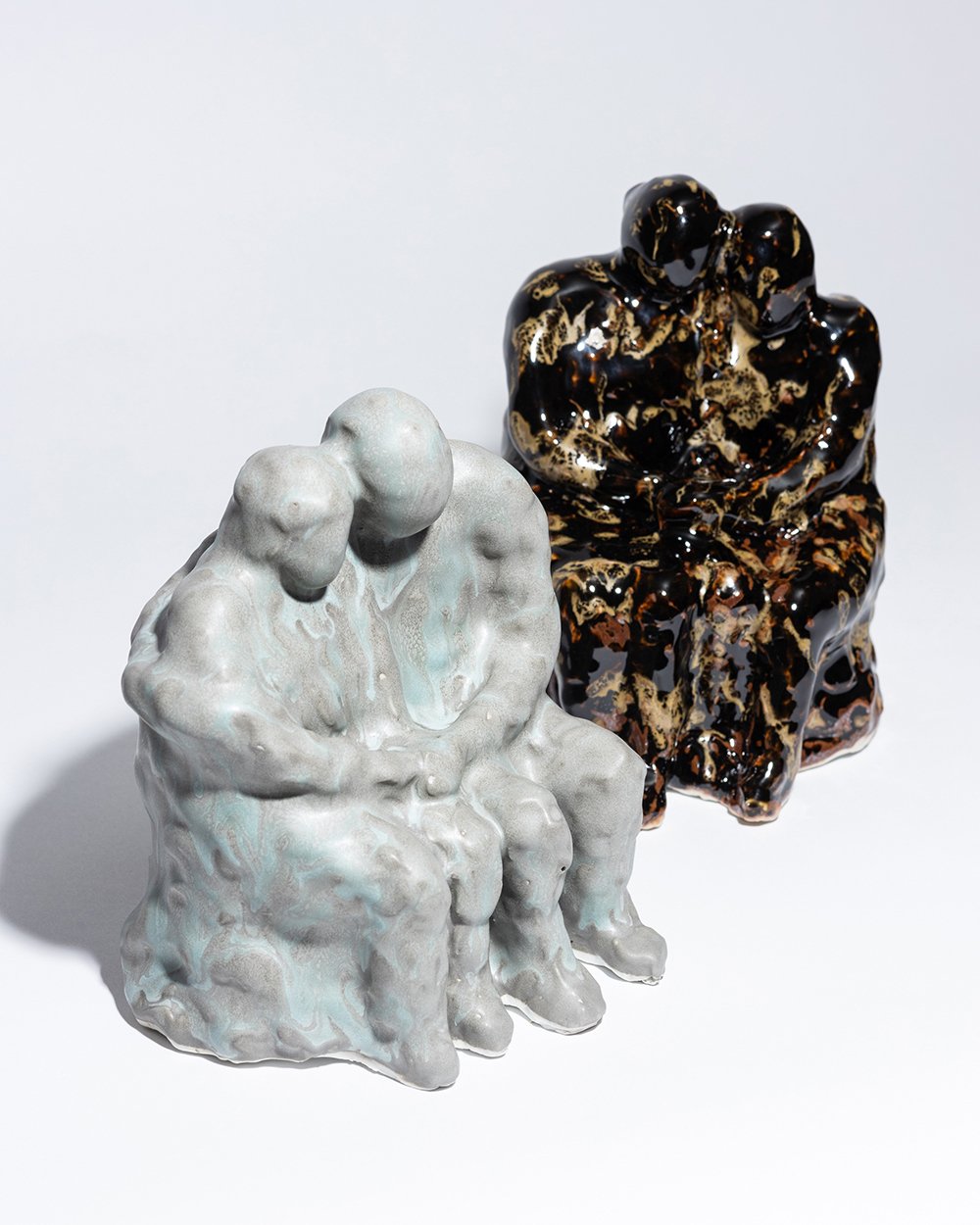
In trying to survive the pressure of it all for the sake of my family I have learned ways to create precious quiet in my head and hold on. In that silence I’ve been able to identify a whispered phrase that keeps repeating itself, arms reach, arms reach, arms reach, arms reach, and I think the message is to make a smaller circle. The Mothers series is that message shaped in the most enduring, light filled material I can access, which is porcelain. Clay, as a medium, is especially suited to this work because it is immediate, highly responsive and undeniable. If you drop one of my Mothers on your toe it will hurt. They are heavy, robust and because of the high amounts of silica in this particular clay they seem to hold their own light source.
I said earlier, I like to work fast. I do not have time to replicate, that is not what is important in this work. What is most important is to convey a presence and enshrine an intimate blending of the form of the mother and the child—in a heart beating, air breathed, a lived moment in time.
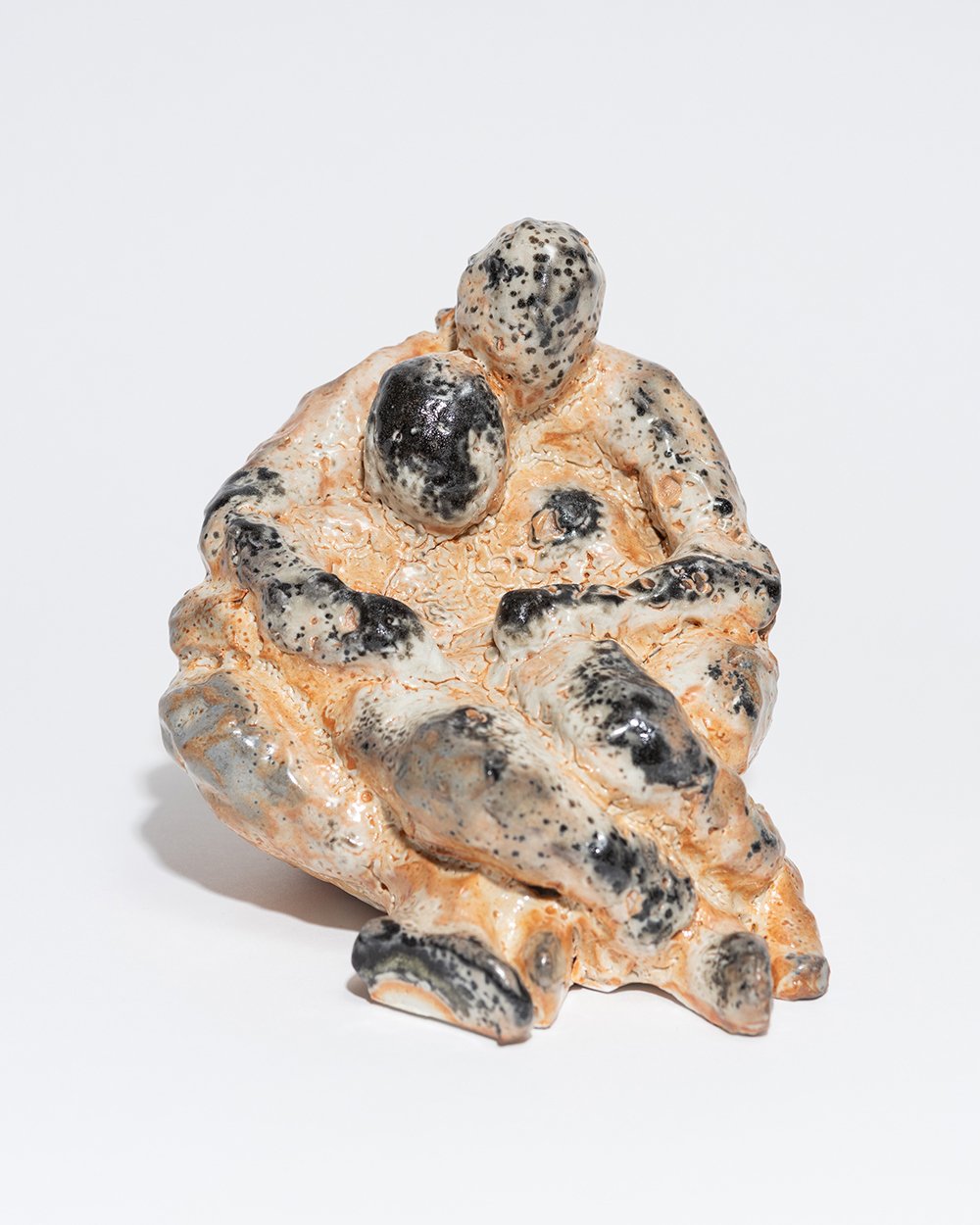
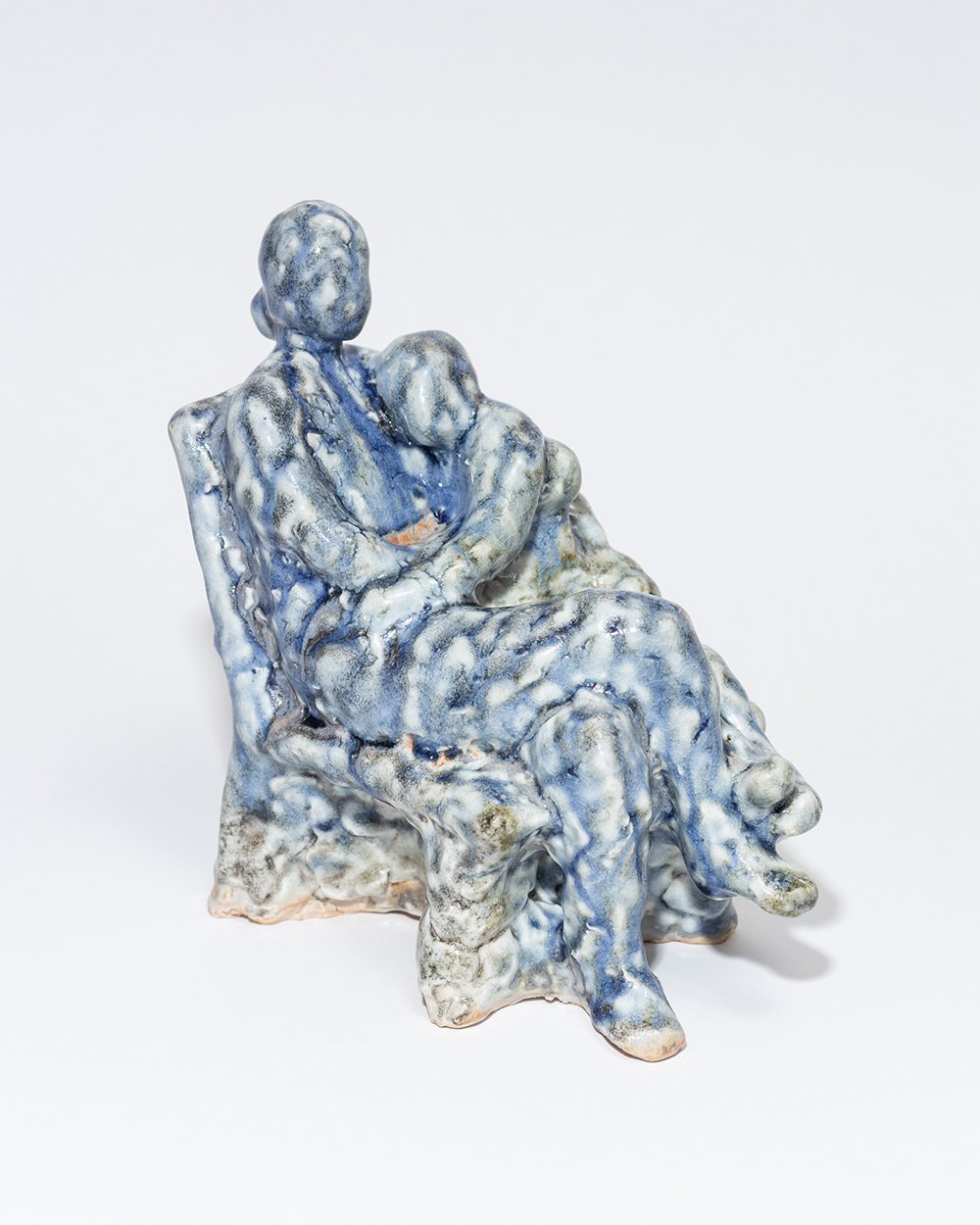
1. The Mothers: 24.01.02 , 2024, porcelain, 8 x 8 inches
2. The Mothers: 25.11.03 (grey), The Mothers: 25.11.01 (black),
2025, porcelain, 8 x 8 inches
3. The Mothers: 25.09.02, 2025, porcelain, 8 x 8
C: Gorgeous, Fay. When you mention the matrix and the evolution of motherhood, I can’t help but think about the podcast I’m listening to at the moment, The Last Invention, which traces the history and rise of AI to the present day. There was something both incredibly chilling and beautiful in it where Geoffrey Hinton, the so called “godfather of AI,” says that he believes that the only way that AI won’t destroy humanity is if they program or hardwire mammalian maternal instinct into its foundational code. It’s called the “The AI Mother Strategy” and he believes it’s the only true way we can coexist with super intelligence without it destroying us. A baby controls their mother because the mother genuinely cares for the baby. It is hardwired. It is the only instance where a less intelligent entity is in control of one that is more intelligent—the mother does not want her child to die and behaves accordingly. In order for us to survive, AI needs to be the mother and we need to be the baby.
F: This wrings my brain out like a dishtowel. You could really take a Freudian deep dive on this guy. A father turns his child into his mother so she can take care of him and keep him alive—gross! I think I know how you’d like me to respond, but I’m stymied by the arrogance of this man. What if AI just kills the rich and decides the poor should inherit the Earth? What if we all just collectively stop championing success, functionality, wealth, status and ease? Wouldn’t that also keep AI from “destroying humanity.” And aren’t we already destroying our own people?
What it comes down to, is that I cannot wait for the rest of the world to be okay before I am. I cannot wait for our collective future to be solved to be hopeful and calm and look forward to mine. I have to find a way to buoy myself without Geoffrey’s help. I have to remind myself that right now is as good as it is ever going to be and for people like you and I who get to hold our children safely in our arms and breathe in their scent off of the top of their heads, it’s pretty fucking good. We need to champion things that affirm this. That is why I make these sculptures. They are my way of slowing down time and reflecting a reality where deep peace, deep knowing and deep sharing with my children are all that matters.
C: A perfect note on which to end. Thank you, Fay, for taking the time to speak with me. I seem to always return to you at the beginning of a new project. The eternal return…mother and child, child and mother, around and around, forever.
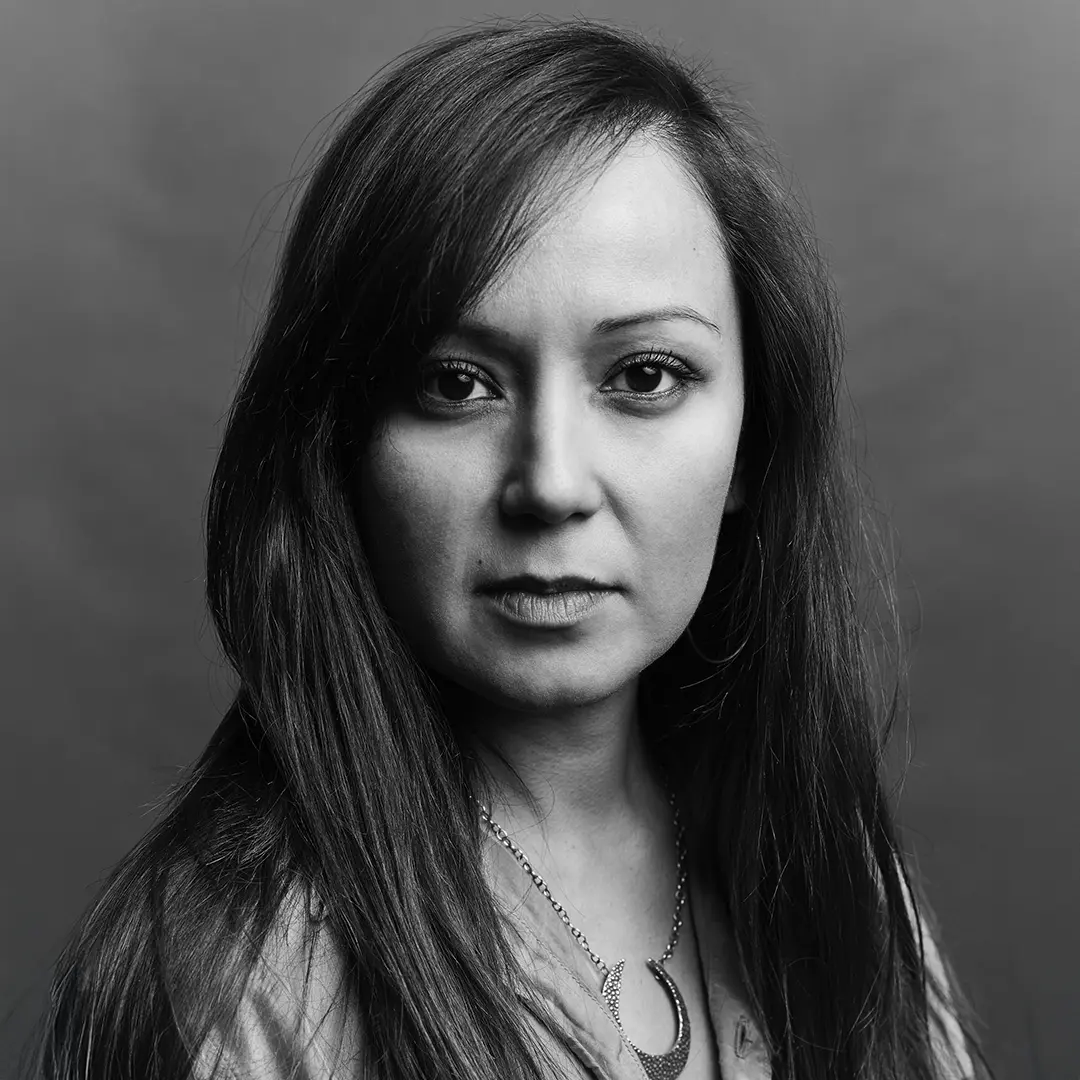
Fay Ray received her MFA from Columbia University and her BFA from Otis College of Art and Design. Solo exhibitions include The Soraya Art Gallery, California State University Northridge, Shulamit Nazarian, Louis B James Gallery, JOAN, and Honor Fraser Gallery. Ray’s special projects and installations have been featured at Gagosian Gallery, REDCAT, and L.A.N.D. (Los Angeles Nomadic Division). Group exhibitions include the Palm Springs Art Museum, Thaddaeus Ropac, Paris; The Mistake Room, Los Angeles and Mexico City; Praz-Delavallade, Los Angeles, CA; Gagosian Gallery, New York, NY; El Museo del Barrio, New York, NY; among others. Her work is held in the permanent collection of the Palm Springs Museum of Art and the Los Angeles County Museum of Art. Ray’s works have been reviewed by Artforum, Los Angeles Times, New York Times, New York Magazine, Riot Material, Wallpaper*, Issue Magazine, and The Brooklyn Rail.
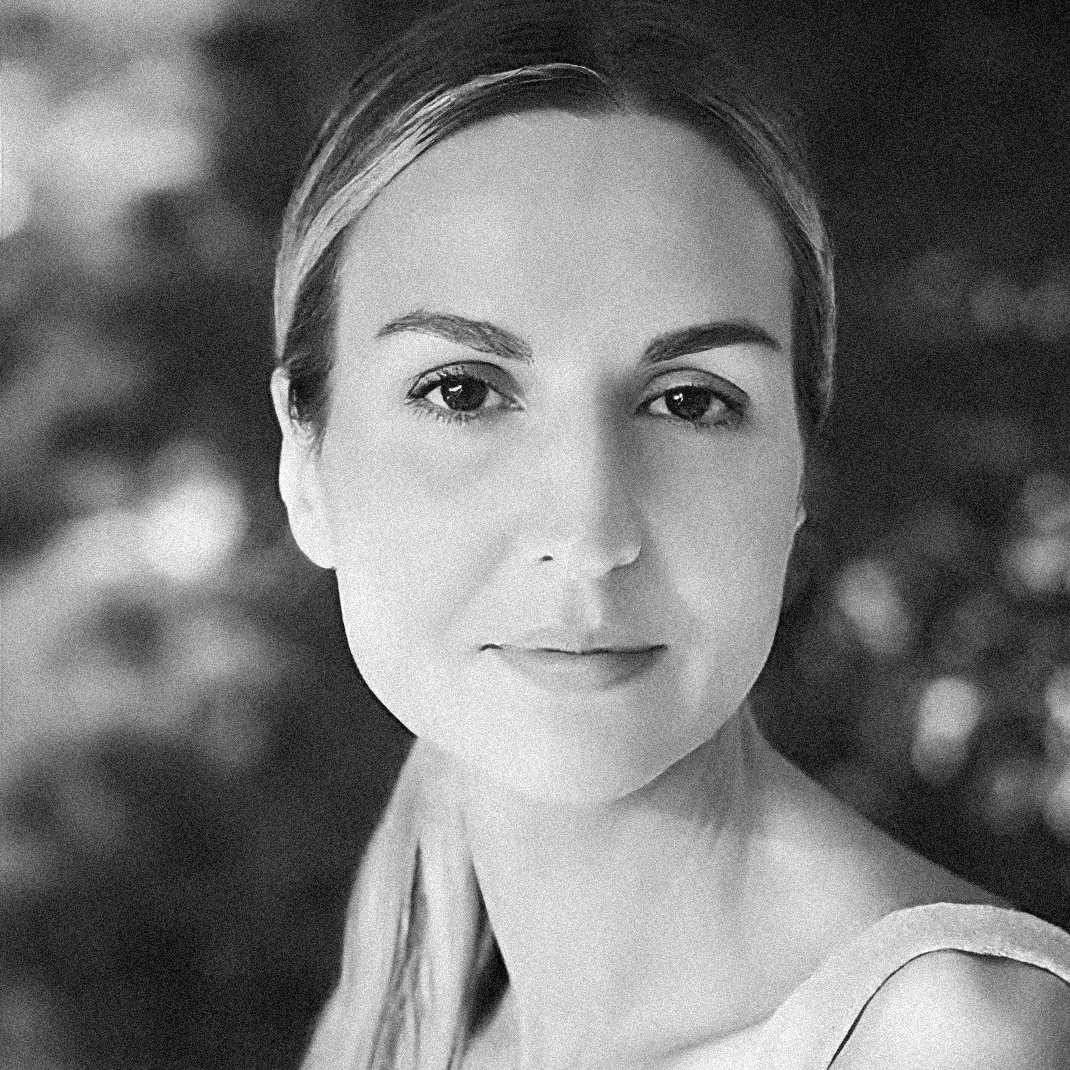
Claressinka Anderson is a Los Angeles–based poet and writer. Her poems and essays have appeared or are forthcoming in Oxford Poetry, Los Angeles Review of Books, Best New Poets, North American Review, Boulevard, Pleiades, Contemporary Art Review Los Angeles (Carla), and elsewhere.
Anderson has worked as an art dealer, advisor and curator, and was the founder of the gallery and art salon, Marine Projects. Her curatorial work has been reviewed in numerous publications, including Art Forum, The Los Angeles Times, Vogue, Elle, and Modern Painters. Anderson is a poetry editor at Bear Review. She holds an MFA in writing and literature from Bennington College.
© Bear Review 2025
ALL RIGHTS RESERVED
Site Design + Build
October Associates
