Bear
Reviews
Bear Review is excited to announce our new series of book reviews from the distant and not so distant past. We're calling it the poetry wayback machine.
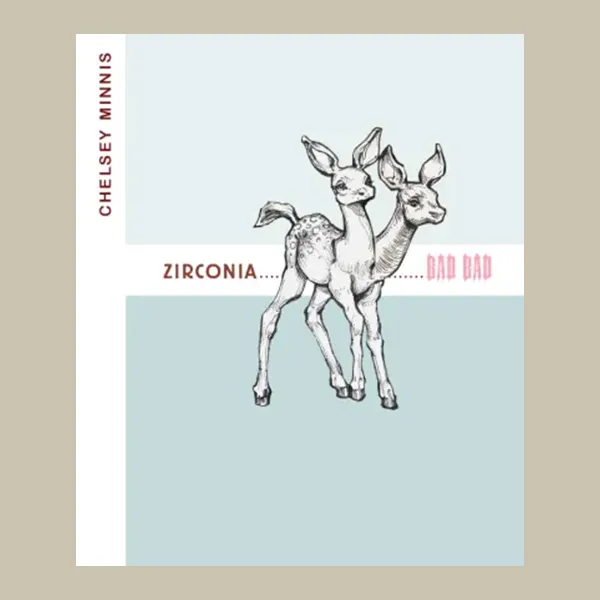
Zirconia…….Bad Bad
Chelsey Minnis
—
Melted Sherbert & Lavish Rebellion
In Chelsey Minnis’s reprinted collection of her first two books of poetry, Zirconia…..Bad Bad (Fence Books, 2019), you’ll find a mall-stroll of tonally playful, dissented, and downright irreverent poems. I have been excited to read Minnis’s art since I first encountered her verse online in 2019, but I couldn’t get a copy of this collection for a number of years. When I finally did, I was ecstatic to discover the iconoclastic and satirical sensibilities of her online poems, evocative of a raw punk ethos that eschews any sense of superficial performativity, were just as present here. These collections reject self-indulgence–the academic, the “hip,” the pandering to trends–but not at the behest of total nihilism or at the expense of a poetic truth that is unequivocally severe of subject, speaker, and critic alike. The speaker in these books scrutinizes the poetic vocation, the capital P-oet, while championing a poetics that exists independently of social values and utilitarian function:
If anyone thinks they need to write reviews, teach classes, edit magazines, or / translate books in order to write good poetry…then maybe they should just take / a rest from it… // If you try to write a good poem again and again for years and years and receive / no awards, no money, no nothing…then you’re happy…
However, the speaker does not grandstand in a self-effacing manner. Arguably, the poetic prefaces of Bad Bad are at their most ostentatious and brutal when the lens of criticism is redirected back at the speaker.
I want to cut the arms and legs off a mannequin because that is what it is like / to have to look at a poem I have written… // I think this is an acceptable feeling…but I do not always like an acceptable feeling… // It is like lickable mink… // And it is like a lion chasing you up the spiral staircase… // And all the drinks in the world are a prize for this…
The prefaces are bare knuckled and the brawling seems to have started well before you, the reader, have arrived. The poems are aware of the inescapability of criticism and highlight that fact through self-criticism. At one point, the inward lens goes so far as to obliterate the safety net between speaker and poet with unabashed defiance. This effectively resolves any ironic, discursive, dialogue about “critic criticising critic” with an idiosyncratic exclamatory referring to “Chelsey” in the third person:
This is not a mini-gun with which to shoot myself. // You can say many nasty things about poetry if you like… // But Chelsey understands what is expected of her!
I think this is so amazing. A critic might highlight a certain hypocrisy in the speaker that, on one hand, challenges criticism and, on the other, engages in it. And if the critic wants to go there, the poem expresses, they can have that “nasty thing.” But what can a critic say to an eloquent and resolute, fuck you. If commodity critique is the oppressor of spirit and truth in self-expression, then a heretical, anti-establishment poem, replete with “unfashionable” cantilevered analogies and exaggerated ellipticals, is the absurdist tool used to dismantle it.
In Zirconia, the elliptical structure establishes an aesthetic fulcrum for which the two collections are conjoined. I find my mind guided into the associative by the long sparkling strands. Coupled with surrealist, techno-optimistic dreamscapes, I am lulled into the associative more-so than the absence dispensed by acres of white space on the page. The ellipsis creates a sense of laxity between connecting clauses, images, and ideas like the pallid rhythm of streetlights streaming past the car window on a dark highway:
this is a moment… / or an… / upward waterfall… / appearing……..and revealing to me now… / curved… / galaxy… / roseate… / aplomb……..hauteur…….epitome…………………slams… / lasers………………………………..deep emotions… / awe… / lucre… / napes… / vales… / lava… / and anything else…
The poem “Fur” is a beacon for many of the independent and intertwined elements represented in either collection. Not only do we have the ellipsis leaving space for a certain self-reflection, but its lyric descriptions of sensuality, a disdain for exploited materials, a reluctant compassion, resistance, systemic critique, and impulsivity are signposts of what's to come. Here, the speaker wrestles with the complete lack of ethical consumption in a system that peddles anxiety and fosters dependence on the very commodities that perpetuate that anxiety–acknowledging the system's liability for violence over individual accountability:
I still believe in the need for honor and the refusal of fur stoles… / but I forgive… / the desire for an inhuman softness… / as many people are furious with themselves… / while wearing clothes of the highest quality… / and they are both disgraceful and touchable…
By citing these poems, I do a disservice to the alluring aesthetic Minnis crafts in the whole. There is so much more to say about this collection. Nothing more succinct, however, than in the brilliant analogy of Ariana Reines, who writes the foreword for these volumes, where she describes the experience “like having melted sherbert poured over your head by a bored genius who knows you better than you know yourself.” Ouch. Not the analogy, but the feeling of public transparency. Reading this collection at times feels like being seen for all our vanity, narcissism, and self-importance. The poems here are cool. Not cool in the way performance gives a panto-gesture towards style, but in the way we feel when we identify a radical self-acceptance in someone else that inspires us. The poems challenge the reader, and the industry of P-oetry, to maintain a genuine authenticity that is so ephemeral in a culture where material success becomes nearly indistinguishable from expression itself. The poems inspire me to be true and unabashed and to search for radical expression as a way around a diffidence that can't be fully yielded to.

Review by
Jacob Deason
06.03.26
Jacob Deason is a poet from Long Beach, Ca who is currently working on his first collection of poetry. He earned a BA in English at CSULB and an MFA from the University of California, Irvine where he also taught creative writing and won the 2025 Academy of American Poets University & College prize. When is not writing, he is spending time on my boat, paddle-boarding, or hanging out with my dog Tuna.
© Bear Review 2025
ALL RIGHTS RESERVED
Site Design + Build
October Associates
