Bear
Reviews
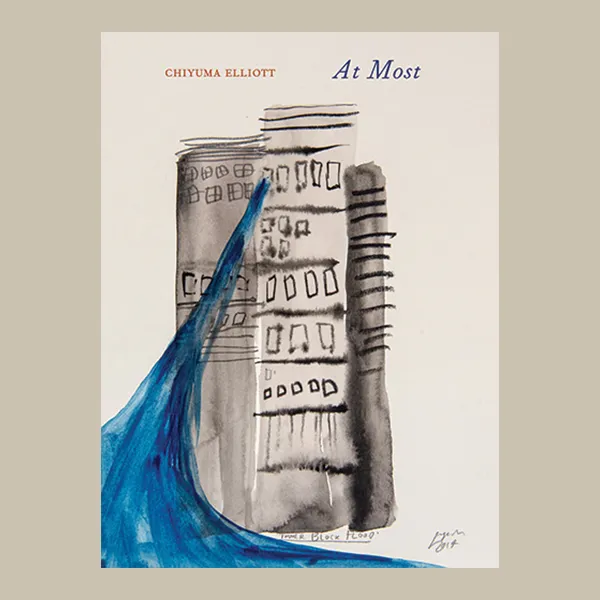
At Most
Chiyuma Elliott
—
This Is What I Want: A Wannabe Astronomical Investigation of Chiyuma Elliott’s At Most
I grabbed a copy of Chiyuma Elliott’s poetry collection At Most at the Unicorn Press booth at AWP 2026, turned to a random page, and was immediately enchanted by the words my eyes landed on: “My heart, that constant little bitch,” which I would later come to know as a line in the poem “Synecdoche.” Context is good, of course, but you don’t always need it.
What matters is that this is a thrilling bundle of poems that is still turning my mind in circles, much like the poems seem to do. This three-act body of work tumbles through time, phases of life, imagined realities, nature, and the speaker’s confrontations with the self wrapped up in memory and question and desire.
Part I examines a younger speaker self – slightly more grounded than the latter parts of the collection, with scenes of high school, rural life, and memories of youth.
But much of Part II is more concerned with adolescence and growth, or knowing oneself in the context of identity and race and romance.
It also had me thinking a lot about the etymology of words, as many poems themselves examine word choice and connotation, meaning. Elliott’s close concern with context leads me to believe that I am to look closely at words like treasures and guideposts, too. One such word is “thorny.”
“Thorny” feels like an appropriate word to encapsulate many poems in this part of the collection, though of course no singular word could be enough to span multitudes.
Poems like “God of Lambs, You Take away” are peppered with thorns:
“I make hegemony sound like a sweet thing growing / near the edge of a creek. And because that chapter // keeps me up nights, thinking of hawthorns, / have mercy – because pine is a symbol of paradise.” (37)
Later, in “Desire Path Revisited,” Elliott examines the self via the body and its architectures, its symbolisms. It, too, is abstract and thorny and does not present a clear delineation. Almost to mirror that understanding of the self, the speaker in this poem offers this understanding of the world – “I think the sky is a fork / I think the water is in stitches.” (43)
Part III of At Most felt the most imaginative to me. The poems take on “once upon a time” scenarios, such as in “Postulate,” which makes use of blank after blank as the speaker imagines the mights and would-be’s and omits their own name at end. There are character dialogue scenarios, too, such as in the mother-daughter back and forth of “Everything Old is New.”
As the final act of the collection, perhaps this imagination is needed. This opening up, this turning. It allows some breath to enter the abstractions that we have been traveling through without a map for so many pages so far.
As a collection, At Most implies a kind of shield… a protective and hard-to-penetrate shell on the speaker, which aligns with the many abstractions, the aforementioned thorns. The poems are confessional to an extent, and it’s clear that the speaker has a lot of inner self to share with us, the reader, but they also press the reader with dense and puzzling questions about time, faith, identity, and so much more.
I could take my pen and try to draw an underlying thread, and it might look broadly like “the self” or “time” in At Most (this collection is rife with time; one of the poems is named after the Greek goddess of memory). And maybe that wouldn’t be altogether satisfying. But I think it may be more important to focus on how Elliott is writing the self, and how impressively she is writing it in this collection, and in how many ways, how many cool iterations. The phases of life, the explorations of poetic forms. Elliott covers triolet, sonnet, epistle, ars poetica, diptych, and aubade, just to name a few. And each one felt fresh on the brain and tongue.
What she finally leaves the reader with is an epistle, and she invokes “us.” To that, I’ll leave “us” with a question she asks, which made me want to start all over again:
Isn’t this what you want: / the advantage of astronomical investigations?

Review by
Hannah Wyatt
07.07.26
Hannah Wyatt (she/her) is a multi-genre writer and artist from West Virginia. She holds an MFA in fiction from West Virginia Wesleyan College, where she is the incoming Irene McKinney Postgraduate Teaching Fellow. Her work appears in Brilliant Flash Fiction, Maudlin House, Pinch, HAD, The Turning Leaf Journal, L'Esprit Literary Review, and more. Learn more at hannahwyattwriter.com
© Bear Review 2025
ALL RIGHTS RESERVED
Site Design + Build
October Associates
