Bear
Reviews
Bear Review is excited to announce our new series of book reviews from the distant and not so distant past. We're calling it the poetry wayback machine.
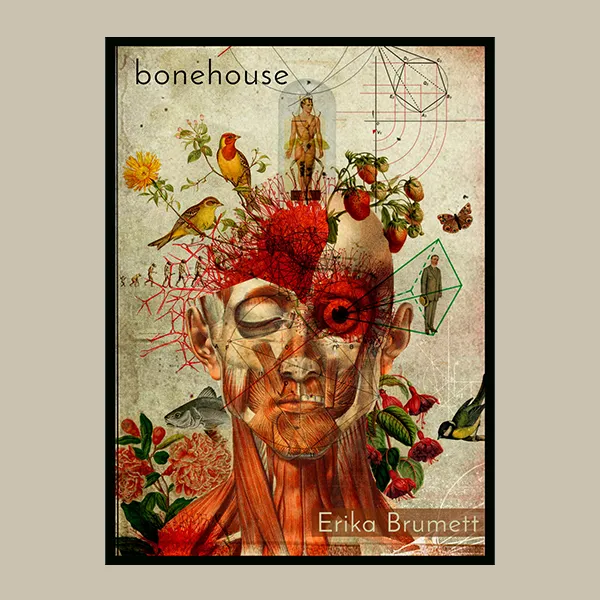
bonehouse
Erika Brumett
—
An Erotic Crawl Through Erika Brumett’s bonehouse
I hope I am not alone in this assessment–that would be embarrassing wouldn’t it? You need two for aural sex, that is, a voice which is acrobatic and lithe and the body for which this voice will burrow inside. This week, my students read an excerpt from the novella Bloodchild by Octavia Butler, in which insectoids corral a colony of humans to birth their flesh-eating grubs in exchange for a strange kind of love and protection. I have bartered with bugs myself–been tricked and tested by these minor invaders, invested and even enchanted by a roach’s durable behaviors. This intensity of sentiment and aural attention culminates rather remarkably in Erika Brumett’s chapbook bonehouse (2018) from Green Linden Press, a debut that traipses through anatomy, history, and personal mythologies to speak of pleasure, an experience that woos even the most minute of species (re: see worms, rodents, and bees).
Brumett’s debut chapbook demonstrates a deep devotion to aurality–her poems are erotic bursts of sound, pleasing aloud as they are written down. “Cunnilingus” (also quite wonderful off the page) showcases such an aptitude for sibilance and rhyme; one need not tread far into the poem to encounter it: “The word sounds like a low-hung cloud, / weighed down below scuds of cirrus. / Yet, its vowels lift–softer, loftier, / than cumulus. Cunnilingus.” Brumett’s meditation populates the etymology of the latinate term, visually situating it as a continuum between heavenly bodies and earthly experience. Such a slow and tender approach begins to emanate the very act that it seeks to discuss as well. The raucous plosives paired with the liquid nature of letters such as l asks the mouth of a reader to perform pleasurable movements, as if we are licking the cunni of the poem itself: “Cunnilingus opens one mouth–splits /it slick–so as to open another.”
It would be an understatement to say that the opening poem, “Worms” is anything other than remarkable as well. It received RHINO’s 2018 Founders’ Prize for what I can surmise, a lengthy catalogue of reasons. What I am most drawn to is the reverence with which Brumett approaches these “little tillers. Ploughs of night- / writhe and gizzard.” She reminds us that all life, no matter the size, is worthy of speculation. Her attention to assonance too is what much of contemporary poetry lacks nowadays, favoring this impulse to tell (too much, at times) over crafting a sensuous experience. “Worms” is evidence that writers need not sacrifice aurality for coherency, need not give up mystery in hopes that clarity might better its chances with potential readers. Instead, through her use of sound devices, Brumett fashions not a narrative of linearity, but one of pastiche and emotion which better captures lived experience. Coupling her observations with Charles Darwin’s, we witness an inversion of hierarchy where “intelligent, unsung / creatures” outlast mankind through their appetites that are “alive with decay,” and who, much like humans, experience pleasure when exposed to music. Brumett’s work fulfills what any good poetry collection should set out to do: collapse binaries, transform perspective, and captivate not one, but every single sense.
I am grateful to Brumett for reminding me of a poem’s stellar trajectories through sonic play. It astounds me; the lack of discussion around this book when it was such a startling and deftly constructed debut. Her poems visit the office of a phrenologist, the bottom of a lake, the paintings of an elephant, and the inside of an appendix, expanding the limits of what a place poem might convey and name. I am more than eager to meet the demands of a voice that speaks to a reader with a blunt kind of tenderness: “Love. Numb as you’ve been–rise.” If my review accomplishes anything, I pray it turns heads toward this immaculate collection and like dutiful grubs, we burrow deep, seeking only to consume and be changed. Brilliant and speculative–we can only hope there is another installment in the poetry of Erika Brumett.

Review by
Kale Hensley
04.13.26
Kale Hensley is a poet, essayist, and scholar whose work bridges feminist poetics, mysticism, and literary history. Her writing has appeared in Booth, Image, Evergreen Review, Gulf Coast, and elsewhere, with multiple Pushcart and Best of the Net nominations.
Currently based in Texas, she is at work on her second collection of poetry that explores the avant-stupid and the glittering horrors of puberty.
© Bear Review 2025
ALL RIGHTS RESERVED
Site Design + Build
October Associates
