
Albert Abonado
—
Diorama
The smell was the last thing to recede
from my father after he brought his boot
down and crushed the skull
of a skunk latched to the tail feathers
of a duck. This is not how I know
him, creeping softly, weightless
before he raised his foot in violence
as he passed through a wet garden,
through a night filled with teeth before he scooped
up the corpse and tossed it into the trash.
My mother complained about the cloud that clung
to him for weeks. There are remedies
that return the skin to its sweetness:
tomato sauce, apple cider vinegar, prayer.
In a field of blueberries, the hoverflies come
for the salt of my mother’s skin.
I came because my father sent me
to find her, worried what the heat can do
after a year of collisions and surgery—
her bucket half-filled with blueberries,
we sat and listened to the sermons
of her favorite Catholic priest play
on her phone when she asked me
about the children I would not have.
I inhaled, then, their skin, the clover they hid
in the folds of their shirts, felt the heat of fingers smaller
than wasps. They trace
the scar at the back of my thumb
with their soft fingernails and ask
for a story. I change the subject, tell them
about the wasp that stung me on the lips
when I passed through the wrong
door, a hum that accelerated towards my mouth.
What did I do next? I looked for the direction
of this desire, found a paper house
that hovered above me, waiting to fall.
Remedy
Either my father makes the sign of the cross on my wrist with ginger or with garlic. One
of these cures fever. One of these is not Catholic. I can’t decide. I close
my eyes. I taste the garlic again, the ginger, the heat of my father’s fingers
in my mouth. I picture him holding my wrist—And in his other hand?
Not garlic this time, but his tooth. Where does a father
keep all the teeth he loses? He leaves this one in my pocket. I press
the tooth into my chest, make it into a new heart. None of this
is true. I start over. This time with ginger. This time I am in bed. I can see
the squirrel by the window with the bread it retrieved
from our trash. I call to the squirrel, but remind
myself this part is also a lie I use to find my father: the squirrel,
the bed, my angry forehead when my father enters
the room and presses the back of his hand against it.
I tell him slow down. I want to smell the soil under his fingernails. I can’t see
my father’s face when he prays. That too is eroding. I replace his face
with more hair, with chicken feed and leather, with salt water
and goat eye. He holds my hand this time with my palms faced
up as if I am about to catch rain. He squeezes
around the wrist. It hurts until I remind myself
there are no nerves in my memories. I must have seen
him do something like this before. Not the bedroom
but the kitchen, maybe, or the backyard with its crabapples
and sparrows, with the bitter melons climbing
into our neighbor’s yard. I need to start again
and admit this is all wrong:
My father, the ginger, the smell
of vinegar. No, in the beginning, my father was a root
I extracted and carved over and over until I recognized his face.
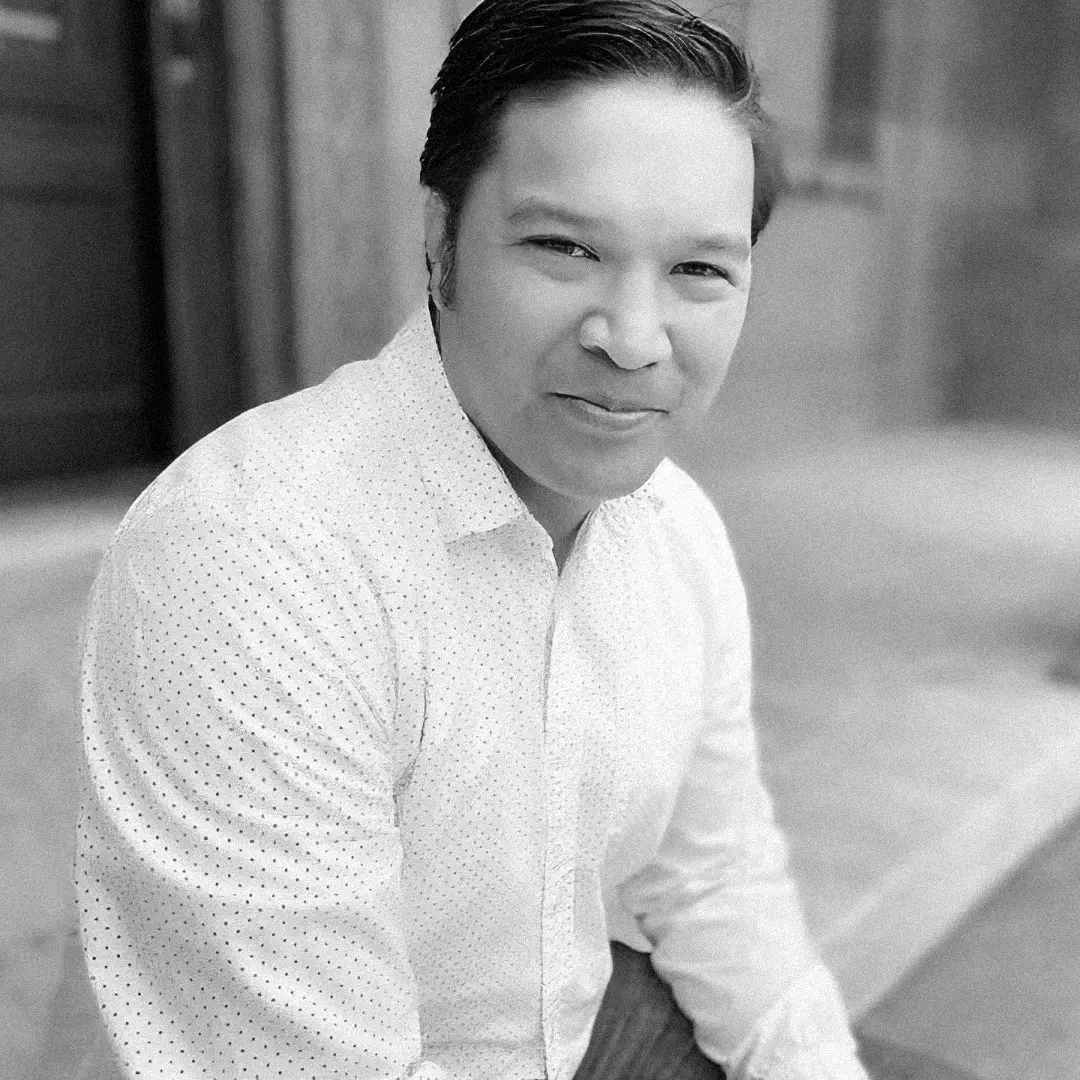
Albert Abonado is the author of the poetry collection JAW (Sundress Publications). He has received fellowships from the New York Foundation for the Arts and the National Endowment for the Arts. Albert teaches creative writing at SUNY Geneseo and RIT. His writing has appeared or is forthcoming in The Colorado Review, West Branch, Poetry Northwest, Zone 3, and others. He lives in Rochester, NY with his wife.
© Bear Review 2025
ALL RIGHTS RESERVED
Site Design + Build
October Associates
