Bear
Reviews
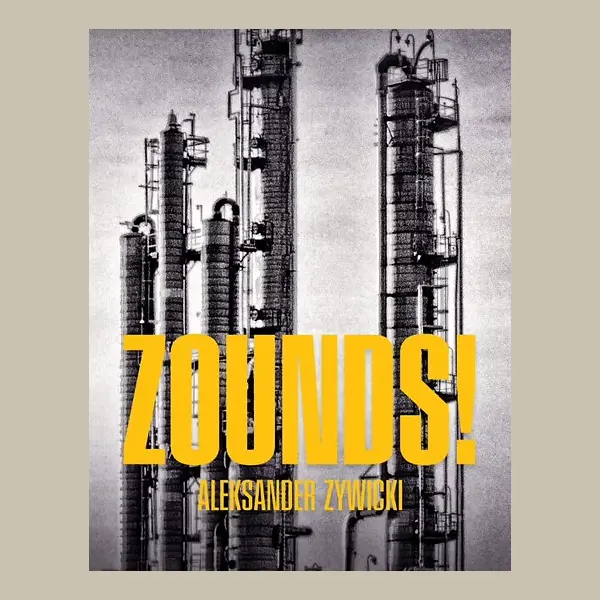
ZOUNDS!
Aleksander Zywicki
—
The Poetics of Doubt and Faith
“I grew up, and I don’t say this lightly, obscenely Catholic.”
—Aleksander Zywicki
Aleksander Zywicki’s ZOUNDS! is a stunningly startling, irreverently reverent, testament of the poet’s “hyper-personal” relationships with doubt and faith. Zywicki brings us into an intimate and emotional linguistic landscape, exposing and redefining the power of enjambment and metaphor’s capacity to disassemble, then reassemble, meaning.
Upon reading and rereading ZOUNDS!, I realized I had more questions than answers. As a result, what follows is an interview/conversation I was fortunate to have with Zywicki. I have taken editorial liberties for clarity. It is a humble understatement to say that I could have imbibed in hours of conversation with Aleks, his generosity, mind, and heart.
To begin our conversation, I asked Aleks if he would read one or two of his poems from ZOUNDS!. I hoped to feel his voice and poems in the air, to provide the groundwork for our conversation. Below are excerpts of the two poems he chose:
the sign of the cross
in the name of the forehead
& of the sternum & of the left
& right shoulders respectively
& sometimes improvised
with lips at the end & a pinch
of nothing held to sky
…
dialing God they called it
when they taught me
crossing youself as though
way up upon a tightrope
strung between
the common tongue
& prayer we walk
…
heathen driven to his knees
the first images of Earth seen
from space were humiliating
all our blue in all that black
a perfect bruise pointless
in every way brazen science
seemed then to be saying
now like the many-lidded eyes
of frogs their shutters snap
nebula & galactic clusters auld
& weird as the crystalline sphere
of Dante & the red human heart
thumps not more than a beat
…
LR: Ah! I love these poems. The first, opens ZOUNDS! and seems an unapologetic entry into the beginning of prayer. You boldly begin the collection with deeply personal, somatic imagery. This took me in immediately. And then, “heathen driven to his knees”, also profoundly physical in its depiction of our smallness. And Dante—“weird as the crystalline sphere” and the “red human heart” in the same breath. Thank you. I’m curious, why these two poems?
AZ: They talk about my own experiences with my relationship with my family and my unique relationship with my faith. But I think these two poems, are in particular, more for everybody than they are for me. When I say everybody, I more accurately mean people who, like me in some way, feel a distancing from their spirituality, from their faith, and don't know what to make of that. Perhaps they grew up with religion and had placed their foundational knowledge of the world in it. And so, if terrible things happen, they can respond within themselves by calling on this higher being, this set of principles, this community of church…but if you lose faith, if it's taken from you, and your left with the ruin, this broken cathedral within yourself, then prayer becomes a source of pain.
LR: It’s profound to consider how a sacred act, such as prayer, might transform into a painful act. Your thoughts bring me to my next question, regarding the religious or spiritual background of your childhood. How did it influence your writing of ZOUNDS!?
AZ: I grew up, and I don't say this lightly, obscenely Catholic. My father was the deacon in our parish, and he baptized me. He also gave me my first communion. At that time, he was wheelchair bound, due to profound rheumatoid arthritis.
LR: As you speak of your father’s disability, I’m reminded of your poem “discipline”, its last line,
“cocooned by ruin”.
discipline
hope is that regenerating
liver of Prometheus picked
clean by the scavenging
beak & always at 3 a.m. when
the gorge is most still
& the sound of gnashing
travels to the thresholds
of unseen sleepers
alive now to the dark
arena of small horrors
where they lie warm
cocooned by ruin
AZ: Oh yes. That’s a play on a Dickinson’s poem, “Hope”. Yes, I was speaking of my father. The image that came to mind for me was how he was cocooned in the ruin of his body, and that somehow this ruin felt safe.
LR: I imagine you as a child, witnessing the vessel of your faith, your father, becoming disabled.
How this must have impacted your relationship not only to your father, but your faith. As you were writing into these poems, how did your conflicted relationship with faith inform or fuel your writing?
AZ: Language, and particularly the way language is crafted in poetry, has a way of comforting, perhaps explaining and allowing people to not only observe, but to take on the role of witness. This role feels active, useful and helpful. I think of Carolyn Forché’s work, and that she is, perhaps, the ultimate witness poet. For her, poems are not this thing that happen. They're not this kind of quaint thing about the past or present. Forché makes poetry as useful as journalism, as important and as necessary. In that way, poetry is a secular act. In doing this, she gives agency to people who endure tough times. She shows us that by paying attention, poems can honor those being devastated or marginalized. I found a similar thing to be true in the writing of this book. Some of the poems are hard on my family. But in a backward, kind of perverse way, I mean for this language to honor them.
LR: I feel you do honor them, in speaking to the pain held within your truth. And you bring this to the reader. It’s one of the undercurrents that propels ZOUNDS! forward. Regarding your father, I think about your poem, “the vision”, regarding your brother, “my night alone with the hammer”. Both poems are singularly intimate and devastating in the speaker’s vulnerability.
the vison
my father knew
he was dying knew
the pocky ulcers
that coiled & climbed
his legs would fang
their venom through
the night and that he'd be
devoured shadow bone
& all by morning
…
my night alone with the hammer
in the end
the cables held little
left I could call
you & so with
the hammer I struck
my own face again
& again you are
my brother my face
is your face too
AZ: Though I’d like to reject everything Catholicism put me through, it also has profound value in that it gave me religious ways of taking on the secular experience. Which is another way of saying it taught me how to make meaning. I think it offered a lens. I had a choice to look through that lens, or not. Had I not had that lens, I wouldn’t know of that choice.
LR: And this meaning is translated through this collection?
AZ: Yes, poems, in turn, provide a lens, a way of making choices, that translate into meaning.
LR: Could you say how you use craft to translate thought and language into poems, into meaning? Ok. I’m just going to say it. Your use of line breaks—totally fucked with my brain.
AZ: (laughing) That's the best compliment anyone's ever given me!
LR: It’s true.
AZ: That’s awesome.
LR: I found myself asking when reading ZOUNDS!, what is the true work of the line break? Noting how you push it. You push it to work on multiple levels. Almost as if asking the reader to have faith in the work the poem is doing. Would you talk about enjambment, its properties, and your work of the line?
AZ: As an English teacher, this is my 16th year teaching, no one has ever meant more to me than Shakespeare. And I know that's kind of a cliché, almost laughable, right? The English teacher obsessed with Shakespeare…but he's the one who turned my brain on.
Aleks quotes the following:
Sonnet 116: Let me not to the marriage of true minds
By William Shakespeare
Let me not to the marriage of true minds
Admit impediments; love is not love
Which alters when it alteration finds,
Or bends with the remover to remove.
It all sounds so pleasant when you hear it. But when you read the poem on the page, Shakespeare is doing incredibly contemporary, modern work with his line breaks. The second line ends with "love is not love ". If you're reading as high school students read, which is to stop at the end of every line, you’re forced for a moment to wrestle with the phrase, “love is not love”. In that moment I think something extraordinary happens; you begin to ask questions of the poem, and so, of yourself. Your forced for a moment to wrestle with the phrase “love is not love”. And in that moment, when you start asking questions, you might ask, in what ways do lovers behave that seems unloving? Or how do lovers prove love to be a false concept? And it's just the work of the line break that does that. When I began seriously writing poems, I knew I wanted to do that, work with language in a way that forces people, and myself, to reckon with precise information at precise times. Almost as though I’m controlling the drip of it, so the reader only gets what I’m showing them, not the full picture. I think that is how poetry is different from prose.
LR: Is there a poem you think exemplifies this? As you were talking, I was thinking about “devotion”.
AZ: Yes, “devotion”, definitely.
devotion
some wells
some ordinary wells
exist for you to drag
the moon up in
a bucket even
though you forget
to do it every night
& so the moon
doesn't rise & some
wells all they do
is punish you
with the scraping
sound your moonless
cup makes upon
…
LR: This poem does so much work through its line breaks, which feel both halting and propelling. I sensed it as a mirror of your struggle with doubt, faith, and devotion. Asking, what is devotion? Which brings me to your title, ZOUNDS!. Would you speak to its origin story?
AZ: The word, zounds, originated in a time when people were much more explicitly religious and the fear of committing blasphemy was extraordinary. Yet, there was a need for a word that plays with blasphemy but keeps God's name out of the mouth. It's supposed to be a contraction for God's wounds, managing to avoid saying God’s, and so technically, became a curse word. It first appeared in Marlow's plays and then appeared in Shakespeare's. I found myself paying very, very close attention to when it was being used. It was always spoken at a point of complete absence of control. And in many ways, that’s what I have been feeling. Frustration. So much about our world. The war in Gaza. And even how to find my own voice in the world of poetry. In Hamlet, it's used at the most insane moment of the play. Act 5, Scene 1, when Hamlet, the most controlled character in all of Shakespeare, discovers Ophelia is dead, and committed suicide. And he blurts out this blasphemy. It's absolutely coming from the depth of his being. It’s like a bark. A primal scream. Everything I'm talking about in this collection of poems is kind of at that point for me. Needing, feeling an urgency, to give shape and meaning to thoughts and feelings that coalesce around my struggles with my faith and my doubt, as well as how to live and be in this world. And my desire that these struggles not only translate into poems but might become an offering for others to enter.
don’t look now
someone is doing with light
what always seems impossible
in paintings throwing beams
but one mainly so that
it seems to call or cradle
the one it touches & no one
else lord let me make it
to the woods before it stops
snowing before they get full
up of people & their dogs
I want to be happy & I am
running out of ideas
Interview by
Lindsay Rockwell
10.22.25
Lindsay Rockwell’s work explores the shared landscape of poetry and the sacred. She’s recently published, or forthcoming in Poetry Northwest, Poet Lore, Tupelo Quarterly, RADAR, SWWIM every day, among others. Her collection, GHOST FIRES, was published by Main Street Rag, April 2023. She is the recipient of the Andrew Glase Poetry Prize and fellowships from Vermont Studio Center and Edith Wharton/The Mount residency.
© Bear Review 2025
ALL RIGHTS RESERVED
Site Design + Build
October Associates
