Bear
Reviews
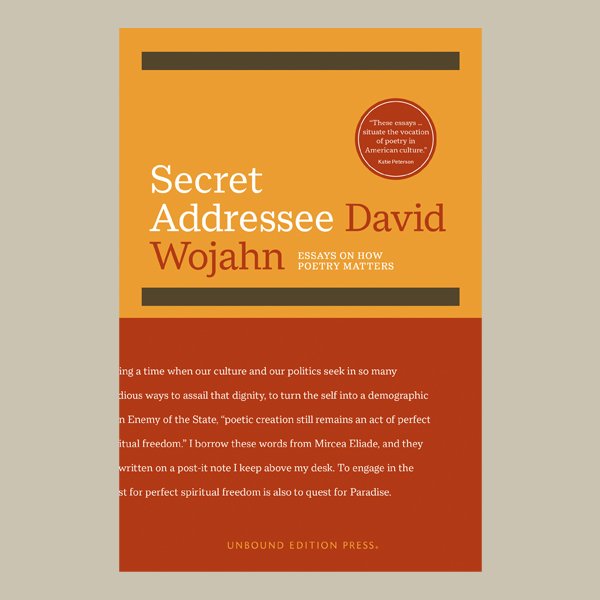
Secret Addressee: Essays On How Poetry Matters
David Wojahn
—
Indelible Transmissions
A new essay collection by David Wojahn is always a gift, as the reader is assured of being guided through an array of poetic topics by a writer whose insights arise from his deep practice of the art. His forthcoming book, Addressee: Essays in How Poetry Matters eloquently fulfills this promise to explore the relationship between poetry and the writers and readers for whom it matters as a vitalizing and life sustaining engagement with language. Threaded throughout these essays are arguments for embracing hands-on forms of making what the author calls the “poetry of reality”, close readings of specific poems that demonstrate the value of sustained attention, and guidelines for teaching poetry as an intimate, evolving correspondence between writers and texts.
Beginning with a chapter about poems as forms of address which are composed with attention and care, destined for readers both near and far, known and unknown, this book ranges expertly and widely over the landscape of contemporary poetry. Many of the essays focus on the act of composing poetry (and reading it) as a tactile process that resists the superficial communication and didactic rhetoric which characterizes our consumerist and political discourse. As Wojahn asserts, difficulty in this context is a poetic virtue, an invitation to encounter and to listen in an increasingly unique way. He writes, “Difficulty as it manifests itself in the poetry of our time is different. . . what is difficult for us is simply the act of reading a text, any text, with sustained attentiveness” (17). And the difficulty he speaks of is not merely heuristic, but also emotional, particularly for a poem that challenges us with “the sheer intensity of its revelations” (27). The revelatory nature of such poems as the author describes them is to emphasize the overlooked, the close at hand, the correspondence intimately received.
Throughout this collection, Wojahn dazzles with his close readings of poems including Robert Hayden's “The Whipping”, “Eleanor Ross Taylor's “Where Someone Died”, and many others. His understanding of poetic image is evident as he quotes the end of Taylor's poem:
“Only some far-off sounds persist.
The brute truck
over the interstate.
The flames in the incinerator
chewing his old vests.”
Wojahn comments,
“Terrifying as these final images may be, they make a stark contrast to the metaphors of oppression, inertia, and delimitation that have characterized previous lines of the poem. The final images are a stunning tour de force —sharply visual, but also kinesthetic, even synesthetic. We both see and hear the flames as they “chew” upon the dead beloved’s vests. And thus the departed is countenanced, brought forth at last as the memory of a living presence — if only for an instant as the flames do their work” (27).
Such perceptive insights occur throughout the book, and instruct the reader how to fully appreciate the craft of poetry. When I was David's student years ago at Indiana University, I was fortunate to hear him speak about the almost miraculous accomplishment of certain poems and it is a pleasure to hear his teaching voice again in these essays. Like the best teachers of poetry writing I've studied with - including Stanley Plumly and Tony Hoagland - David often emphasized the extreme difficulty (that word again) of writing a successful poem. Although what “successful” meant varied, clarity of expression, verbal energy and ingenuity, and a depth of imagination that connected with and moved the reader were essential. The fortunate readers of this book will encounter a master class in portable form.
This leads to another theme that unites these essays, which is the art of teaching poetry, an intimate, mysterious process of transmission that balances encouragement, challenge, and modeling. In the outstanding chapter, “At That Urge For More Life: Adventures in Lo-Rez”, the author asks, “. . . how does a teacher gently guide students away from the superficialities of literary fads, teach them the rudiments of poetic technique, and ways to discern writing that will last as opposed to writing that will be relegated to a footnote in literary history? . . . how does one develop that consummate diplomatic skill of balancing encouragement and frank critique?” (174). These perennial pedagogical koans are framed by Wojahn's years of teaching in low residency programs where an intimate correspondence occurs between teachers and students, one that eschews superficial forms of communication for epistolary substance. Describing the (typically) seven page single spaced missives he sends his low residency program students, Wojahn says, “. . . each of my five students during a typical semester receives about 35 pages of my counsel. . . And each letter generally contains an additional several (or more) pages of handwritten margin notes on student poems and critical writing. . . And let me emphasize that these communications are letters — not emails, not texts, not tweets" (180-81). The volume of these exchanges inspires and astounds, as does the nature of their composition. In his essay, “Something of the Sort: Full-bodied, paper-original, non-expedient correspondence”, Stanley Plumly writes that the advent of email "changed the nature of reflective time", and in doing so, writing style itself, as "email has little tolerance for complexity and/or ambiguity, texture, and/or sustained labor - certainly not in personal exchange.” These are the very qualities: complexity, texture, sustained labor, that characterize the transformative exchanges Wojahn celebrates, exchanges that could occur in no other medium.
Another example of the usefulness of handwriting as a means of supporting the practice of poetry by fostering a certain quality of attention and observation is described in the chapter, “Excursion to the Town Dump: Poets and Their Notebooks.” Wojahn cleverly contrasts a striking passage from Gerard Manley Hopkins's notebook with a tweet from Sarah Palin to illustrate how the linguistic compression facilitated by technology sacrifices depth of thought and expression. As he writes,
“I want us to praise the notebook—both in and of itself and for what it tells us about the workings of a poet’s mind, and for how it helps us to chart the process of inspiration, turning to what in time becomes a finished poem. I seek to make this offering before the handwritten notebook becomes yet another “dead format,” and before the kind of discourse, inclusiveness and attentiveness which it can represent disappears entirely from our consciousness” (143).
The emphasis on process that notebooks document pushes against the disappearance of “the poetry of the real” which Wojahn laments earlier in the book, as it illustrates how the imagination reproduces itself through language both incidental and chosen. In contrast to “the hyperreal”, a term borrowed from Baudrillard to connote a realm in which distinctions between imagination and reality are irrelevant, the poet's notebook is a repository of just such delineations, a generative, ongoing conversation between world and word.
In the final chapter of David Wojahn's Addressee: Essays on How Poetry Matters the author steps forward to reveal in compelling and vulnerable terms how poetry can help us to endure amidst the radical uncertainty of our time. He writes, “Poetry may not save your life, but it surely can enable you to understand how the wondrous and the sorrowful must inevitably commingle” (272). Citing examples as various as Miklos Radnoti's “Forced March” and Thomas Hardy's “During Wind and Rain”, the author details how poems can console by articulating myriad forms of human endurance. I will not give away how Wojahn speaks about his own poetic sources of consolation, how this essay builds to a crescendo of empathy and emotional intensity that I wish readers to experience for themselves. As in the best literature, when you finish the book the ending crystallizes all that has come before into an emphatic, lingering whole.
In this brief review, I cannot touch upon all the various strands of this dynamic essay collection. Instead, I have been tracing my own lines of interest; another reader may easily find her own, for example, the author's moving essay about poetry and parenthood. And though I've forfeited any claim of objectivity - no writer's work and teaching has meant more to me - I was delighted to again be amazed and instructed by Wojahn's insights, and perhaps more importantly, to be inspired and challenged to participate in a vital art form whose ability to sustain and imagine may be our best form of collective solace.

Review by Brandon Dean Lamson
10.08.25
Brandon Dean Lamson the author of the memoir Caged: A Teacher's Journey Through Rikers, or How I Beheaded the Minotaur (Fordham University Press, 2023) as well as two poetry books: Starship Tahiti (University of Massachusetts Press, 2013), winner of the Juniper Prize for Poetry, and Houston Gothic (LaMunde Press, 2009). A broadside of his poem "Child's Pose" was published this spring by Ashland Poetry Press, and his recent poems have appeared in Bear Review, Poetry Northwest, and Prairie Schooner. Currently, he teaches literature and creative writing at the University of Texas at Austin and is an ordained priest in the Soto Zen lineage.
© Bear Review 2025
ALL RIGHTS RESERVED
Site Design + Build
October Associates
