Current
Issue
Fall 2026 / Volume 13.1


Claressinka Anderson speaks to artist iris yirei hu.
C: Are you familiar with Maggie Nelson’s Bluets, her obsessive, fragmented love letter to the color blue? In it she writes: “Admit that you have stood in front of a little pile of powdered ultramarine pigment in a glass cup at a museum and felt a stinging desire. But to do what? Liberate it? Purchase it? Ingest it?...You might want to dilute it and swim in it, you might want to rouge your nipples with it, you might want to paint a virgin’s robe with it. But still you wouldn’t be accessing the blue of it. Not exactly.” And what is “the blue of it?” For me, blue and blueness are beauty and grief—they are luminous, yearning—sky and sea, heat and ice. I confess I also have a thing for blue. It’s what first drew me to your work! I’m curious about your relationship to the color, and what it means to you.
i: I am familiar with Bluets, although it’s been a while. It was originally recommended to me by my late best friend and collaborator, the writer emi kuriyama, who was a student of Maggie Nelson in the mid-2010s. emi’s passing was life-shattering for me, and ultimately brought me to explore and understand the depths of subterranean waters that have impacted my creative path. Grappling with such an unexpected and sudden loss in my mid-twenties was a divisive, and at times, tremendously alienating experience—I went inside myself. The ground shifted, and I had to find my own path amidst the chaos, noise, and saturation of the aftermath. I am forever changed by death.
As a child, I had a peculiar proclivity towards things we couldn’t see, past lives and afterlives, occult practices, and energetics. My mom saw my curiosities as legitimate knowledge systems worth exploring, and encouraged me to do so. Just at dinner the other night, I told her that I’d like to finesse my intuitive abilities by working with someone who can really guide me, and her response was so astute. She told me to look into my dreams, that there, through my unconscious, I might find a teacher or a direction.
Recently, a close friend connected me with a friend of hers who is a minister, because she described us as “death-literate.” I had never felt more understood from two words strung together! I have become familiar with death, loss, and disappointment in the same way that I have learned to become present, awake, and attuned to how I feel in any single moment. I believe my karmic work in this life is to hone and practice presence in all aspects of my life. At times, I think my artwork is the byproduct of my spiritual assignment. It is freedom. It is alive. It is luminous. It is the expression of my life journey.
So, “the blue of it” is all of the above. Blue is the color of being. It is the color of grief, dreams, and the unknowable mystery of being alive in the here and now. But Nelson also seems to be getting at the materiality of blue, its “body,” if you will, all while grasping for nebulous meanings from its sensory or spiritual capacities. I am reminded of Michael Taussig’s book What Color is the Sacred? in which he interrogates the West’s fear of color—a “polymorphous magical substance,” he calls it, and fear of the so-called “primitive,” through colonial violence.
C: How does blue get to have such profound sensory and spiritual effects considering its often violent and nefarious underpinnings?
i: Taussig writes precisely about the friction of color that I think Nelson is speaking to. In his view, the spiritual effects of color and its violent, colonial history are materially inseparable. The same substance that moves us also haunts us in its tether to fear, extraction, and domination. I am interested in this friction too, and have explored it in my essay, Grand Blue Mother, which is about working with indigo dye, “the blues,” never finding resolve, and the intimacy and longing that come from the position of truly never knowing. In that never knowing, creating becomes the clearest path forward. I talk about my Miao heritage, an Indigenous minority from China who are closely related to the Hmong, both for whom indigo is sacred. Indigo is a color that has connected the world, for better or for worse, and I am drawn to its ability to generate connections across geographies and cultures. In indigo fermentation and dyeing, the blue color is only achieved by exposing the substance to oxygen. From its green submersion, it necessitates air to bleed blue, and in time, slowly fades in the presence of the sun. Blue is relational, and its material is where it transcends the biographical for me—into a fugitive, worldly, and ambivalent undertaking.
C: I love thinking about a color in terms of its relationality and the inherent friction that comes from that—how every color is another color at its root, has an embedded need for other colors and substances in order to exist. And of course, how one color can erase another. In your essay you describe the indigo dye vat as a type of ancestral underworld containing myriad stories and lifetimes you will never know, including portals into nefarious histories. I would imagine that the application of this dye as a base to your paintings is deeply considered. Their ground becomes all we have discussed so far, rich in symbolism and meaning; a magical, blue soup. Your work is deeply rooted in this sense of connection—to plants, animals, humans, and energy. How do you decide what covers that ground? Covering is only one aspect, of course, a physical reality born through the act of painting. Many elements in your paintings feel inherent to the ground instead of covering it, they are interwoven like a network of stars in a galaxy or beyond that, like portals to places beyond it.
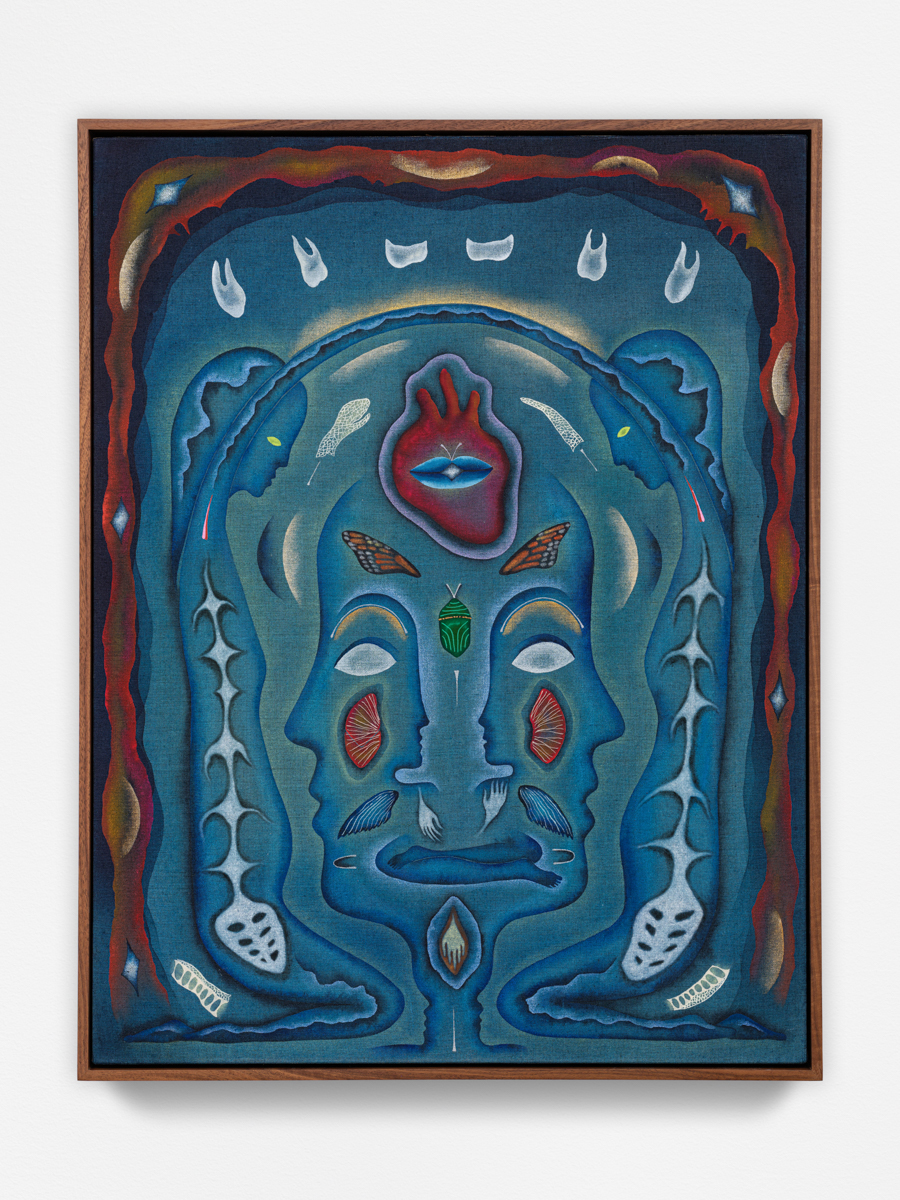
Chalice (2026) by iris yirei hu in Unconscious Relics for Official Welcome, Los Angeles, Oct 24-Dec 19, 2026. Courtesy of the artist and Official Welcome, Los Angeles. Photo: Evan Bedford
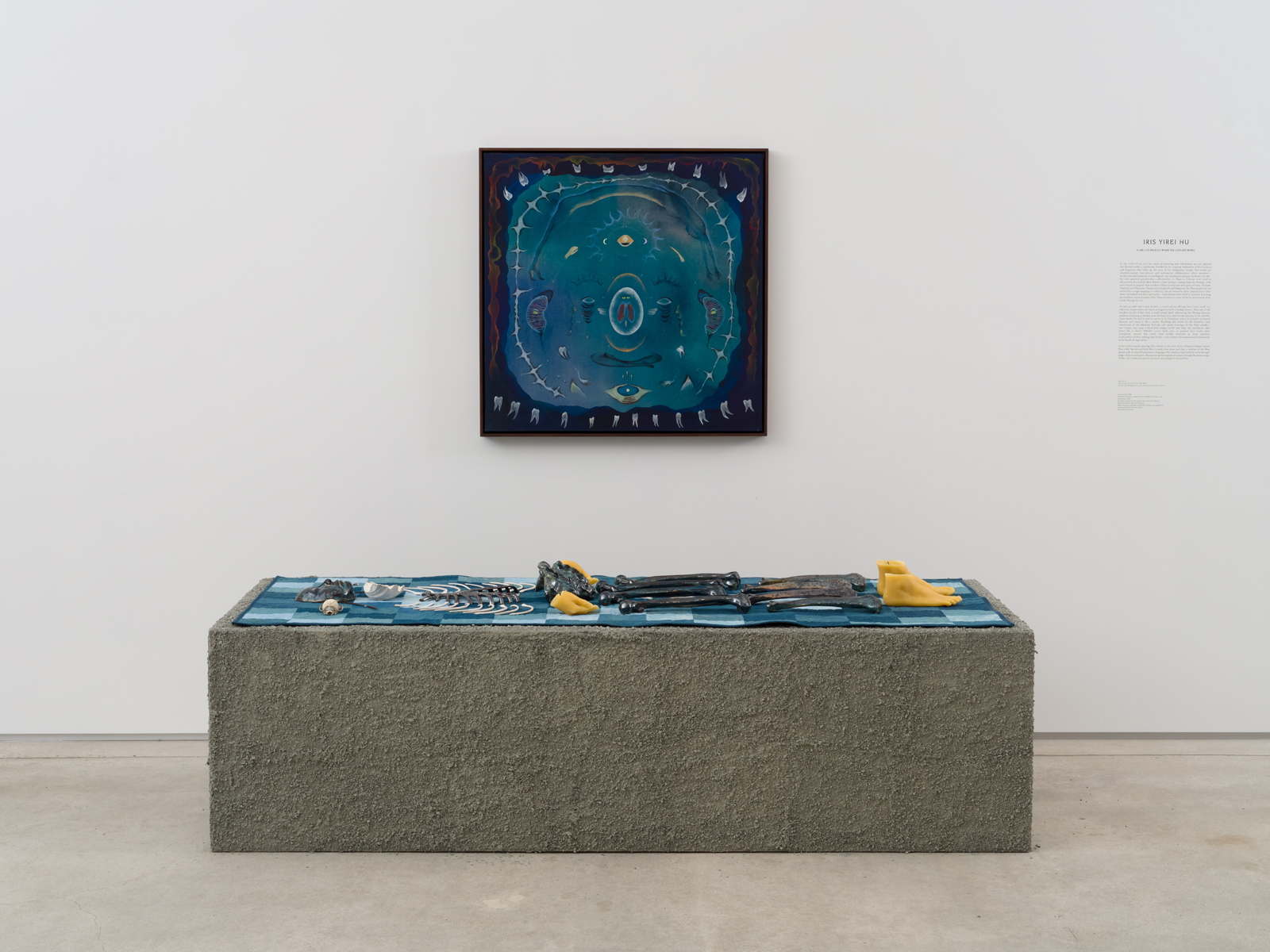
1. Installation view of The invocation of the spirit blue child (2026) and Corpus mundi (2026)
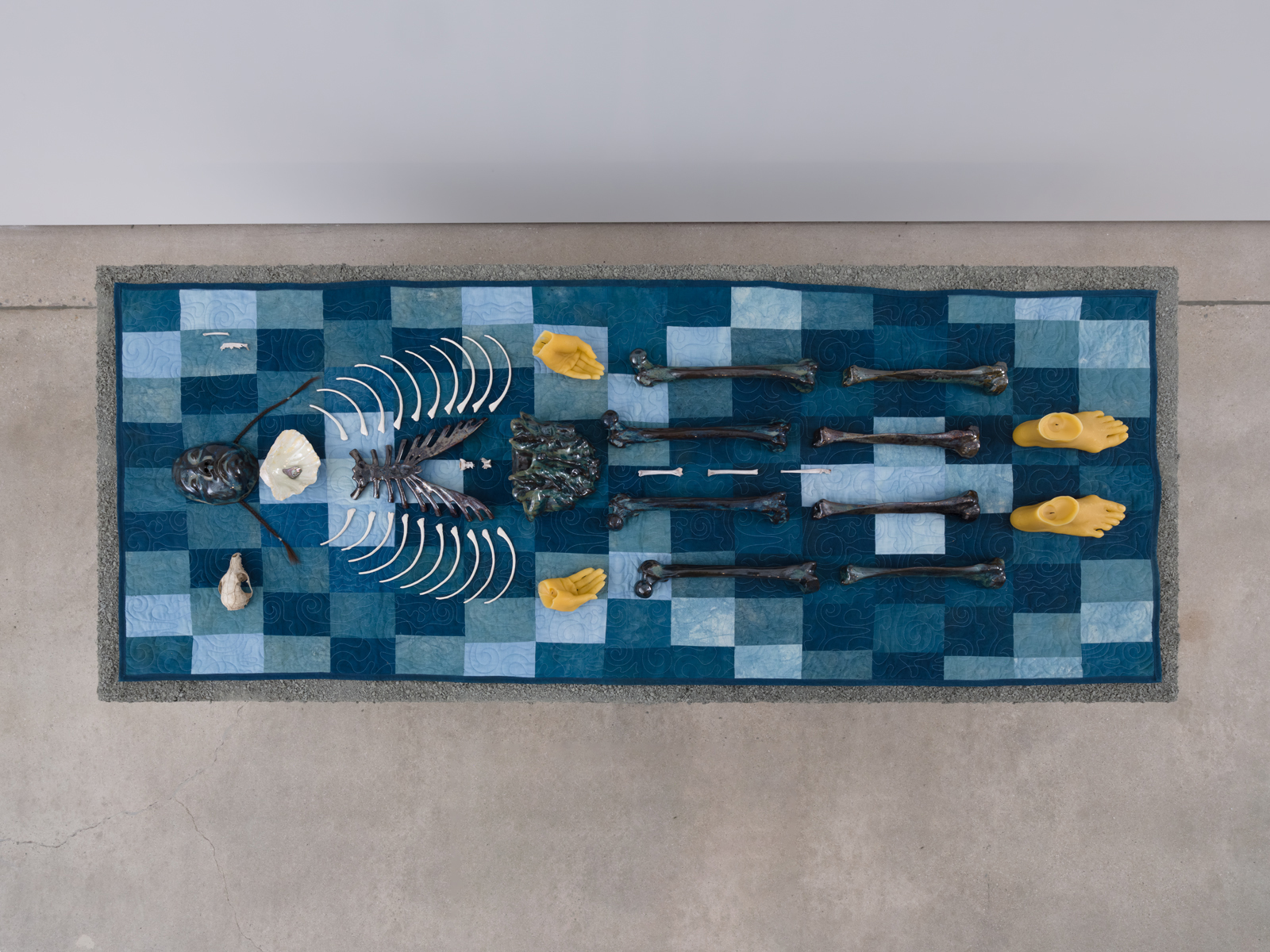
2. Installation view of Corpus mundi (2026) by iris yirei hu
From Speaking in Tongues, organized by ICA LA Senior Curator Amanda Sroka with Curatorial Associate Emilia Shaffer-Del Valle for the Institute of Contemporary Art, Los Angeles, April 4-August 23, 2026. Photo courtesy Jeff McLane/ICA LA.
i: Yes, I consider the “why” of certain material choices when I make sculpture and installation work. In painting, sometimes those choices become less obvious or even less considered because painting can function more as an illusory space rather than a tangible or conceptual one, though of course it is both. Just to differentiate, the paintings in my current show at Official Welcome are not dyed with indigo, but rather they are washed with ink. However, the origin story of working with blue begins with indigo dye. In my years of making, I have learned to be more selective about when I dye my substrates because it is a physically taxing endeavor.
I appreciate your distinction between what covers something and what is inherent to it. Covering feels to me like a vertical relationship with space, and inherent feels like it just is, or maybe rising from the ground or attuning to what’s around us. I think covering also implies erasure, replacement, and compartmentalization. In my current work I want to acknowledge the discomfort, the dark, and the uncertain, along with the beauty and marvel of delightful things, which feels like an inherently truthful way to live. I want to speak to the experience of being through porosity, which is both a material and conceptual feature. I aspire to navigate the dark, optimistically.
In my early work I operated on the principle that anything could be covered, or painted over. My paintings then were quite colorful, flat, and saturated. I would say that they were highly vibrational. Because I’m now working with more fluid, atmospheric, and translucent qualities, once I paint something on the substrate, it can’t be undone—it’s alive and present. I work in a call and response sort of way, so that things emerge on their own time. Plants, organs, wings, and fins are suspended in space, and so are light and shadow. Painting this way requires me to be intentional and decisive. If my work had a sound, it would sit somewhere between a low sustained hum and the sound of breathing.
C: Of course, now I have to ask if you experience synesthesia or see your work through a synesthetic lens! I’ve always been fascinated by the interconnection between language—which at its root is a series of visual symbols—and sound. Does the sound you hear in your paintings come from blue, another color, or something else?
i: I’m fascinated by language and sound too! But I didn’t mean to imply that I have synesthesia. What I had meant to suggest is that the work feels like it comes from a place of literal depth, like a cave, a tomb, an underground city, or something subterranean. In my experience visiting those places, it is often cold, and if it is quiet, I hear the sounds I’d hear if I put a conch to my ear—an ambient presence. I also don’t work with any music or audio in the studio, so the only sounds I hear are the sounds of the city, like traffic and sirens. So to answer your question, sound feels relational here, inherent to the cavity marked by the blue that is already resonant.
In terms of language and visual symbols, I’m reminded that in Miao and Hmong cultures, our art, symbols, and motifs were often worn; they are visual information that doubled as resistance. Throughout history, our peoples were silenced and our languages deliberately suppressed, as is the case with many groups of people across the world. So we turned towards inscribing our language in colorfully embroidered motifs and symbols as a way of communicating, remembering, and enduring. Silence forced us towards inventing ways of preservation and expression through art. While I’m not embroidering textiles or drawing from any specific symbols and motifs, I see my work in parallel with that cultural practice. I am inventing a highly specific iconography that exists across the visual world that I’m building.
C: I’m very interested in the iconography you’re building. In your paintings there are always symbols containing other symbols—animals, plants, and body parts within organs, faces within faces. There is also a rorschach-like mirroring effect happening across the entire canvas, a sense of constant unfolding where one thing opens to another, holds it, or is held by it. All these elements seem to function together as a type of communal body. I love both the visual and conceptual translucency of this gesture. It plays into ideas of intersubjectivity and the layered, palimpsest of the “body” on the canvas.
i: I appreciate your understanding of my paintings as a “communal body” because that is how I understand living relationally and collectively. The iconography has a porous, unfixed, and transformational quality. I’m glad you see the mirroring too; the faces look side to side, up and down, and at you. I like to think about some of them as confrontational—a face with eyes that witnesses. The paintings are vessels for spirit, the body, and reflection, and are meant to hold, not only depict holding.
Chimera (2026) by iris yirei hu in No Place for Silverlens, New York, August 6-August 29, 2026. Photo courtesy of the artist.
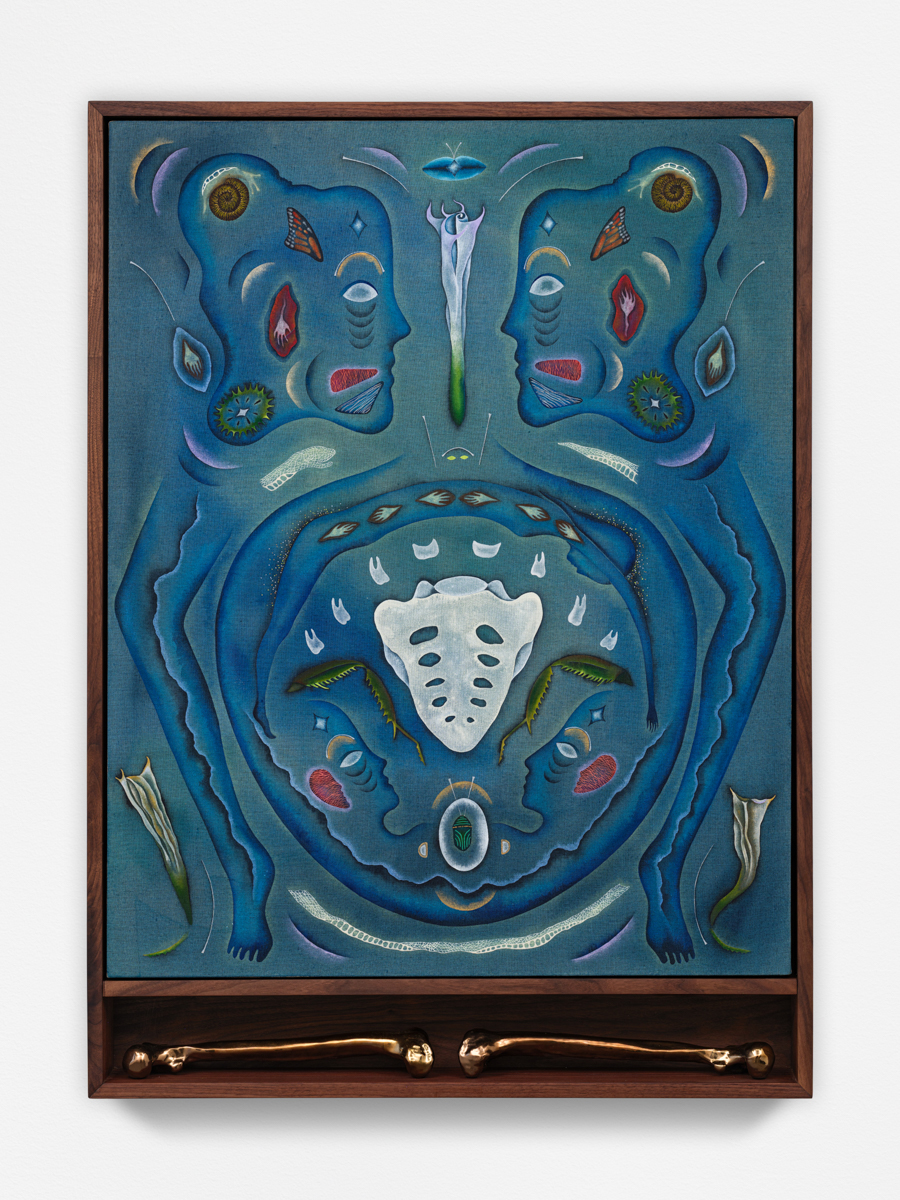
Ossuary (Death Valley) (2026) by iris yirei hu in Unconscious Relics for Official Welcome, Los Angeles, Oct 24-Dec 19, 2026. Courtesy of the artist and Official Welcome, Los Angeles. Photo: Evan Bedford
Generally, the symbols in my work are not meant to be decoded or solved. They are best understood as excavated relics of a body—human, insect, plant and celestial bodies—or of the dreaming mind. I am frequently asked “what do teeth mean or what do snails mean,” for example. I have found myself both uninterested and unable to answer questions that ask for a fixed answer. I find that meaning shifts and changes in relation to a set of symbols that are repeated and rearranged throughout. Their meanings are revealed to the viewer the more one sits with it. I welcome the viewer’s own experience to make meaning from the work.
There are a few exceptions to that rule, of course. For instance, the datura bears specific personal, ecological, and cultural meaning. They grow on the side of freeways, pop up on roadsides or construction paths. They are ordinary, and simultaneously so magical, potent, and poisonous. They walk a fine line between beauty and death. My depiction of California native plants throughout my oeuvre comes from my work with the late Tongva elder Julia Bogany. In the context of my show, the datura is a symbolic relic of our generative relationship, and it also evokes a liminal space, the night, toxicity, and seduction.
C: Tell me more about your upcoming show. I’m also interested in your work with Julia Bogany, how did you become connected with her?
i: My show at Official Welcome is called Unconscious Relics. I think about this body of work as an excavation. What can be uncovered from the ground, the portal, or the unconscious? The exhibition explores the threshold between dreaming and death. I conceived of the exhibition as a tomb, and the paintings and ceramics are artifacts one would uncover from it, like funerary or viscera vessels, scrying objects, and reliquaries. The artifact or “object-ness” of the paintings are hinted in some of their titles, like Chalice or Ossuary (Death Valley), and others are titled Psychopomp and Afterlife, which speak to concepts one would encounter in a tomb. Together, the paintings are informed by the visual language of tomb painting traditions: bilateral symmetry, figures in profile, flat spaces where objects float without depth or perspective. They form a hermetic system that evokes a particular cultural history of a subterranean underworld, inspired by several years of research and site-visits to caverns, caves, rock art sites, ruins, and necropolises. The exhibition is meant to be monastic and internal, and a reflection of ritual, devotion, and love.
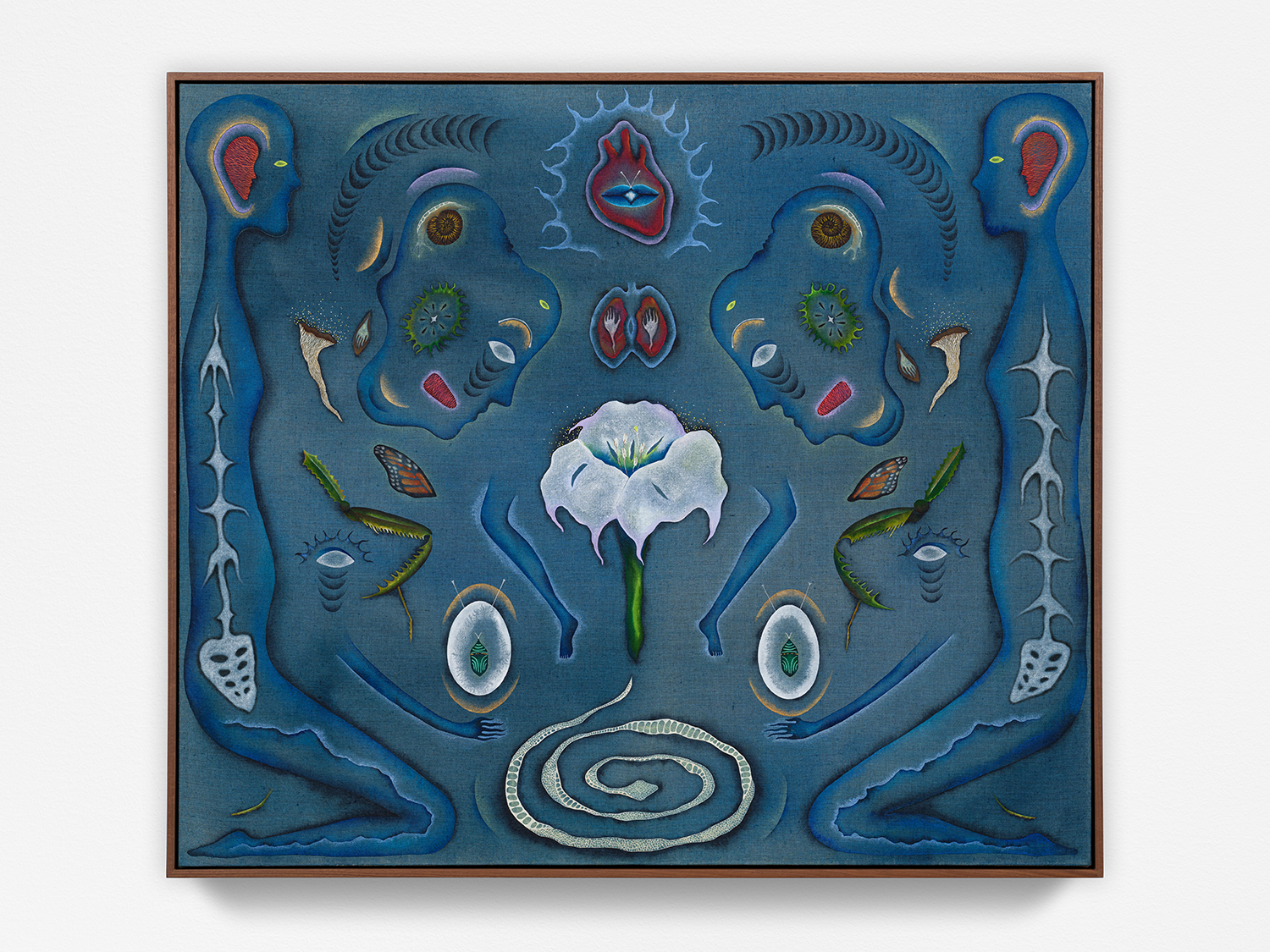
Afterlife (2026) by iris yirei hu in Unconscious Relics for Official Welcome, Los Angeles, Oct 24-Dec 19, 2026. Courtesy of the artist and Official Welcome, Los Angeles. Photo: Evan Bedford
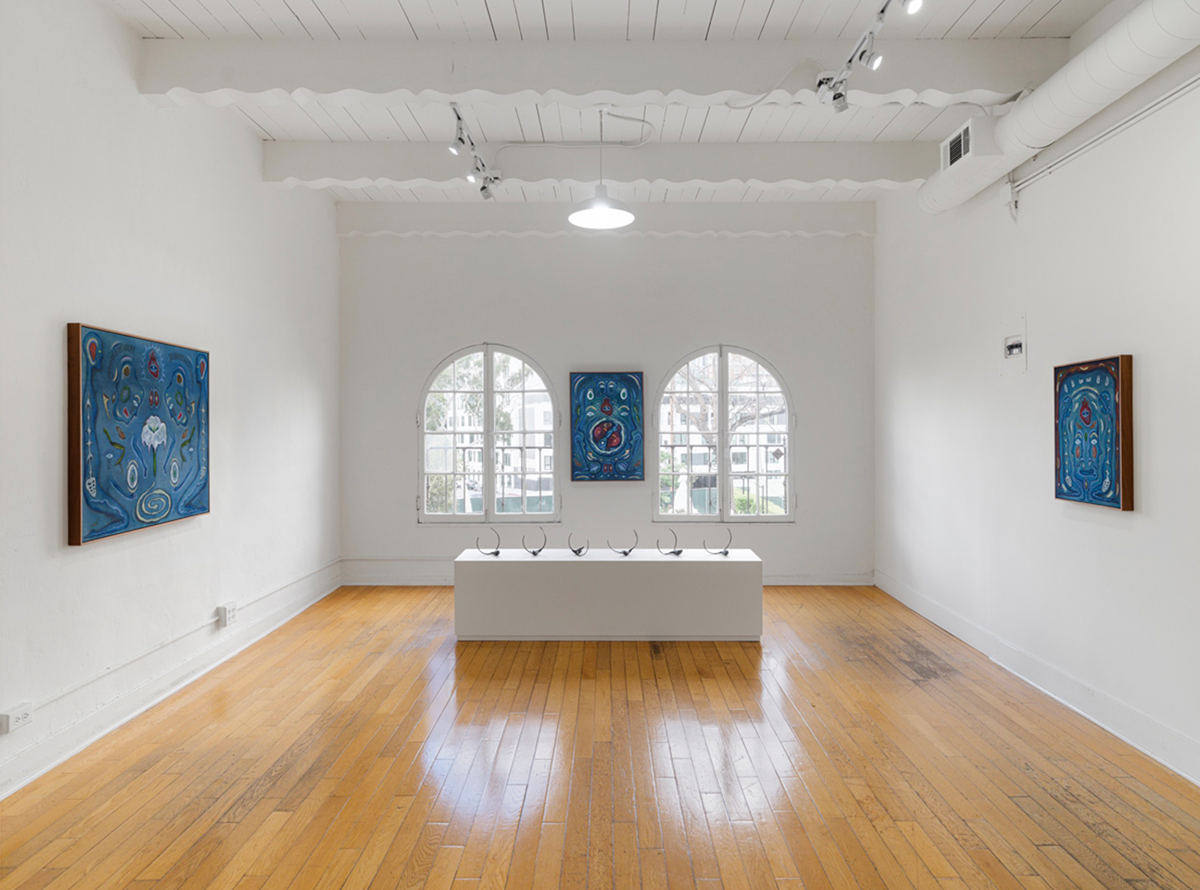
Installation view of Afterlife (2026), Psychopomp (2026), Cornu (Devil’s Claw) (2025), and Chalice (2026) in Unconscious Relics for Official Welcome, Los Angeles, Oct 24-Dec 19, 2026. Courtesy of the artist and Official Welcome, Los Angeles. Photo: Evan Bedford
Thank you for asking about Julia. Julia Bogany was a member of the Gabrieleno San Gabriel Band of Mission Indians and a beloved cultural ambassador, educator, activist, and advocate for her Tongva people. The Tongva are one of several indigenous peoples of the Los Angeles basin. Julia and I worked in both creative and classroom capacities, and collaborated on public artwork for several years until her passing.
After graduate school in New York, I moved back home and grew interested in the histories of Los Angeles. I was also looking for a more sincere way of making art and making friends, to be real. Oftentimes, when I speak to people who are not from Los Angeles, they assume that it's a plastic, superficial place. That’s likely a sliver of the experience here, and I would argue that any place that’s driven by a visible, recognized network of power—art, Hollywood, publishing, etc.—can feel that way no matter where you are. Surprisingly to me, what’s often left out of the narrative is truly how diverse and community-forward Los Angeles really is. Everybody is a little bit of something else, if even only by the variety of cuisines in any given strip mall.
C: I wholeheartedly agree with this. I think it’s honestly what has kept me in Los Angeles for so long. The vast geography and traffic headaches can be divisive, but in some ways it causes people to try even harder to create a sense of togetherness.
i: Circling back to your question about the ground, I grew interested in the idea of Los Angeles as a palimpsest. While that is an accepted understanding of Los Angeles, I found that the more decolonial perspective and critique to that idea is the very fact that the land itself resists that colonial framework. Hardy native plants are still here, popping up on construction paths when the soil is turned. This led me to Julia, who I met at the San Gabriel Mission, a site of forced labor and enslavement of the Tongva people by the Spanish missionaries. It remains a functioning church, and also a relic from another time. How do you remediate this history as a living descendant of unjustified colonial fracture? Julia’s mission was to make Tongva people, particularly women, visible, and she worked in all capacities to do so—civic, cultural, educational, creative, interpersonal. She modeled a human-centered, all-hands-on-deck organizing approach, which was completely oppositional to the carceral, vindictive logic of cancel-culture that was prevalent at the time.
Julia welcomed everybody, as imperfect as they were, to her work. She required the ability to be fully present and to have an open mind, and simultaneously, she was incredibly discerning and astute. Her devotion and commitment to her work inspired me; it was earnest, political, and spiritual. Lessons from Wise Woman (Tongva Elder Julia Bogany), Grandmother Oak Tree, and Hands was the first installation we collaborated on that later found another life as a 47 ft.-tall mural at the student housing complex at Cal State Dominguez Hills.
C: I understand you are also making a mural for the LA Metro Westwood/UCLA D Line extension which is very exciting!
i: Yes, a month or so after Julia’s passing in 2021, LA Metro approached me to propose a site-specific design in glass mosaic for the future Westwood/UCLA D Line station. In my grief, I proposed a work that called attention to the native flora, fauna, and wildlife of Southern California, along with their seasonal shifts and the cycles of life and death. The artwork features a symbolic union between Tongva elder Julia Bogany and emi kuriyama, who I mentioned earlier, and celebrates their kindred legacies, while reminding us of our collective responsibilities to the earth and to each other. I see the Metro commission as my love letter to Los Angeles. It is still in progress, and upon completion, will have been a six year project. Consisting of three panels, the work will be 16 ft tall by 160 ft wide and will become the largest work in Metro’s transit system. And, lastly, it will be underground! A true subterranean experience.
C: Incredible! I can’t wait to see it. It sounds like the physical embodiment of all you’ve described in terms of the communal considerations of and inspirations for your work. And what place is more fitting than the Metro—a system of transit Los Angeles so desperately needs to expand and inspire people to use. Thank you, iris, for this wonderful interview. It’s been such a pleasure. I’d like to end by asking you what you’re reading at the moment.
i: Thank you for saying that, and for your generative questions! A couple of months ago, I finished When I’m Gone, Look for Me in the East by Quan Barry, who is one of my favorite writers. Her works center cultures and geographies that are both her own and are not. What I love most about her writing is that she is able to bring so much magic, luminosity, mystery, and belief into her work, yet the depths of her research are palpable without being pedantic. Set in Mongolia, Look for Me in the East follows twin brothers—Chuluun, a Buddhist monk, and Mun, a once-recognized reincarnated lama who left the monastery—who can hear each other's thoughts and dreams. Along with several companions, the twins journey through the vastness of Mongolia to find the next child reincarnation of a Tibetan spiritual leader.
In Barry’s work, there is often a glowing quality in a sea of darkness. Her characters are otherworldly, yet the places—which can be understood as characters themselves—in which the stories are set are so of and in this world. I think she uses fiction to contend with, and possibly resolve, historical fractures brought on by colonialism and war. I started reading Quan Barry’s other book, She Weeps Each Time You’re Born, after emi kuriyama passed away. The book starts with Rabbit, a baby girl pulled out of her mother’s grave, and through her, we learn so much about French Indochina and Vietnam. For me, the book asks: What does the land remember, and how are we to resolve violence and change? Fiction as a genre offers a kind of freedom I’m seeking in the making of my work, so I borrow from it. In my work, emi has appeared as the rabbit in the moon, an image which also references East Asian mythologies. You’ll see this, along with conceptual and literal references to her short story, “The gHost,” in my upcoming Metro mosaic.
Unconscious Relics runs through Dec 19, 2026 at Official Welcome, Los Angeles. The LA Metro D Line extension is slated to open in the fall of 2027.
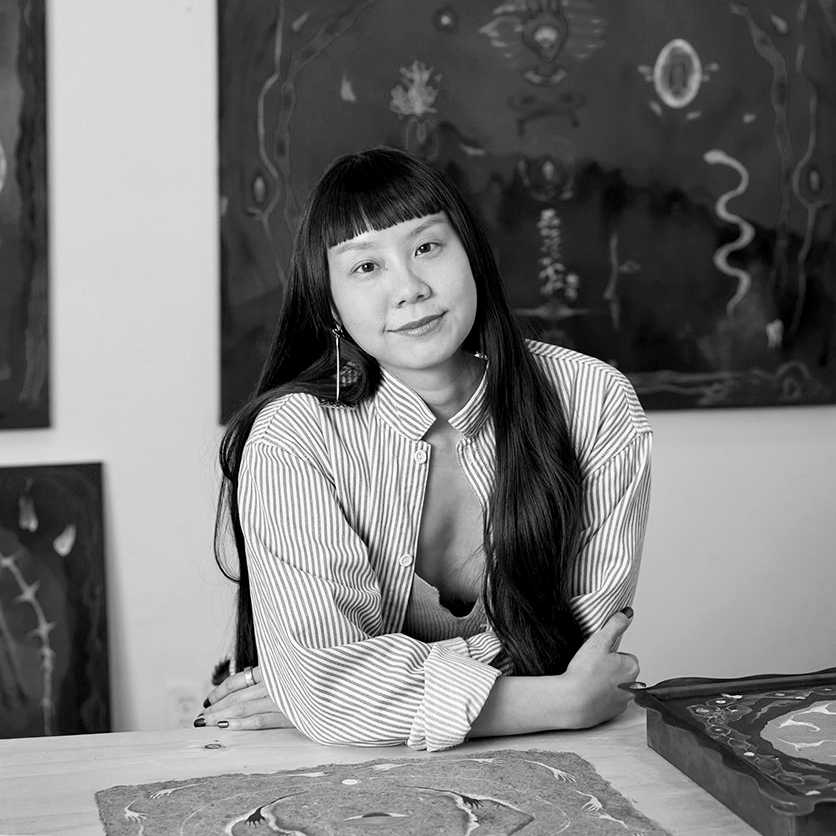
iris yirei hu is a multidisciplinary journey-based artist whose work moves across intimate paintings and sculptures to textile installations and public art. Central to her practice is a belief in collaboration and friendship as generative forces that transgress the myth of the individual. Her work has been exhibited at venues including the Institute of Contemporary Art, Los Angeles; The Armory Show; Center for Arts, Research, and Alliances; and Museum of Contemporary Art Tucson. Her honors include: Ruffin Distinguished Artist-in-Residence at the University of Virginia (2026), Longenecker-Roth Artist-in-Residence at UC San Diego (2025), Kohler Arts/Industry Residency in Pottery (2025), California Community Foundation Fellowship for Visual Artists (2022), and Headlands Center for the Arts Artist-in-Residence (2022). Her writing has appeared in Amerasia Journal and her work has been reviewed in the Los Angeles Times, Artforum, CARLA, and Hyperallergic, among others.
Photo: Claudia Lucia
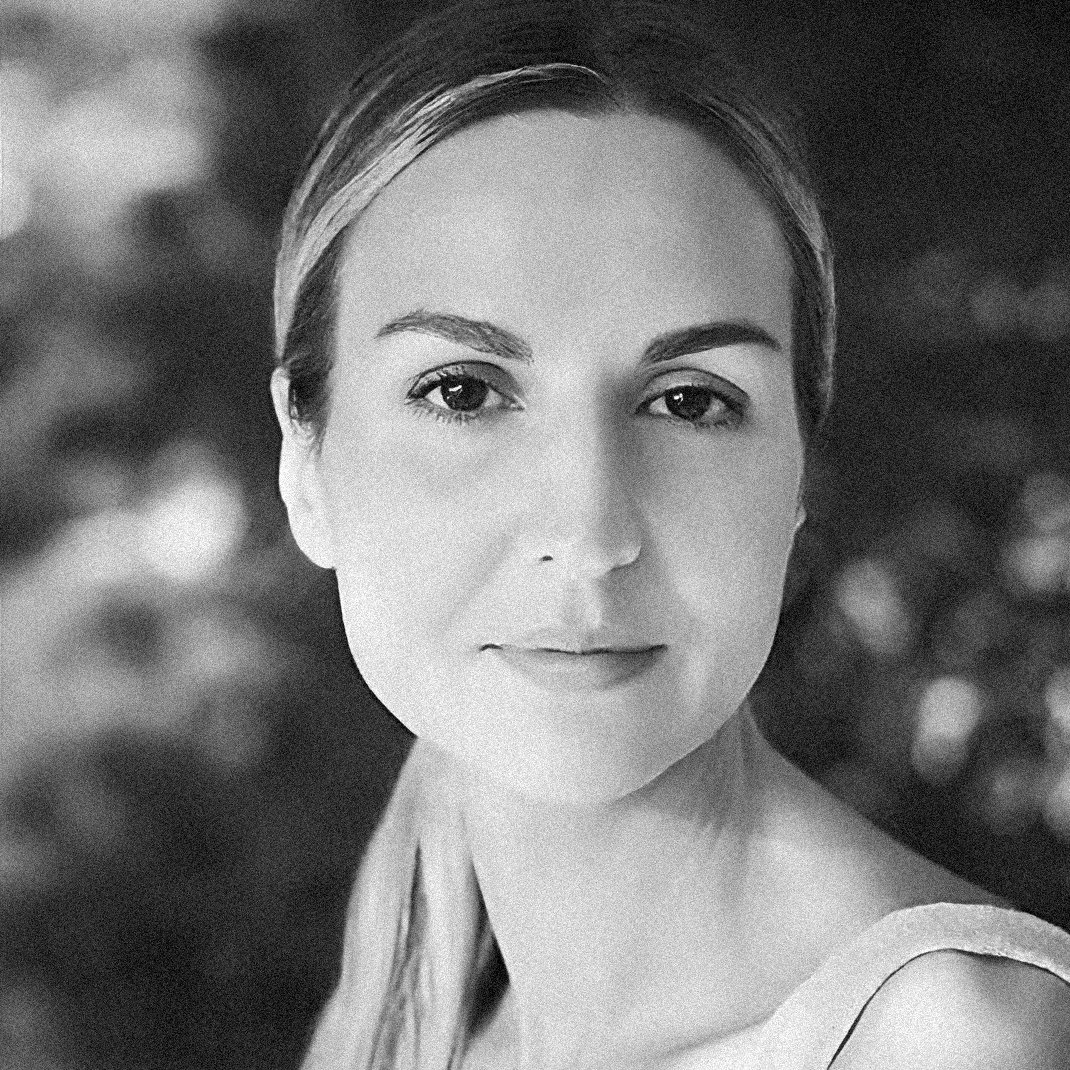
Claressinka Anderson is the co-editor-in-chief at Bear Review.
Anderson has worked as an art dealer, advisor and curator, and was the founder of the gallery and art salon, Marine Projects. Her curatorial work has been reviewed in numerous publications, including Art Forum, The Los Angeles Times, Vogue, Elle, and Modern Painters. She holds an MFA in writing and literature from Bennington College.
