Bear
Reviews
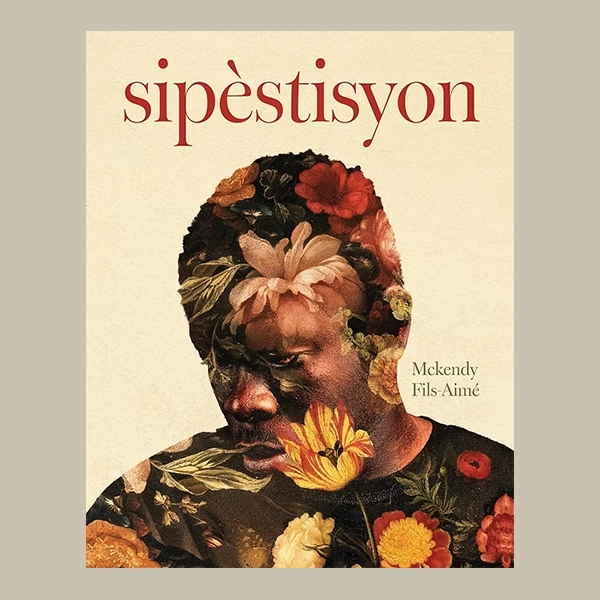
sipèstisyon
Mckendy Fils-Aimé
—
To be superstitious is to bargain with the universe itself. If it isn’t engrained through family or tradition, it usually originates from some perpetual state of fear, or a fierce protectiveness for the well-being of others or one’s self. (Or, a mentally exhausting combination of the two.) As rigid and specific as superstitions are, however, they also seek a sense of control. If our most mundane choices could invite disaster, why wouldn’t we decide to avoid making those choices?
These sensations of hyper-vigilance might sound familiar to survivors of childhood/domestic violence as well. Children are inherently powerless in our society, and that powerlessness is tenfold in an abusive household. Adhering to superstitions and growing up after surviving such abuse both involve seeking a sense of control that seems impossible. While the former may or may not be possible—that isn’t actually relevant to this review—the latter most certainly can be. Mckendy Fils-Aimé’s debut collection, sipèstisyon, is a visceral encapsulation of that search for autonomy through the lens of a Haitian-American speaker growing up in the predominantly white state of New Hampshire.
Meaning “superstition” in Haitian Creole, sipèstisyon is also the title of a series of poems that appear intermittently throughout the book’s three sections. Each poem is subtitled with a traditional, solemn warning: “If you comb your hair at night, you will lose your memory” is what opens the first poem in the collection; other examples include “If a blackbird enters your home, you must kill it or someone close to you will die” and “If someone sweeps too close to your feet, you will never marry.” The structure of these is adjacent to “if/then” statements, thus framing their outcomes as inevitable.
These poems invoke each superstition through mirrored narratives balanced with vivid lyricism. Yet their reflections always warp, or even more fittingly, shatter, potentially inviting even more misfortune into the world of these poems. One brief and especially visceral installment is subtitled with “If you walk on your knees you’ll cause the death of one of your parents”:
“each time you knelt me in the corner,
my young & welted arms crossed, i ran
in place, imagining myself traveling
entire continents. this is how i tried
building you a casket—my wish: oak,
my prayer: a nail—yet nothing happened
for decades until after we left you
to meditate on your viciousness.”
Through these searing tercets, resonant of the triangulation between the two parents and their child, Fils-Aimé subverts the power dynamic in the superstition’s “inevitability.” Going with the logic of the offered warning, the speaker’s parents have outright invited at least one of their own deaths by placing their child on his knees after beating him. Not only that, but it has invited thoughts of their death(s) into the speaker’s own young mind. He channels his stagnant energy into the thought; he is willing it to happen.
sipèstisyon is as much of a coming of age story as it is a book of spells. In a non-linear fashion, the poems depict a young boy grappling with his two cultures: “Michael Jackson was a lougawou” details not only the terror of believing a shapeshifter from folklore is real and dancing on television at age eight, but of encountering that danger in the real world:
“…the man in the grocery store
whose smile peeled away like a first skin
when he pushed my cousin
onto the freezer aisle floor.
Michael looks the same way
at the end of the Thriller video.”
As the speaker grows older in the pre- and post- 9/11 ages—the details of which are palpable in poems like “for a moment a New Hampshire middle school solves racism” and “kayfabe”—he finds solace in unexpected places. In “reverence,” the first poem of the second section, he allows himself to be tutored for first communion by Linda, a woman from church. What she doesn’t know is that these lessons are their own kind of salvation, a weekly escape for the speaker from his father (“my mother had to pry me from his hands like a broken nail”). By the poem’s final couplet, the speaker is only focused on not disappointing Linda, and reimagines Psalm 107:20 in gratitude for opening her home to him when he needed it most: “she sent out her word / & healed him. she rescued him from the grave.”
In “maybe generational trauma is a combat sport," however, the speaker makes his own solace out of something he was initially forced to do. Though at first he “loathed” the karate classes his mother signed him for at fourteen, he eventually comes to value this “treatise / on subduing danger or [ode] to self-discipline.” It also gives him skills of self-defense in his own home: “you were proud of each new stripe & belt & friend / until i grew brave enough to block one of your slaps.”
sipèstisyon never shies away from complex truths, however. The poem then unfolds into a meditation on the history of violence that preceded the speaker and his mother—not just familial, but colonial:
“i know your open hand was possessed by grandma’s
& her mother’s before her. the tree switch
begets the belt, which begets the sandal, which begets
the slap, each generation’s violence: tails of a cat-o-nine
held by a Frenchman: a sick progress, a perverse phoenix
fed by the immolation of our lineage.”
Here, while haunted by this ever-present abuse, the speaker makes space for his mother’s own hauntings, her own pain. Yet he does not linger or attempt to excuse her role in what one might call a “generational curse”: “Mom, i refuse to be like you: a student of this dark / discipline. i deserve a better curriculum.”
On the language level, this collection consistently stuns in its ability to precisely craft images that balance the inherent emotional tension with lyrical clarity. As seen in the above passage’s sharp alliteration and consonance, sonics are also a prominent element throughout the entire book—unsurprising, given Fils-Aimé’s decorated background as a performance poet in the New England and national poetry slam scenes.
These poems are keenly observant and self-aware—traits that, as mentioned earlier, aren’t unfamiliar to survivors of abuse. But Fils-Aimé also utilizes this attention to detail in poems that hone in on joy and community, underscoring how soul-sustaining both can be in the process of healing. Take “pâté” in the third section, for instance, in which the adult speaker endures rush hour traffic to try a new Haitian bakery in Boston:
“i’d bite into each pâté,
never noticing the fawn-coloured flakes
falling away, descending onto my shirt
or, like seeds of a wind-kissed dandelion,
floating slowly towards the ground.”
There’s a sense of intimacy in a poem like this, when readers are allowed this “physically” close to a subject. Close enough to see the small flakes of a pâté’s crust fall from the food in the speaker’s hands to the ground below his feet, and close enough to know the power the speaker finds in pushing through the anxieties about ordering in Haitian Creole. “in my second language,” he reflects, “i am a boy / again, shy & timid, but excited to eat.”
At last, the speaker’s sense of child-like wonder is not tainted or destroyed by an angry parent, or a racist classmate, or the memories of the two. Moments like this are especially poignant in sipèstisyon, which is unflinching in both its pain and joy. On the human level, of course, it cannot be overstated how much emotional and mental work is behind being able to balance both in adulthood. It’s also an ongoing, imperfect process, and one that can’t be done in solitude. Fils-Aimé encapsulates these nuances deftly in the penultimate poem, “entering my third decade”:
“…we are a lake
of laughter overflowing with good stories
between slices of cake. no one mentions
the stones once trapped in the riverbed:
rusted knives carving across the sediment
a spell, or the years I spent kicking
up so much debris I thought myself a curse.”
Notably, most of the poems in sipèstisyon are written in all lower case, including the “i.” Only in the third and final section does the speaker begin to capitalize himself, to stand at his full height amidst friends and chosen family. The hyper vigilance is still present, as is the sense of foreboding inevitability. Yet if there’s anything to take away from this unflinching collection (and there is so much to!), it’s the reminder that the continuation of generational trauma does not have to be inevitable. It’s a difficult curse to break, but not impossible—and sometimes, we have to dig the lake of laughter ourselves before we can dive in.

Review by
Lyd Havens
28.09.26
Lyd Havens is the author of Chokecherry (Game Over Books, 2021), as well as a co-author of I Wish I Wasn't Royalty: a Playable Chapbook (Game Over Books, 2020). Her work has previously been published in Ploughshares, Poetry Northwest, and Grist, among others. Born and raised in Southern Arizona, Lyd is currently an MFA candidate in poetry at the University of Virginia. She's on Instagram at @lidheavens and writes a newsletter at lydhavens.substack.com
© Bear Review 2025
ALL RIGHTS RESERVED
Site Design + Build
October Associates
