Bear
Reviews
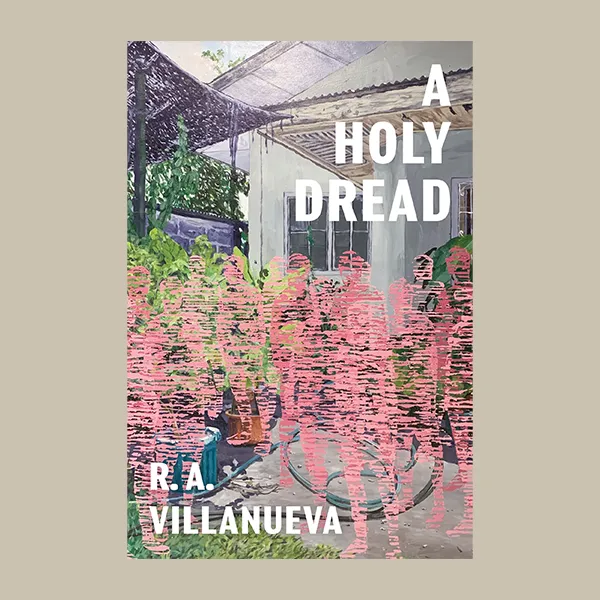
A Holy Dread
R. A. Villanueva
—
From Here to There—the Long View of R.A. Villanueva’s A Holy Dread
The title of R.A. Villanueva’s collection A Holy Dread references the medieval Christian mystic Julian of Norwich’s Revelations of Divine Love, in which she describes the anxiety “with which we face that which we love most, or that which loves us the most.”
Confrontations and the anxiety that comes with them slip in and out of A Holy Dread, though they’re not all necessarily spiritual in nature. Whether he’s talking about his mother’s cancer, or the dislocations inherent in claiming two cultures that are both immediate and as far apart as one can imagine, or the relationship he has to his own children, whose interests and actions are mundane and wondrous, there is an underlying mystery at the heart of these poems, as if Villanueva is never quite sure what it is he’s grappling with. It’s not the forced mystery his Catholicism (a repeating motif of the collection) seems intent on creating through repetition of the opaque, but more like a certain Genesis story the poet is reminded of while traveling in some part of England, in “Namesake”: …this Jacob’s flex / against the bindings of language, / of acronyms, of history… (32).
This Jacob of the Old Testament (eventually renamed “Israel,” or “Contends with God”) of the fights what he believe is a man, but in other versions is an angel of God, after having sent his family over what is now the Zarqa River in Jordan, leaving himself stranded on the far side. Villanueva’s work isn’t strictly a poetics of the refugee—he is not necessarily yearning for something that was lost, but rather acknowledging that something impedes us from reaching the other side, where we intuit something waits for us. What it is that impedes us is manifold, but in “Ditching” he speculates that
Lately it appears the water
has been waiting for us to keep trying
to make it across. The rivers
and trenches glossed with light
know we are so relentless as to plan
for catastrophe, layering backup
upon reserve (11).
Besides the evident bemused pity nature seems to take on us human beings here, there is the more serious consideration of what it is in our nature that compels us to “keep trying to make it across”; which of course is probably nothing more than the desire to make it back: back to the Eden we lost and which seems to have stuck in our brains epiphenomenally:
albumen prints of Hopi dancers, the
men all grasp snakes in their hands or teeth, sing
for rain with rattles and whips…
Think here of incense, noise, covenant hymns—
how Palm Sundays we spent the liturgy
knotting crosses from branches, swords from leaves (24).
Clearly one ritual replaces another, and then another, under different names. If the poet’s memory is open enough, it might become the conduit between these different attempts at reaching back to the as yet unrecognizable, that misplaced essence, like a transtemporal Purloined Letter staring us in the face. Or maybe better to say like a Balikbayan, from the poem of the same name, which Villanueva explains in the series of notes at the end of the collection as a merger of two Tagalog words, “balik” (to return) and “bayan” (homeland), describing “a Filipino who travels back to the Philippines after living abroad.” This poem, one of the many in the collection that ground personal memory as an anchor against being whisked away while dipping one’s toes in the metaphysical rapids of faith and identity, starts with nephews and memories of backyard baseball, ending on a lovely little anecdote of cutting his Philippine grandfather’s hair and then taking him to see the ocean for the first time. Unlike, say, “Saudade” where the poet wonders “where / is the patron saint of exiles” (25), here Villanueva seems unbothered by some kind of absence of divine guidance. It is a tricky maneuver: we don’t necessarily see the connection between the mark on his nephew’s face, the fastball his brother caught in the eye as kids, and the grandfather who “practiced [their] names” (27) on the sand of the shoreline—but then Villanueva’s poetry here is careful not to allow any significant space at all, really, between the possibility of reaching the other side and the relative logistics involved in getting there.
His Catholicism—like many people I’ve known from predominantly Catholic countries, this descriptive does not need to be qualified into faith or apostasy—provides many of those logistics, not to mention much of the dread. But so do the ways in which our separation from nature has reached such a point that, it seems, only God can save us now. And although I’m not sure Villanueva would agree with that assessment—
They bow Salve, Regina at the foot
of this tree flanked by lilies and find—clothed
in mantle of blue—the Virgin atop 30
scars in the trunk. Hers is the form they hope
we see first, an image we know we won’t
hold holy or miraculous (29)
—here, I think, is where the last section of the book, “Mirabilary” (see, again from the Notes: “one who writes of wonders.”), allows Villanueva his final pronouncement on getting from this side to the other. The title of the section is somewhat enigmatic, but not its content: the “wonders” Villanueva writes about are his children. Not a parent myself, but the proverbial non-blood related “uncle”, to read this section of the book is something akin to having those conversations with friends who are—the exhaustion and the surprise and the hope and the amazement, all of it. What is the meaning of it all? I ask them, curious and relieved I still can;
Where is the profound existential center of parenthood? To which they respond with a look of incredulous but good-natured pity, and then I get it: their kids are not ideas, they are not abstractions to ride out a high. They are “saint[s] shadowed by the axe” (37) at least as Villanueva has it in “This dark is the same dark as when you close”, comforting his son, frightened of the dark. In another, he talks of how he and his partner “are taken by the circuits / of his mind glowing as he imagines / the distances between us” (39) while their son counts up the years between his age and their own. Of his daughter, snoring and drooling on his shoulder during mass, he concedes to himself that “What dreams I can remember are the dreams / that frighten me most…” and like some Goneril of Lear’s nightmares, knows that “this / child will learn to curse the sound of my voice” (43).
Not for nothing are the cognates of dread and holy, respectively, “apprehension” and “the whole”. To apprehend or ascertain the whole—this is the promise of some far-off reward, the glimpses across the shoreline which we sometimes comprehend here and which, when we do, we are ill-prepared to reach, despite our planning, our rituals, our offerings to the generations that come. Nevertheless, with A Holy Dread Villanueva has created a small document—a devotional, maybe, or a book of conjuring—to help give some shape to the mystery, some song that can be sung at bedtime, or in ecstasies before whatever one fights against (or for). Something that “…promises yes” as he says in “EPITHALAMION BEGINNING WITH THE TEMPEST”, “despite every havoc” (58).
Review by
Benja Castor
01.28.26
Benja Castor spends too much time writing when he should be doing more important things. He splits his time between the States and Argentina. His poetry and prose has been published in a few places, under a different name.
© Bear Review 2025
ALL RIGHTS RESERVED
Site Design + Build
October Associates
