Bear
Reviews
The Stuff of Hollywood
Niki Herd
—
A Tombstone of Response, Both Eulogy and Ekphrasis
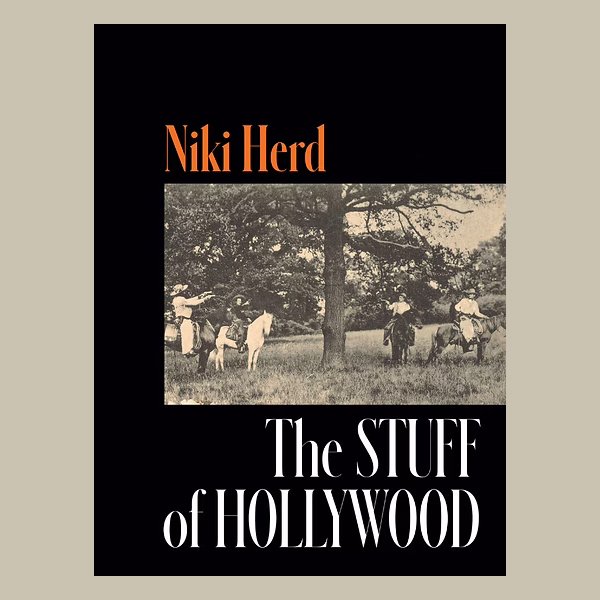
In The Stuff of Hollywood, Niki Herd connects the rise of the silver screen with the prevalence of guns in American culture, both of which have attained a godlike status in American mythmaking, the implication being gun-slinging heroes garner worship—the insidious motive Herd underlines in her collection: white supremacy. Herd incorporates police reports, scripts from film and media broadcasts, and photography that coalesce to form a case study of the role of the camera in furthering gun violence.
Beginning with the line “Abandoned bank building now museum in the South,” Niki Herd’s poem in honor of the Stony Island Arts Bank exhibit entitled, Objects of Care: Material Memorial for Tamir Rice, mentions the wood that constructed the gazebo was most likely cedar. Most likely cedar. As in, the wood that may have constructed the cross upon which the figure, Jesus Christ, might have hung possibly contained cedar as well.
“& this is the closest she will get to writing a love poem about the city in which she was born & damn why does it have to be an elegy? The weight of wooden” (9)
In the Christian faith, cedar may represent strength and beauty, but also pride and arrogance, as well as the importance of striving for humility. The cedar here is representative of Tamir Rice in memoriam, but the poem itself sets the tone for the rest of the collection, in which so many brown and black lives are lost to gun violence, which must be grieved as well. Yet, the cedar is also a reminder of the pride, arrogance, and lack of humility found in those who’ve wielded guns against brown and black bodies, the spectacle made of these erasures through the eye of an ever-watching camera lens.
We learn as well in this poem that the museum markers which label exhibits are referred to as “tombstones”. With this nomenclature, each poem in Niki Herd’s second poetry collection, The Stuff of Hollywood, is a tombstone of response, both eulogy and ekphrasis to each horror, and documentation of a collective watching and inability to intervene. Herd sums up this sensation of helplessness in the following lines from her poem, “Good On A Depthless Pond”:
“of unbecoming. How does one undrown from the incivility of this world?” (91)
There are poems in which Herd makes physical on the page this erasure, to trip over the spaces a reminder to the tongue and thus the body of that which is missing. The poem “POLICE DEPARTMENT POLICE REPORT NARRATIVE” omits words so repetitively that their elision highlights their occupation within both the page and the world:
“when a stray broke through her west bedroom window and lodged in her bathroom wall. / When explained and showed where she was standing it was obvious / the only missed her by .” (8)
As in “AUCTION LOT NUMBER 2” in which the removal of names and words translates into a form of redacted reporting that forces us to imagine the missing presences, all they entailed, that fill those spaces invisibly:
“The video camera used by on March 3, 1991 / to record the Los Angeles Police Department beating / of The first viral video that both literally & / figuratively shined light on police misconduct in the United States” (11)
The same redaction does not hold true in the film and media representations of prominent white figures acting on the world stage, literally being recorded for mass consumption, whether for tv and the movies or for the news. Herd asserts there is no difference between either form of media and describes “the line between real violence and that engineered” in her poem about the Century 16 shooting in Aurora, Colorado at a screening of The Dark Knight Rises (33). She dissects this murky line further in a comparison between the script for the 1915 film The Birth of a Nation and text from the televised congressional hearings for the January 6th insurrection. Lines in this poetry collection ricochet across various periods in the book as with the lines below from Herd’s poem about the Century 16 shooting, The Birth of a Nation script, and text from the congressional hearings:
“More than the flag. More than the Statue of Liberty. Our true symbol of democracy is the AR15. In its eyes everyone is equal.” (33)
“173. Ben tickles his sister’s face playfully with the Confederate flag. She falls to sleep, and smiling tenderly, Ben covers her with the flag.” (52)
“American flag. Face mask. Weapon on the right. Brown cowboy boots— [End videotape]” (67)
In all three quotes, all characters are either mentioned or directly recorded. In only one quote are the characters mentioned actually fictional. Does it matter? On pages (78-79), Herd presents photos of the actor, Charlton Heston, first portraying Moses in the 1956 movie The Ten Commandments and then holding a rifle aloft triumphantly at a National Rifle Association meeting in 2000. And on pages (76-77) is displayed a screen grab from a battle scene in The Birth of a Nation followed by a photo of the attack on the U.S Capitol on January 6, 2021. The slanted, kinetic lines of movement in the images mirror each other across the spread. So, too, in the American mythmaking that is Hollywood and everything that is filmed, whether or not it exists in real life, the swashbuckling, cavalier hero is always the gun-carrying—never the assailant. In “The Stuff of Hollywood” we come to realize that the camera affords for them a star quality and that it does not matter by which means.
Review by Jay Aja
07.21.25
Jay Aja (they / he) is a poet and comics artist. They identify as nonbinary, transgender queer, and second-generation-immigrant Guyanese. Jay’s work has been supported by the Tin House Summer Writers Workshop and the National Women’s Book Association. He is an Honorable Mention in the 2024 Tom Howard / Margaret Reid Poetry Contest with poetry in Foglifter. Jay has written poetry book reviews for Bear Review, Atticus Review, Saw Palm: Florida Literature and Art, and GRIFFEL. Find more of their poetry, comics, and book reviews on social media @comicsbhaijay
© Bear Review 2025
ALL RIGHTS RESERVED
Site Design + Build
October Associates
