Bear
Reviews
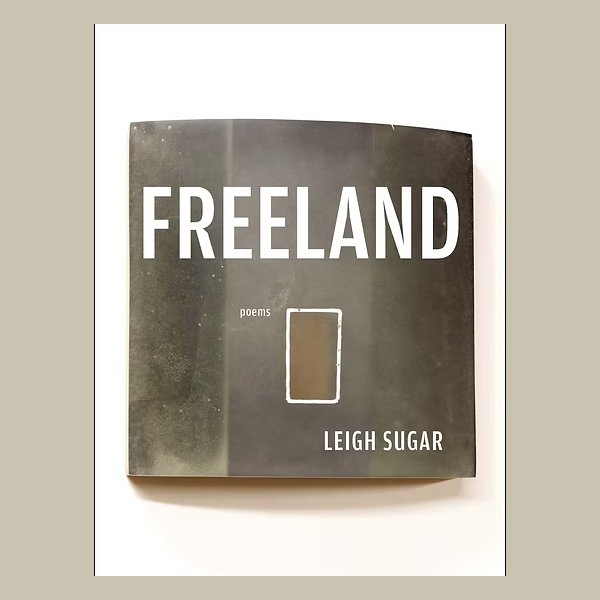
FREELAND
Leigh Sugar
—
The opening page to FREELAND by Leigh Sugar reads:
Freeland, Michigan is home to the Saginaw Correctional Facility, a Michigan state prison.
Leigh Sugar’s FREELAND is a book of obsession and careful analysis, one that constantly turns over the reality of incarceration in the United States in order to examine it from a variety of angles. For much of the book, Sugar’s speaker corresponds with an incarcerated writer, referred to as a beloved, and many of the poems in this collection map their relationship and how they must contend with the reality of one of them living in confinement.
These days I scrawl 619754
on envelopes after a locked-up beloved’s last name.
He says, Leigh, I dream I’ve forgotten my number
and wake to realize I’ve forgotten my name.
(from “Inheritance”)
This carceral reality inflects every poem in FREELAND and is omnipresent—for Sugar’s speaker, living a life outside of prison doesn’t mean that she ever stops thinking about prison; if anything, her freedom brings into stark contrast the fact that her beloved, and countless others, remain incarcerated in the United States.
What irreverent law,
the cosmos: birds circle aimlessly
in false dusk.
(from “Eclipse Before Seeing You In Prison”)
In a breathless, unpunctuated prose block, Sugar deftly renders the panic of not knowing what to do upon the release of the beloved at the end of a ten-year sentence:
Do I stay in the car or do I wait for you in the
waiting room where I’ve been returning all
these years to visit Do I call ahead or do I
trust that everything’s proceeded smoothly
Do I bring a change of clothes for you
What color T-shirt do you want Vneck or
crewneck What size jeans What fit
What fit will be in style in ten years
What brand of underwear Do you still like
black boxer-briefs Sneakers or boots
High or low-cut socks Should I bring a snack
Is a bagel with cream cheese OK How about
fruit salad How long since you’ve eaten a
strawberry …
(from “Fantasy”)
Throughout FREELAND, Sugar weaves in and out between invented forms: “Security” is written from the perspective of a prison security guard who is processing Sugar’s speaker through a checkpoint for a visit, revealing the guard’s casual, default dehumanization of the incarcerated while subjecting Sugar’s speaker to increasingly invasive searches. In a second poem titled “Fantasy,” words wrap around the page to form a box, or a door, with finely-tuned statements that show the ways in which we inhabit a world that contains structural deficits. It becomes clear that even some basic, humanizing wishes inhabit the realm of fantasy for how far we are from actually seeing these statements become truth.
“Diseases have cures and doctors to cure them, and there is no hierarchy of who gets what care when. People only die when they’ve lived long enough to give love and receive love and learn as much as they’re capable of, and then when it happens it is without pain or cost. Cells are only what keep bodies and plants alive.”
(from “Fantasy”)
The highlight of FREELAND is a crown of sonnets entitled “Corrections”—while other parts of the collection are experiments in form and language, with poems frequently departing from the left margin and across the page, the pared-down nature of the sonnet and their sequential links which build upon each other have a forceful, cutting effect which reveals the emotional core at stake in the collection. “Corrections” examines the ways that Sugar’s speaker’s relationship with the beloved is fraught as a result of his incarceration, and the strain that it places upon both of them to maintain this relationship in confinement and under constant surveillance.
Through letters, we wrote ourselves into existence.
Forged a shared history amidst the void.
Became—ourselves, each other—characters
for the other’s story. It’s too much pressure
to be your symbol of freedom, I said, and knew
I was projecting. I don’t know how to love you
other than to tell you of my days, my meals,
everything you cannot see. What if it’s not enough?
What if writing you my life is a distraction
from some other writing I should, could,
would be writing? I’m afraid to be a woman
waiting. I’ve always lived with hunger.
I’m more afraid of your presence. Afraid
of what will happen when the lack is gone.
(from “Corrections”)
True to life, Sugar’s speaker does not arrive at a neatly-packaged revelation by the end of the collection—it is clear that she is changed by her experience and will be unable to stop thinking about the reality of incarceration. Readers of FREELAND will likely find themselves contemplating the structures, including language, that seek to render the realities and experiences of incarcerated people invisible.
Review by William Ward Butler
06.05.25
William Ward Butler is the poet laureate of Los Gatos, California. He is the author of the chapbook Life History from Ghost City Press. His poems have appeared or are forthcoming in Bennington Review, Cherry Tree, Five Points, Hunger Mountain, Switchyard, and other journals. He is a poetry reader for TriQuarterly and co-editor-in-chief of Frozen Sea
© Bear Review 2025
ALL RIGHTS RESERVED
Site Design + Build
October Associates
