Bear
Reviews
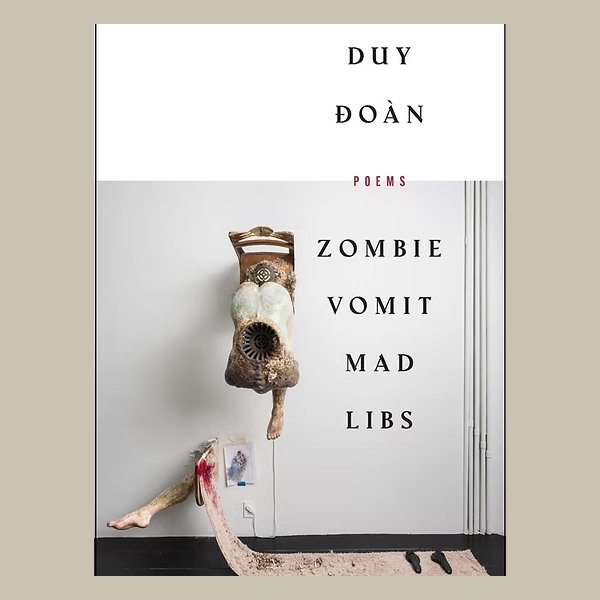
Zombie Vomit Mad Libs
Duy Ðoan
—
“Remember when”
Vietnamese American poet Duy Ðoàn—in these poems of love, hope, rage, and dystopia—have the potential to reshape the contemporary poetry world. In Zombie Vomit Mad Libs, a blank page is not simply a blank page. Each page is a canvas on which Ðoàn uses words like some artists use mixed media to unite the humane, the easily perceptible, the Kafka-esque, and the abstract. From jarring one-line poems that sear themselves into readers’ memories to longer punk rock-esque monologues, these poems dare to balance on life’s edges and peer into the depths in order to confront the grotesque, rearrange destruction’s aftermath, and find hope in the most dismal abysses.
However grotesque the world may be, Ðoàn’s poems consistently find romance and hope in even the smallest places. “Dopamine” testifies to Ðoàn’s ability to render beauty from life’s jagged shards. Part confessional, part observation, “Dopamine” elegizes the small moments that form a relationship. “The person I’ve been talking to / this last half year / recently upped their flirting game,” confesses the speaker. Deep, weird factoids like “eww the human body is filled / with countless holes” center their conversations. The poem morphs into an elegy for the pre-Covid world. An immense amount of white space between the first stanza and the second stanza creates emotional and psychological distance and dissonance. The second stanza’s first lines reinforce that dissonance: “The last time we’ll ever have dinner together in a / restaurant with more than 25% capacity.” The second stanza’s fifth line—“We’ll never see anything like that again”—solidifies the dissonance. The poem’s dystopian tone culminates in this single line, too. It is sharp, direct, simplistic, and gorgeous.
“Buddy and Butterscotch, Water Goat in the Year of the Snake” contributes a bit of humor to the collection. However, that humor is once again laced with Ðoàn’s signature dystopian takes. A “speedster” named “Butterscotch”—AKA one of the speaker’s beloved cats—is the poem’s central focus. Cat care is a bit of a tug-of-war between the speaker and their partner, and one of the poem’s most beautiful moments develops from both the speaker’s self-awareness as well as their awareness about their partner:
I left my anger behind
while we were honeymooning;
you kept a daily vigil
alone in the mornings,
checking your inbox, beaten
by a box, putting first things first.
The repetition of words like “box” and “first” creates a cyclical tone in these lines, creating the sense of both ritual and tedium. As the poem continues, the partner promises “to scoop the box more often.” Ðoàn’s gift for duality particularly shows in the final stanza:
when we got home, I thought that was
a keen way of looking at things—me
observing you leaving here.
You vaulted from one bliss to another;
you were offering me morning vigils.
The final lines’ past tense implies that the speaker’s partner has left for good, that their romance and relationship has ended. Nonetheless, they possess a duality that also implies that the partner has, reluctantly, accepted this part of their and the speaker’s relationship. In essence, this duality allows readers to ultimately choose their own ending for the poem—and the couple, perhaps even Butterscotch the cat.
Other poems, like “Nosferatu: A Symphony of Horror—First Goodbye Scene [Intertitles Remix]”— allude to contemporary pop culture. Gorgeously minimalist, the poem relies on short lines. The poem’s emotional power lies in its linguistic sparsity and fragmentation. The spacing between lines and stanzas contributes to the poem’s lure:
the country
the dusty roads worried the
horses
thieves travelled
far for it.
The spacing between these lines mimics words like “worried” and “travelled.” Other lines utilize only single words:
but
he
Hutter and his
his.
This singularity creates emphasis and a strange mysticism that shrouds the mysterious phrase “Hutter and his,” a reference to Thomas Hutter, the young German real estate agent and husband to Ellen Hutter who travels to meet with Count Orlok in Nosferatu. The lines’ left-alignment defies the mysticism produced by the poem’s language. The alignment forms a rigidity, but it also forms an inescapability that resonates perfectly with Nosferatu’s literal and metaphorical eternality.
“Serotonin—the Thirtieth Week of the Year of the Earth Pig” is confessional and vulnerable. “We crush on tragedy, your vantage point / giving you the upper hand,” admits the speaker. To the speaker, the unidentified “you” says things like, “smell your foot to see if it’s rotting.” The speaker acknowledges that they “can’t get this from anyone else.” This single clause enshrines the speaker’s relationship with the other person. However, other lines reveal the depth of and devotion in the couple’s relationship: “we gave up on the meteors and started counting // fireflies the way some couples keep trying for // monotony, like when the neighborhood squirrels / died and the acorns stayed behind.” While these images are complex, they segue into a simpler set of lines that captures the couple’s budding intimacy: “Whats ur birthday. / R u ticklish.” These lines signify a return to the beginning, to a simpler time, and conclude the poem with a youthful innocence.
Zombie Vomit Mad Libs breathes fresh life into today’s poetry scene. It tugs at life’s many edges, places all of them carefully, and then stitches and staples the pieces together. Most of all, it establishes Duy Ðoàn as one of contemporary poetry’s most refreshing—and necessary—voices.
Review by Nicole Yurcaba
07.29.25
Nicole Yurcaba (Нікола Юрцаба) is a Ukrainian American of Hutsul/Lemko origin. Her poems and reviews have appeared in Appalachian Heritage, Atlanta Review, Seneca Review, New Eastern Europe, Euromaidan Press, Chytomo, and The New Voice of Ukraine. Nicole holds an MFA in Writing from Lindenwood University, teaches poetry workshops for Southern New Hampshire University, and is the Humanities Coordinator at Blue Ridge Community and Technical College. She also serves as a guest book reviewer for Sage Cigarettes, Tupelo Quarterly, Colorado Review, and Southern Review of Books. Her poetry collection, The Pale Goth, is available from Alien Buddha Press.
© Bear Review 2025
ALL RIGHTS RESERVED
Site Design + Build
October Associates
