Bear
Reviews
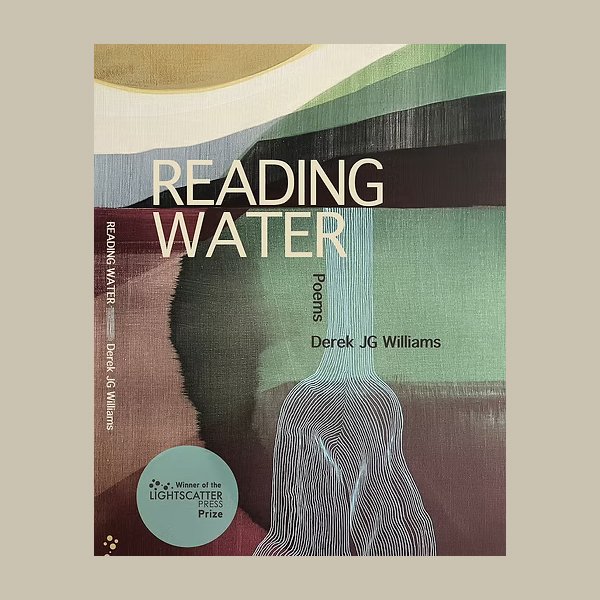
Reading Water
Derek JG Williams
—
In Derek JG Williams latest collection, Reading Water, we are thrust into an aquatic world of love and grief. We find ourselves aboard a small and lonely boat, struggling to navigate a shifting landscape of feeling.
I angled the boat around the rocks
no map marked the bright passage I approached
a parting granted by trees gone skeletal
This is Williams’ world—a chain of inlets that propel us through memory, through daily tenderness and grief. As we drift through these murky waters, we meet a cast of characters, only loosely linked. A wife. A dog. The rotten carcass of a whale. An uncle, long-dead from AIDs. A mother, recently deceased.
For Williams, language is a way to speak to and about these characters, a way to access his love for the humans and animals that populate these pages. In these poems, we often linger in shallow pools of memory, what rises to the surface:
Growing up,
the family parrots, in imitation
of my mother would holler my name
from one room to another.
Today I’d give anything to hear
my mother’s voice yelling
for their squawking to stop.
But these memories don’t last long. They run through the fingers, disappear. We see this most clearly in the collection’s title poem, where a woman on the broad stone steps of a Chinese temple writes about the grief of losing her son in “stacks of wet characters / spilled precisely.” Her characters, written in water, evaporate and disappear. When the narrator of the poem circles back soon after, both the woman and her grief are gone. Williams writes:
I try to write like her, in water.
The words go, and stay
gone—sons get lost,
and daughters too.
A boat scraped by rocks
rocks dangerously.
Yes, it’s impossible
to know deep water.
Of course water is still a metaphor for grief here, but Williams goes deeper; stretching toward what he can’t ever know. With language, he tries to communicate these griefs, knowing all the while that the “words will go and stay gone,” knowing that his foot will never brush the bottom of this particular pool. All that matters is that he’s grieving now. That the water is all around him, soaking him through, as at the end of this same poem he writes:
When
the rain falls it leaves
me wet.
In the second section, the poems turn toward life by turning toward the body. Here we find Chinese takeout, odes to tongues and eyes. One poem called “Ode, My Pissing Lover” is about the narrator listening to his wife pee. The connections in these poems are a lifeline, keeping the narrator afloat. This is most clear in a poem called “When I Dream of Drowning Alone, My Lover is Breathing Beside Me,” where the narrator sleeps beside his wife. The connection between these lovers is physical, a literal life-giving cord:
An umbilical snake
knots us together even while
we sleep
As the poem ends, we understand the need for this tether, this closeness. Alone in his own dreams, the presence of another body, the comfort of love, keeps the narrator from drifting out to sea:
Find me
when I’m afraid. Hold me
when fear has taken me far.
I don’t think it’s an accident that the title of Williams’ collection calls up the idea of treading water. For so much of this book, Williams gives us the experience of treading, worn out by all his love and grief, his daily longing. But these feelings, though sometimes painful, also color his life. Because there couldn't be grief without love, without longing, without awe and desperation and fear and hope. This is the human condition, which ultimately holds us all together. We all swim in this murky soup. Opening his heart, Williams writes:
I love my friend I love
my mother and father and my wife
doubtless I love the years
their unpredictable flowering
their frailty
I close my eyes and bury
my nose in the warm
neck of my dog
to tell him exactly
how I feel

Review by Rebecca Valley
05.08.25
Rebecca Valley is a poet living in North Carolina. Her work has been published in Permafrost, Bennington Review, Black Warrior Review, and elsewhere. Her poetry chapbook, The Salvageman, was published by o-blek editions in 2022. She is also the author of a collection of true crime stories for children, which you might enjoy if you like books about dognapping or museum heists. You can find her online at www.rebeccavalley.com
© Bear Review 2025
ALL RIGHTS RESERVED
Site Design + Build
October Associates
