Bear
Reviews
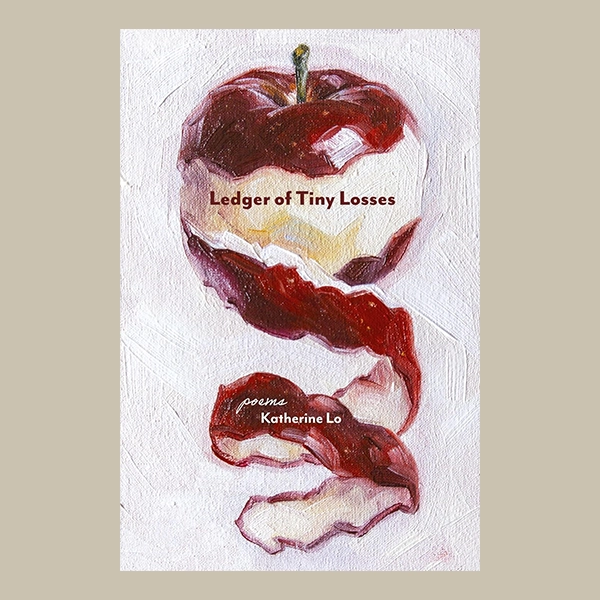
Ledger of Tiny Losses
Katherine Lo
—
“The wound is the place where the Light enters you.”
Rumi
Each of the 24 poems in Katherine Lo's luminous debut collection, “A Ledger of Tiny Losses,” winner of the Grayson Books 2025 Chapbook Competition, flash dimensions of being that weave past to present, despair to hope, and the speaker’s own lived experiences to the universal and philosophical permutations of grief and loss.
Who among us has not spoken to our lost beloveds, or imagined conversations when we seek guidance or empathy in the messy business of our day-to-day lives? Lo’s poems resurrect and reimagine such conversations, along with stories and behaviors that defined her lost parents and other beloveds, and remain imprinted in her consciousness. The result is a tapestry of emotional connections and spiritual ambiguities, which exist — and somehow empower — alongside disconnection and brokenness in the speaker’s life.
In “We’re Sorry, You Have Reached a Number,” a uniquely visual poem, two-thirds of the page consists of the speaker’s imagined conversation with her father and is positioned to the left. On the right is the remaining third of the poem, comprised of short lines broken vertically. That section carries the title into the poem below, written as one would hear the words from an operator:
(that has been)
(disconnected)
(or is no longer)
(in service)
(if you feel)
(you have reached)
(this recording)
(in error)
(please check)
(the number)
(and try your)
(call again).
On the left side, the speaker addresses her late father as she contemplates solutions after discovering black mold under layers of paint during a bathroom remodeling project:
I will have to call the roofer. Maybe even
a contractor. This is what I would tell you
about if I could. If the number in my phone
labeled “Dad” still connected me to you.
And the thing is, even if I could, I know
you wouldn’t be able to tell me what
I should do or what materials I’ll need.
You would be as much in the dark as I am.
While most of the book’s poems are written in couplets, tercets, or are presented prose poem-like in one continuous stanza, the created form of “We’re Sorry, You Have Reached a Number” serves to juxtapose the impersonal voice of the operator with the speaker’s acute awareness of her father’s absence and the dialogue she’d have with him if she could.
The next poem, “Hello, Mom,” extends the speaker’s longing for communication to her deceased mother, but also wrestles with brokenness at different levels. Others may see her as wise, but Lo’s speaker knows the weight of the caretaking burden she shouldered as a young woman, and is clear-eyed about the anger she never allowed herself to feel:
I want to tell you about the flashing lights
on the display screen of the refrigerator
still new enough to shine, and how long
I waited on hold to schedule a repair.
All the conversations now seem to be
about what’s gone wrong, what’s broken,
everyone’s parents especially, their bodies
a series of mysteries to test and test again,
each new specialist making a guess.
Is the medication helping or harming? Is this
a short-term crisis or the final decline?
Lo’s speaker has learned to live with ghosts. Like the flashing lights on her refrigerator, these apparitions appear to both illuminate and blindsight the speaker in the uneasy coexistence she carves out with them. She continues:
What can I say to these middle-aged friends
who turn to me, asking? It is so new to them,
and I was so young the night you turned to me
and cried I don’t want to leave. All the anger
I never felt now simmering under the lid,
the full rattle on its way.
In “Ghosts,” which begins with the speaker’s brother sending her a video of a man from his neighborhood who walks just like their father used to, “…so I could see what he sees almost every day—our father on his daily walk,” Lo speaks to that communal relationship:
…I used to be
scared of ghosts, hid under the covers from them,
sang songs to dispel them. Now I know
they’re just here to remind us of what we might
otherwise grow numb to, forget. A little stab,
welling drop of ruby, proof of life.
The book’s title poem, “Ledger of Tiny Losses,” is a reminder of how our lives are defined not only by the monumental events we experience but also by the incremental — the small and intermittent erasures that accumulate over time and scar the psyche. The loss of memory, the loss of shared behaviors we observed and participated in that helped shape who we became as adults and our sense of belonging in the world is every bit as profound as the loss of life itself, Lo seems to say.
The short length of this poem, with its sensual images of the apple and how the poem’s persona pares, eats and savors it, illustrates these points well:
Last night I dreamt of you
standing in the kitchen, paring
slivers of apple from its core
as you did so often, your lips
curved to grasp each slice,
the juicy crunch of it muffled
by your cheek. Only this time
you did not turn to me, your gaze
fixed on something beyond
the window, did not invite me
to share in this pleasure as you
always used to. Another entry
in the ledger of tiny losses.
Mid-way through the collection, the poem, “Love in Middle Age” introduces the speaker’s husband as another character in her family dynamics. (We learn in other poems that the husband, initially her boyfriend-turned-fiancé, was a widower when they met, and that the late wife’s presence continues to haunt both them both…yet another ghost to make peace with.) She writes:
…..Every time you slid your hands
into your lobster-claw mitts to pull a roast
out of the oven or flung an arm in front of me
when you braked the car too hard, thin threads
were spooling out of you. And my cautious heart,
which doesn’t like loose ends, began to gather
and weave them, blue crossing red and yellow,
and where there were only wisps is now
a solid row of squares that keeps growing and soon
will cover me. Maybe even become a necessity,
the way a blanket straight from the dryer warms
someone who doesn’t even know she is cold
until the moment she suddenly isn’t.
In “My Husband Apologizes for Having Cancer,” we hear more about the risk and necessity of trust:
He knows I’ve had enough — mother, father, sister,
not to mention all the cancer-adjacent cases, the beloveds
of our beloveds. As if he had any say. As if he hadn’t
had enough himself of living with a cancer-stricken
spouse. The one before me. Of course I know he really
means he wishes I didn’t have to suffer any more…
…But see, my darling man,
I know the risk of loving, the soft belly we must all expose
to really be alive….
The semaphoric poems in this moving collection speak to each other, and to the reader, in a language forged by forgiveness, acceptance and survival. They bear witness not only to the lives and stories of the speaker’s family, but also to her determination to carve meaning out of commitment, regardless of the pain that might entail.
As dutiful daughter, sister and wife, Lo’s speaker threads the roles of listener, caretaker, and record-keeper, and focuses on preserving and protecting the legacies of those whose histories she has inherited. At the same time, she understands that growth can only come from vulnerability and an open heart.

Review by
Sarah Carey
15.10.26
Sarah Carey explores place, loss, relationships, and ancestry through Southern landscapes and scientific observation. Her debut full-length collection of poems, The Grief Committee Minutes (Saint Julian Press, 2024), was an Eric Hoffer Award finalist. Her second collection, Bloodstream, was released from Mercer University Press in February 2026. Winner of the 2026 Sweet Lit Poetry Contest, she also is the author of two chapbooks, including Accommodations (2019), winner of the Concrete Wolf Chapbook Award. Visit SarahKCarey.com
© Bear Review 2025
ALL RIGHTS RESERVED
Site Design + Build
October Associates
