

Claressinka Anderson speaks to artist Debra Scacco.
—
Claressinka: I was first drawn to your work because of its obsessive connection to language, and I’m excited to begin this conversation by looking at your practice through that lens. The line is a potent foundational and connecting force throughout your body of work—lines of language, cartographic lines, ancestral lineages, pathways of labor and commerce, boundaries and borders—it is embedded in everything you do. Poetry is also about the line; where does it break? When thinking about the line in your practice, how do you think about continuity versus its inevitable interruption?
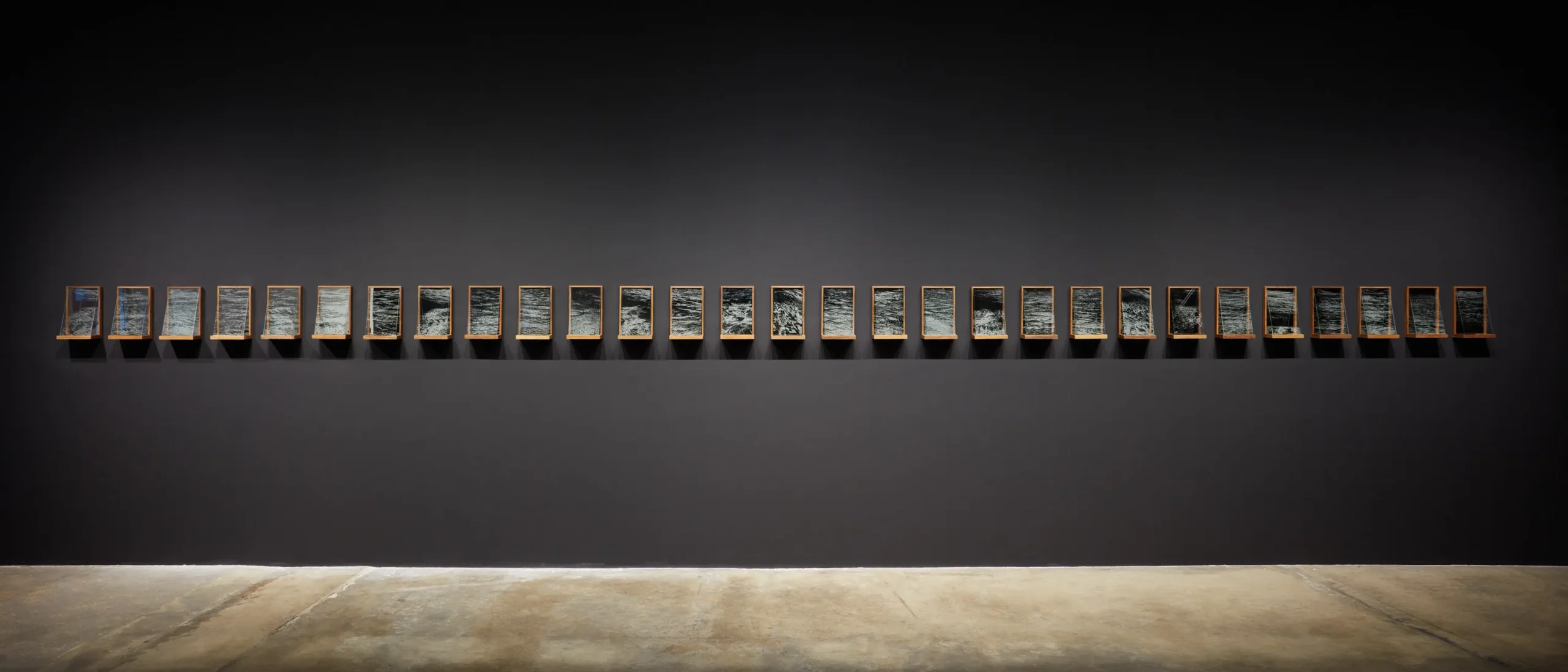
The Narrows Engravings. Glass, mirror, teak. 2017/18
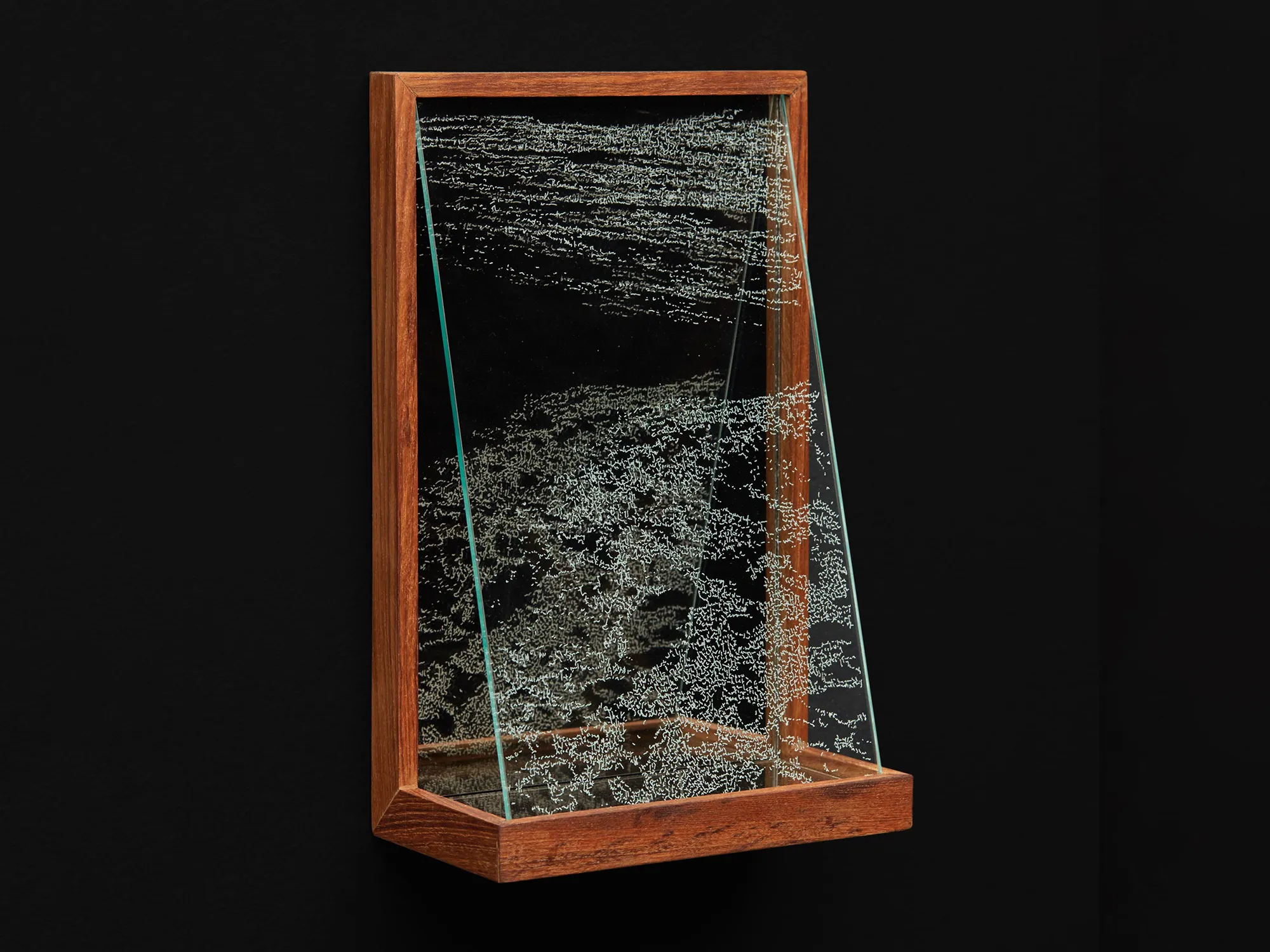
Algeria 1921. Glass, mirror, teak. 12 x 7.9 x 4in 2017/18
Debra: Wow - what a question. The line is undoubtedly a central force in my work. Everything is a line, especially when it comes to access of place. We see this now more than ever with increasingly violent and illegal immigration action by federal forces. Lines have shaped my life. My Sicilian grandmother was born in America and returned to Sicily shortly after (she would now be referred to as an ‘anchor baby’). This gave my father birthright citizenship which allowed him to immigrate to the States as a teenager. This granted me access to a European passport which allowed me to live abroad for 16 years, and to continue to live with my immigrant husband while we applied for our right to live in the US together. This particular combination of circumstances is no longer possible because of immigration policy in three countries. I recognize that if my father were an immigrant teen in the US now, he would have a target on his back. My family and I wouldn’t exist if we arrived in the US at a different time, so I dedicate my life and practice to interrogating the violence of lines and the ways in which they intend to predetermine our fate.
I appreciate likening the line of a poem to the line of a drawing. They each provide a break, a breath, an acknowledged absence (or presence?). Continuity and interruption are extremely important to my process. I’ve created 14-foot drawings where each line spans a single breath, and monumental rubbings that reflect my wing span and the architecture of a manufactured river. I have created work from 20,000 feet of hand-dyed rope that presents as a web, yet is a complex set of lines with overlapping breaks.
I think more about continuity and interruption in the process of making work rather than in its completion. My own body is often the interruption—my wing span, my breath, the physics of space—especially as my work has grown in scale.
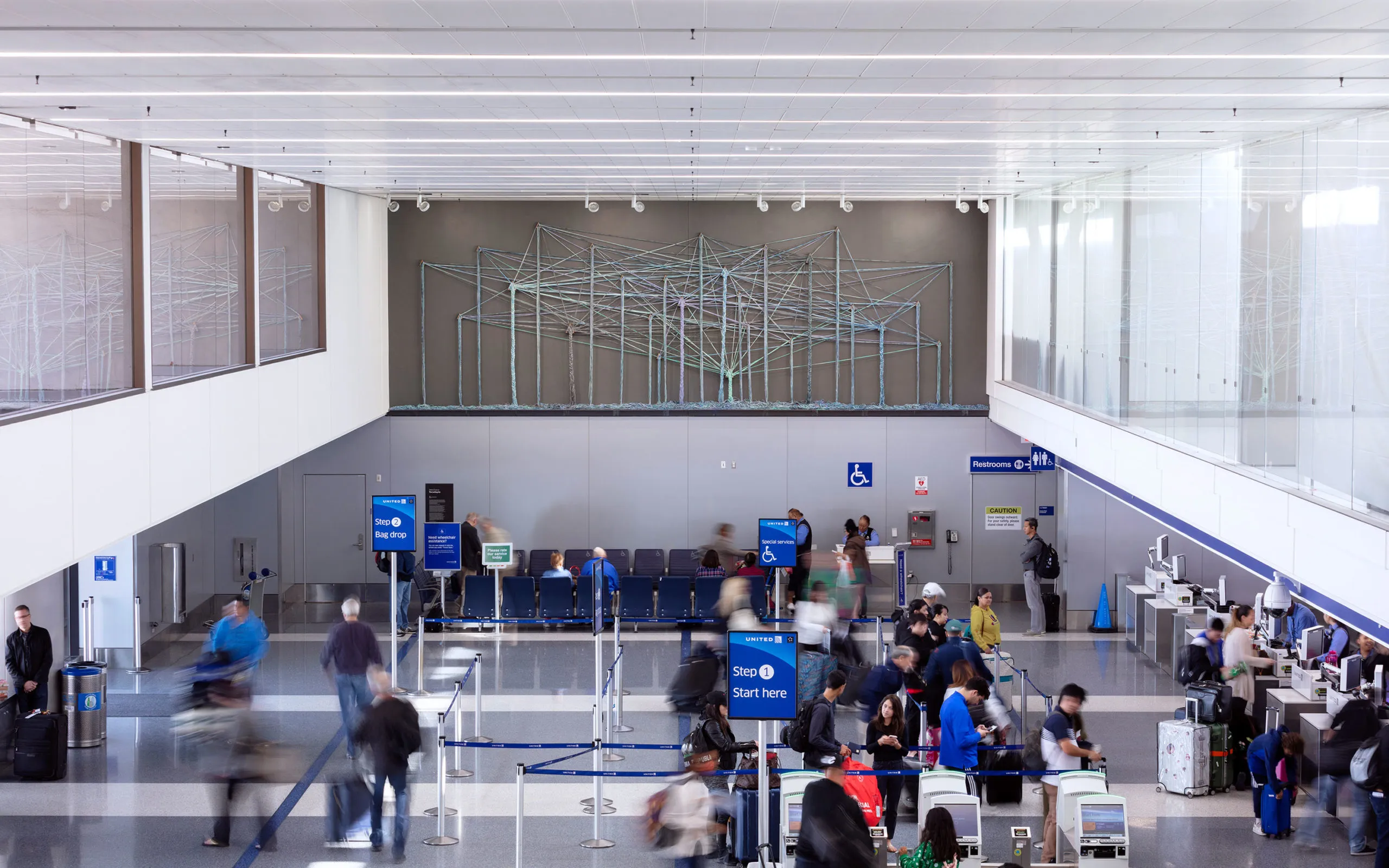
The Letting Go. Hand-dyed nautical rope, teak, acrylic, 12 x 32 x .75ft 2019
Image Credits: LAX installation photography: Panic Studio LA, courtesy of
Los Angeles World Airports (LAWA) and City of Los Angeles
C: I like thinking about the line in this way because a line rarely has an end. When you begin to zoom out, you see that a line is a series of interruptions—lines embedded into other lines—even an ending is embedded into a larger line or lineage, and so forth. The line connects us all, human and animal alike. And yet, the interruptions are so often violent. You’ve thoughtfully addressed these inherent violences by interrogating your own personal histories and cartographies and expanding them out into the world. Your earlier work started with a unit of language that led to its visual manifestation in a drawing. Is that still how you work?
D: I love the idea that, despite interruption, we are all embedded within a lineage. This is why the line remains central to my work. Despite the map’s best attempts, we are all connected. By water, by air, by wind, by dust… This is increasingly evident as the climate crisis worsens: Canadian fires clouding New York City skies, industrial fires in East LA raining ash and odor miles away, and of course the 2025 wildfires that remain a daily reality for so many Angelenos.
Language is the beginning of the line. The words of a religious-, nationalist-, capitalist-text that dictate who (where, what) is othered, villainized, owned, less-than. I’m beginning a project that returns to working with language—this time using historic texts as the basis of mark-making. The project, titled The 100-Year Echo, begins by transcribing key immigration policies including the Doctrine of Discovery (1452). Perhaps because we are witnessing the collapse of many of our systems, I feel drawn to personally transcribing the language that shaped the lines we live within today. This work began during a residency at Ellis Island Museum (2012), where I transformed oral history transcripts into text-based drawings and engravings that shared first-hand immigrant experiences.
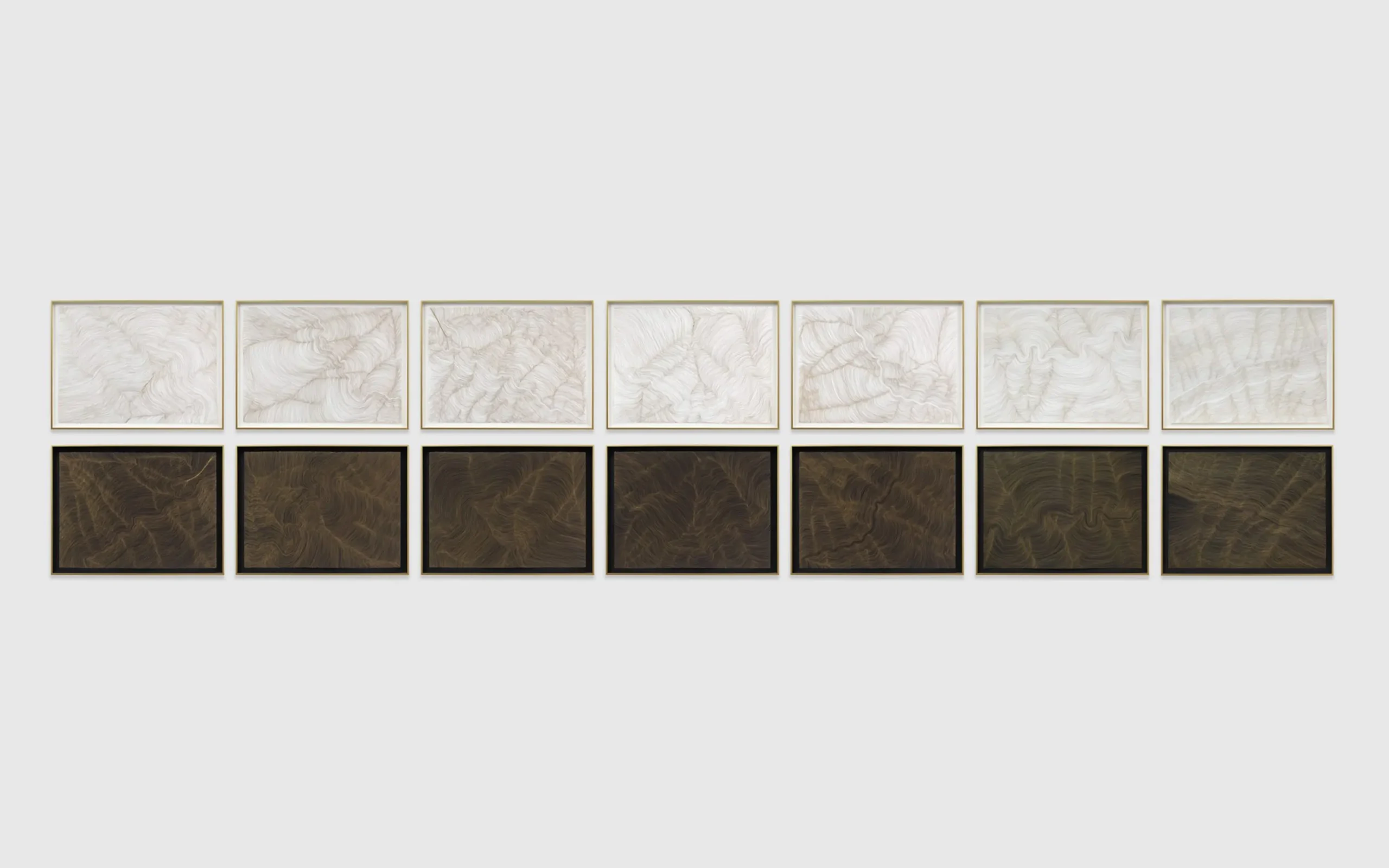
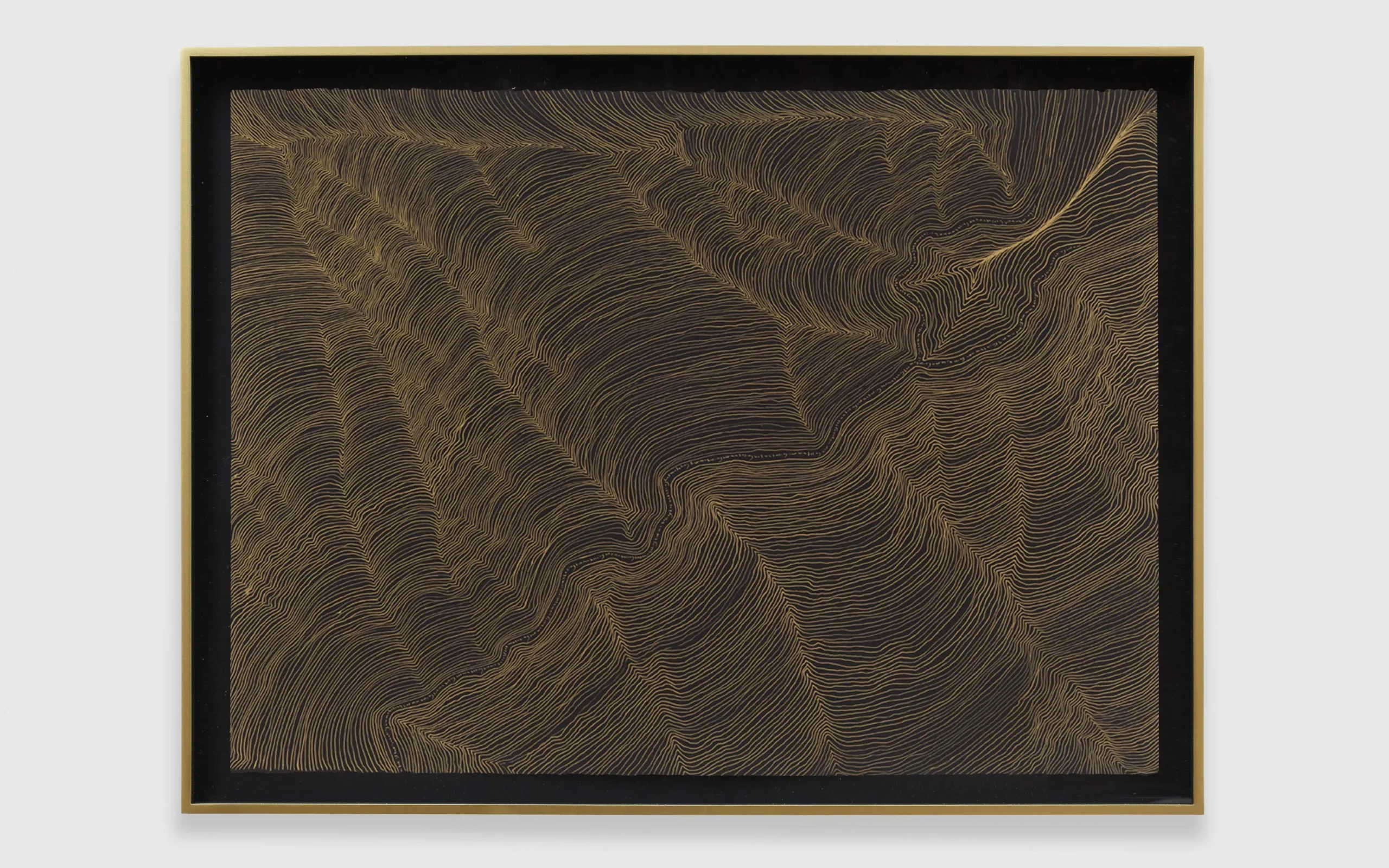
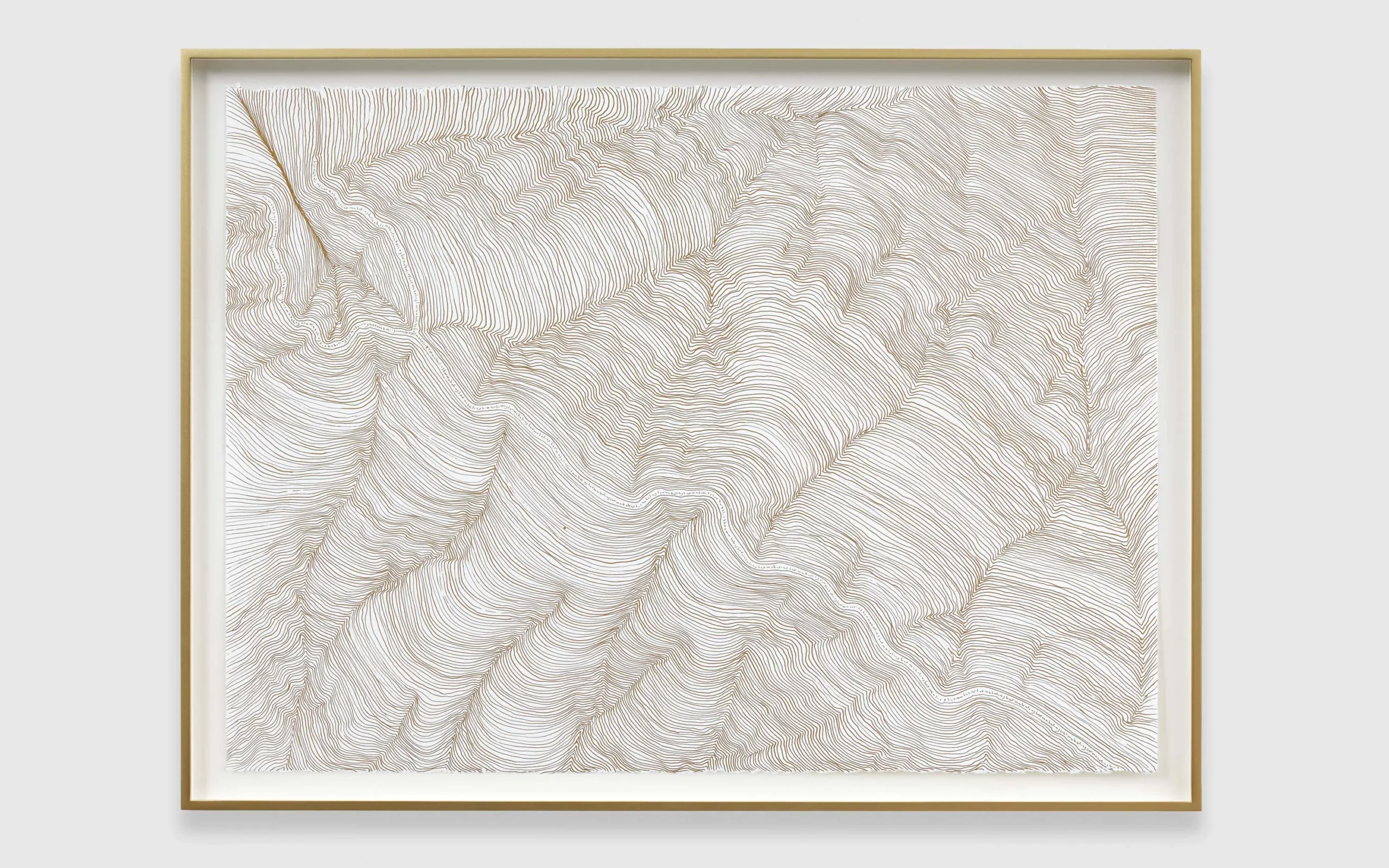
1. Topographic Drawings: Boundaries.(All)
2. Let me belong I, Metallic ink on paper, 25 x 32in, 2014
3. Let me belong II, Metallic ink on paper, 25 x 32in, 2014
C: Do you see language as embedded in the outcome?
D: Even when it isn’t, every project begins with language. Most recently, The Sea Around Us draws inspiration from Rachel Carson’s seminal 1951 publication of the same name. The poetry with which she speaks about the mystery and interconnection of the deep sea forever changed how I view the world, and the interdependence of all living systems. “Othering” often occurs as a way to numb us to violence. We see this in the mythology of deep-sea monsters: creating a single species to fear (yet again, the “other”) devoids the ecosystem of its richness and individuality, attempts to excuse the violence imparted on the deep sea by humans.
C: I agree. Also, that the deep sea is so unknown to us is why we are endlessly fascinated by it. I read only recently that there are thousands of species living in the deepest parts of the ocean that we have yet to discover. I’m interested in the fact that alongside your interrogation of the line through pathways of language, there is a concurrent theme of water in your work. Perhaps I am putting my own (erroneous!) reading and interpretation onto it, but the fluidity of water, the speed of it, the overwhelming, and at times disorganized enormity of it, reads more as a place without language. What do bodies of water symbolize in your work?
D: Rachel Carson says this best.
“…each of us carries in our veins a salty stream in which the elements sodium, potassium, and calcium are combined in almost-the same proportions as in sea water. This is our inheritance from untold millions of years ago… as life itself began in the sea, so each of us begins his identical life in a miniature ocean within his mother’s womb”
- Rachel Carson, The Sea Around Us
While line is a formal force in my practice, water is a key conceptual and material force. I’ve long looked to waterways as boundaries, dividing lines, separating and uniting bodies. The ocean has always meant distance to me—London to New York for my own immigrant journey, New York to Sicily and Italy for my family’s journey. My father emigrated by boat in 1949. The fact that he felt every mile of the Atlantic Ocean stays with me to this day.
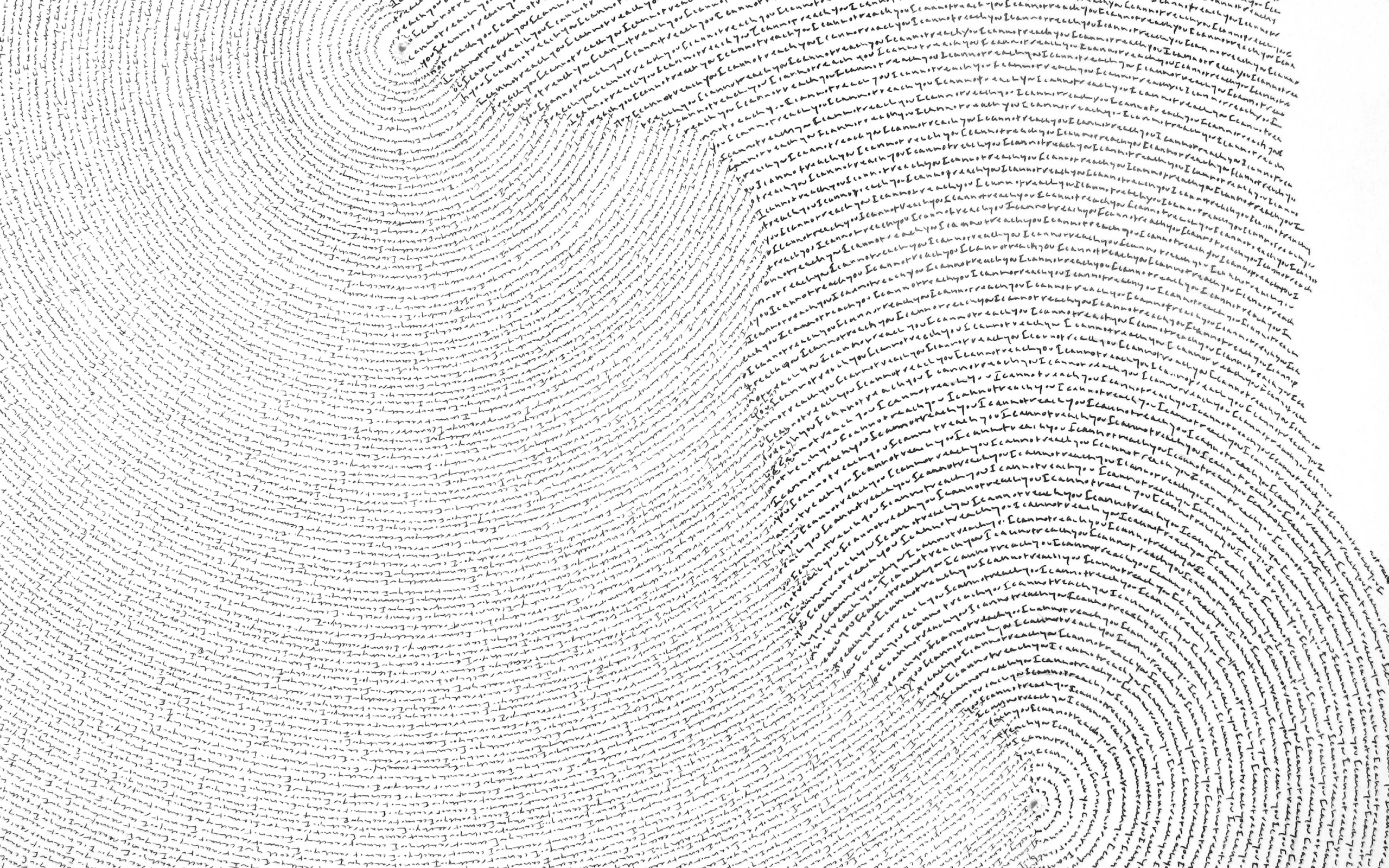
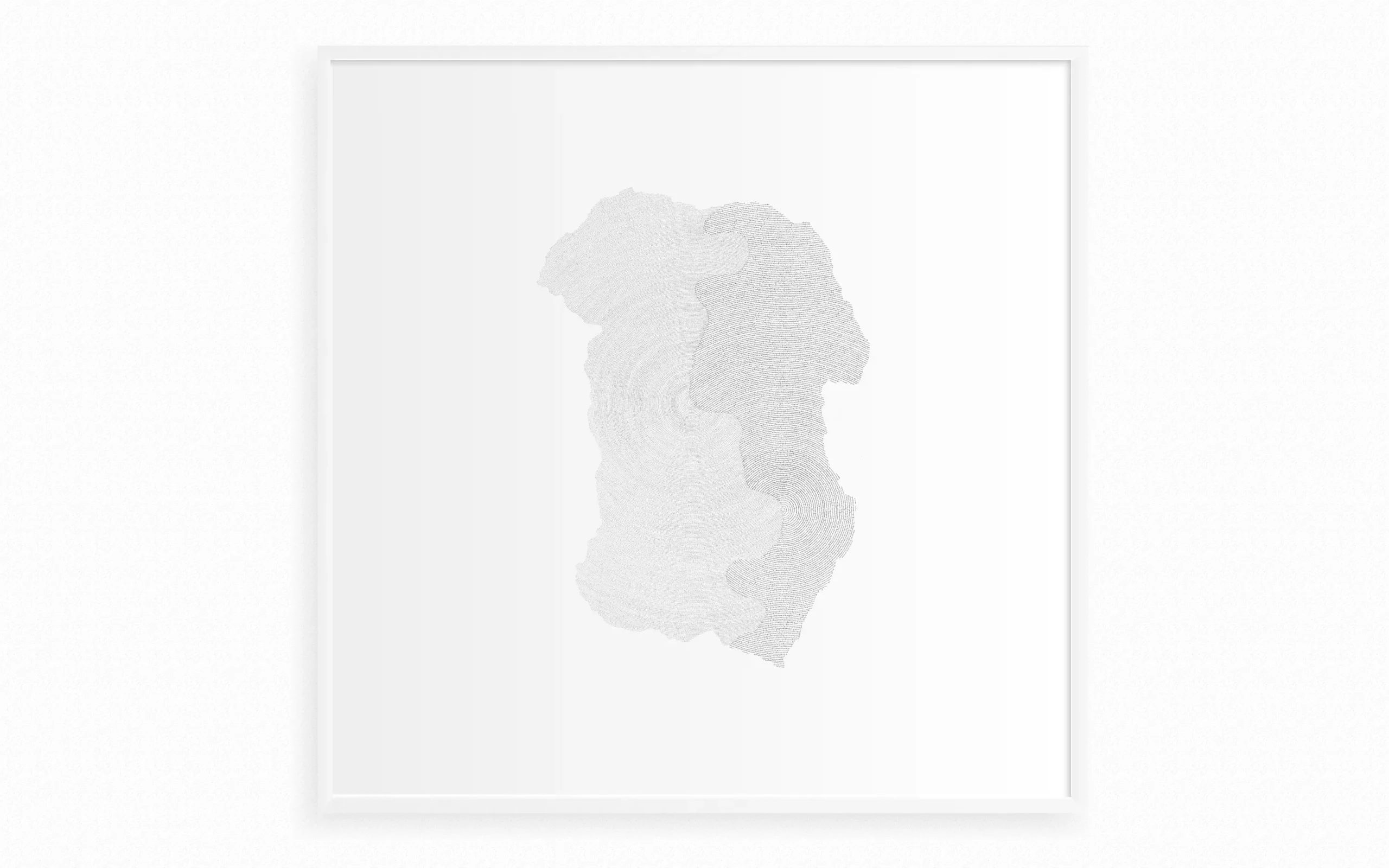
1. I cannot reach you (detail)
2. I cannot reach you, Ink on paper, 58 x 58in 2012
My early cartographic drawings identified rivers in three countries as north stars for my own identity. It was a way to align myself with my historical geography. Before moving to Los Angeles, I knew little about water access or infrastructure. Then I began to work with the Los Angeles River.
This 51-mile concrete channel, along with her surrounding infrastructure, is the physical manifestation of colonization and resilience. The Los Angeles River is a hard line that should be soft, a permanent line that should be free. The Army Corps of Engineers took control of the river in 1938. This action manufactured a drought. Now, it steals water and the right to cultural practice from First Peoples in the Owens Valley and the Los Angeles area, and deprives the possibility of water self-reliance from the people of Los Angeles and beyond.
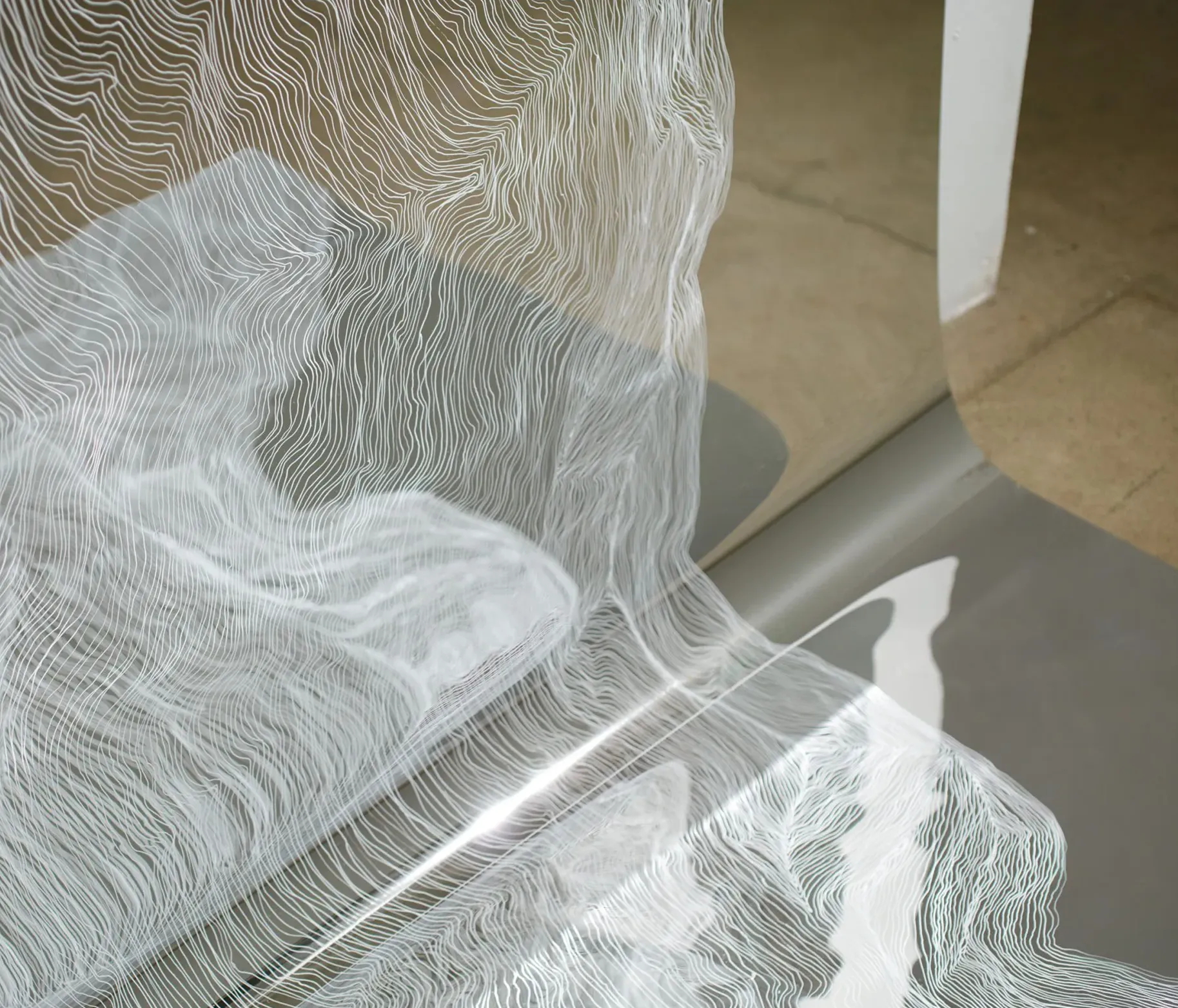
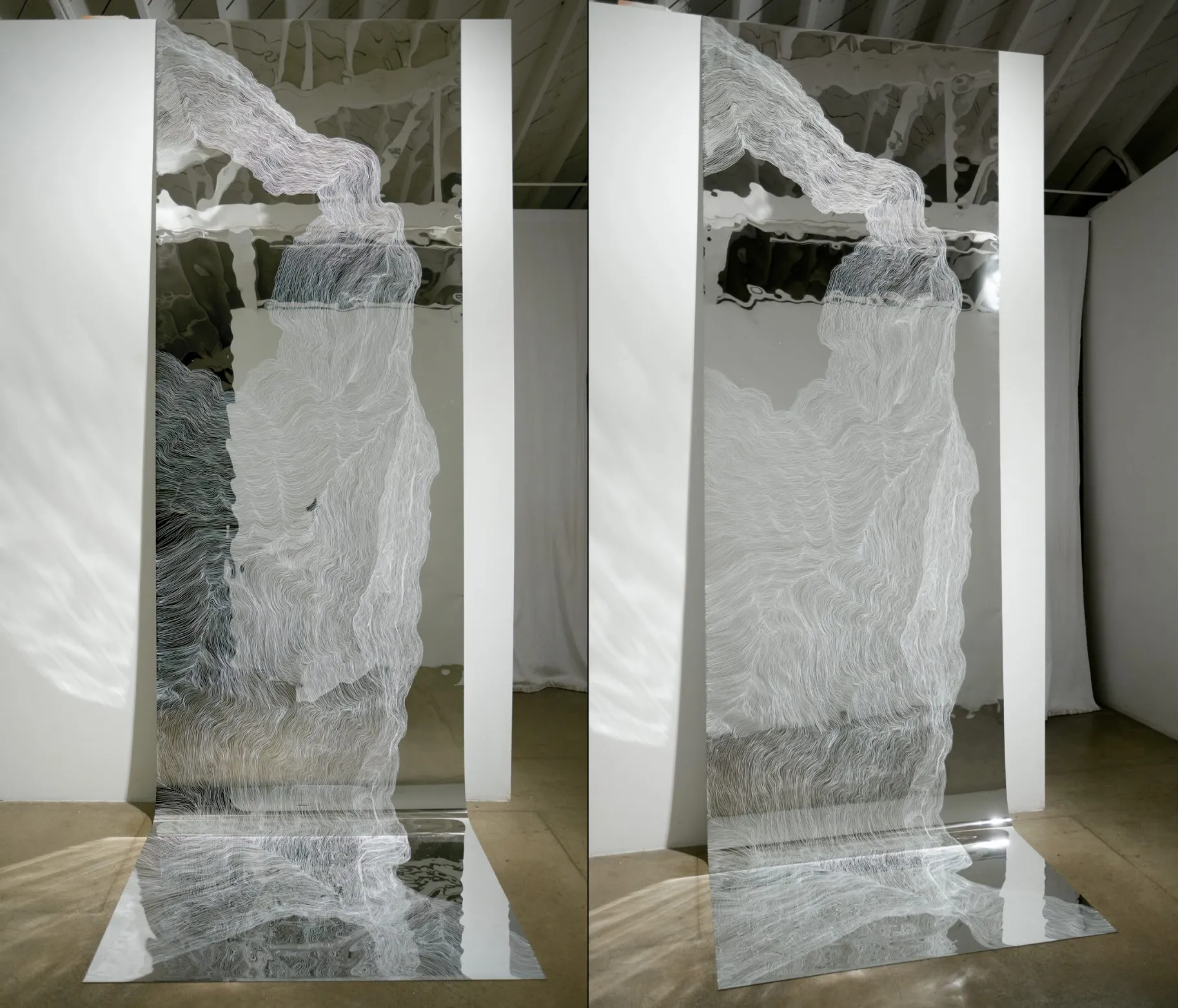
1. Rio de Porciúncula (1769-present) (detail)
2. Rio de Porciúncula (1769-present), Ink on Duralar, 5ft x 14ft 2012
Language and line are attempts to record, make permanent, claim authorship or ownership over. Yet, while some may try, nobody can own water. When the flood comes, when the dam breaks, when the tides surge, human-imposed lines and language are futile. Perhaps this is my fixation. The force needed to support all life is out of our control. No matter how many lines we draw or words we write, we cannot control rain or snowmelt or, as much as we try, river courses or coastlines.
Bodies of water are inherent places of contradiction. They are life-giving ecosystems with the potential for deadly force. They are rife with poetry and violence. They hold the memory of time immemorial and the impossibility of capturing a moment. And so they are overflowing both with and without language. While we can assign human attributes to water, this is a force greater than language or intellect. It is quite simply the force of life.
When I study the damage humans have done in the last few hundred years just by diverting water, I recognize healing marine, freshwater and brackish ecosystems is at the heart of healing all ecosystems. We come from the ocean, we live by the river. Without water, we do not survive.
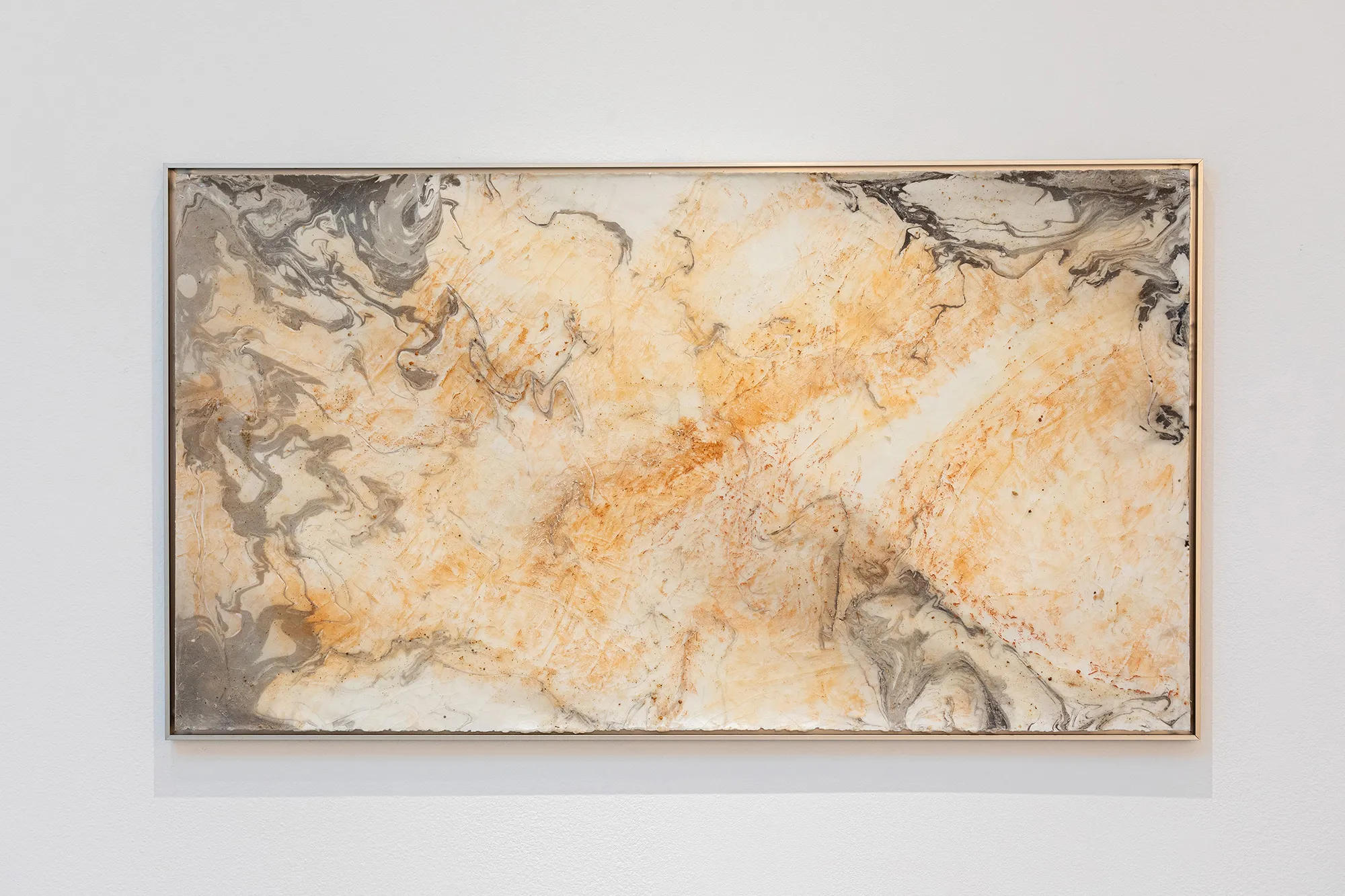
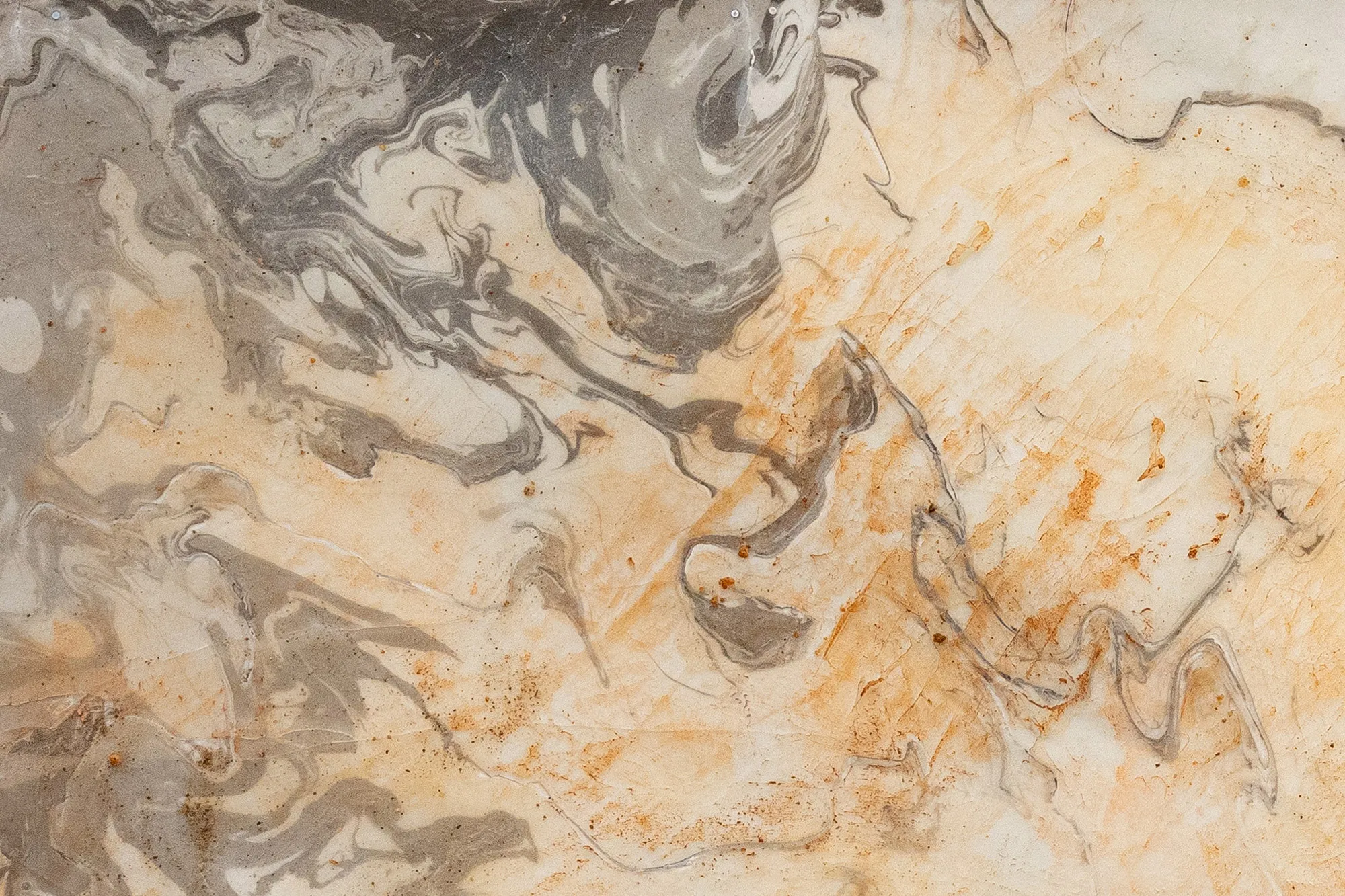
1. Crowley, Soot, glue, water, wind, wax, aqueduct dirt, California clay on paper, 25 x 47 x 2in 2024
2. Crowley, (detail)
C: What a comprehensive, beautiful, and sobering answer. In The Sea Around Us, the Hidden Lands sculptures—while allusive to islands—read more like bones to me, the fossilized remnants of what once was. There is death in these works. The drawings, too, are about sedimentation: what sinks to the bottom, decays, accrues, hardens. There is this tension in all your work, between the solid and the fluid. Thinking about water inevitably brings us into direct confrontation with our own rigidity as a species, our continuing effect on climate change, and our likely extinction. AI optimists hope its technology will solve climate change, then build data centers that pillage our precious resources. There is a fundamental disconnect between our existential anxieties and how we actually live our lives.
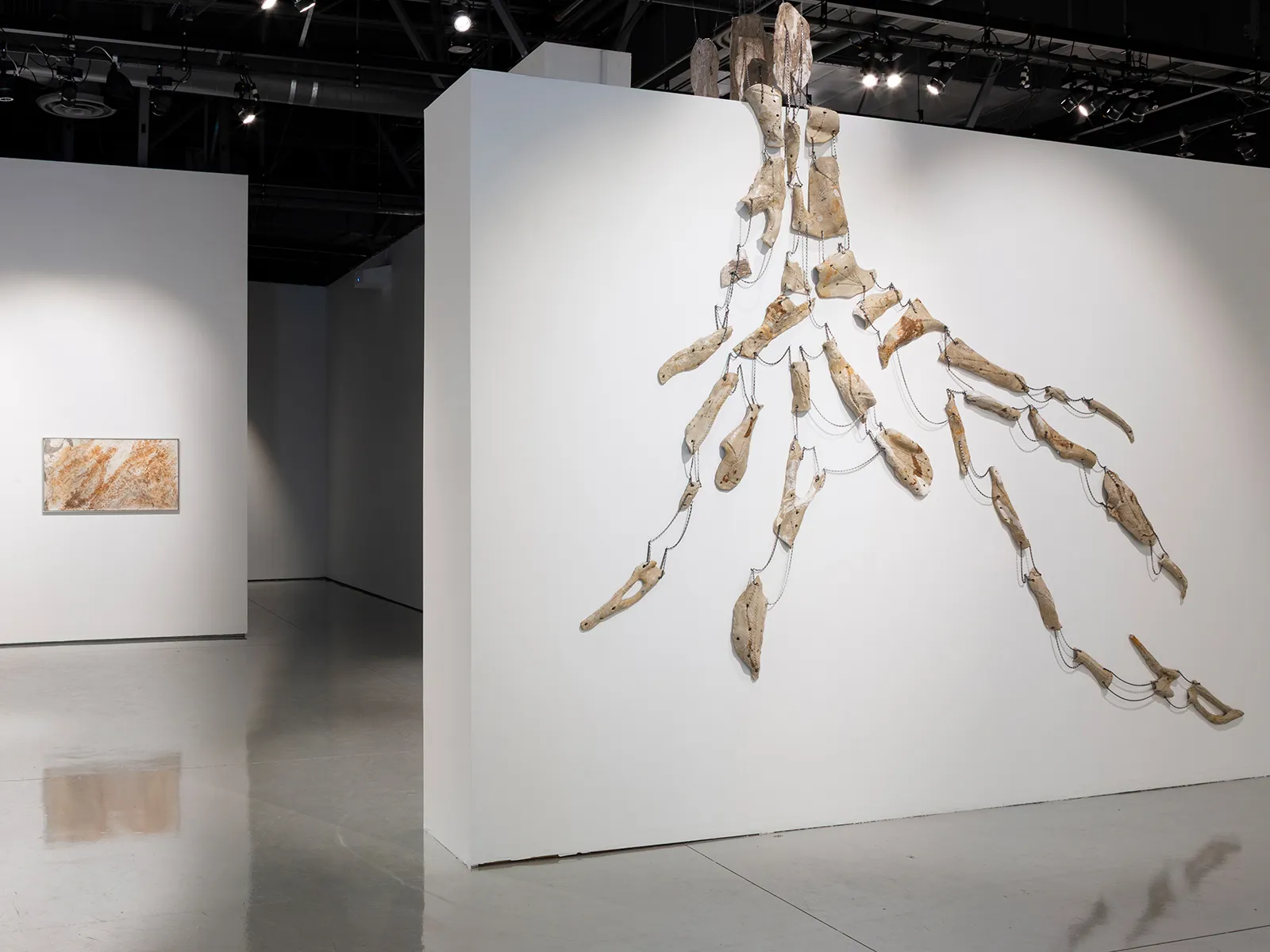
Hidden Lands, California clay, steel, Dimensions variable 2025
D: Yes, I often refer to Southern California (where I have lived for nearly 15 years) as the canary in the coal mine. Droughts, wildfires, earthquakes, coastal erosion, oil drilling, industrial fires, big tech, staggering wealth inequality, police brutality. And… rich blue skies, electric sunsets, beaches, mountains, culture. It was only when I began studying and spending time with the Los Angeles River that I recognized the direct line between colonization and environmental devastation. If you want to control a people, you control their access to water. American history is rich with open disdain for First Peoples (look up the term the “Indian Problem”) from whom our lands and waters are stolen. The Los Angeles River is a shining example of this. The confluence of the Arroyo Seco and the Los Angeles River is case in point. When you look to the west, the concretized bodies of water unite (both presenting as concrete channels in the ground). When you look to the east, the 5 and 110 freeways echo these channels, but suspended in mid-air. Channelizing the river and constructing the freeways is the transposition of nature and infrastructure. The river is stripped of her lifegiving and interconnected force. No longer is she a source of life for the beings around and within her, no longer a point of origin for surrounding ecosystems. This natural lifeforce has been replaced by engineered human-made systems of aqueducts, dams, reservoirs and freeways. The river becomes a concrete ribbon in the ground, and is replaced by concrete ribbons in the sky. Prior to colonization, Tongva peoples travelled Southern California waterways in handmade canoes. Now, we drive vehicles powered predominantly by fossil fuels. This dogged ignorance of the value of water is not new — just accelerated by AI, data centers and deep sea mining; driven by a new level of greed at the very top of the economic pyramid.
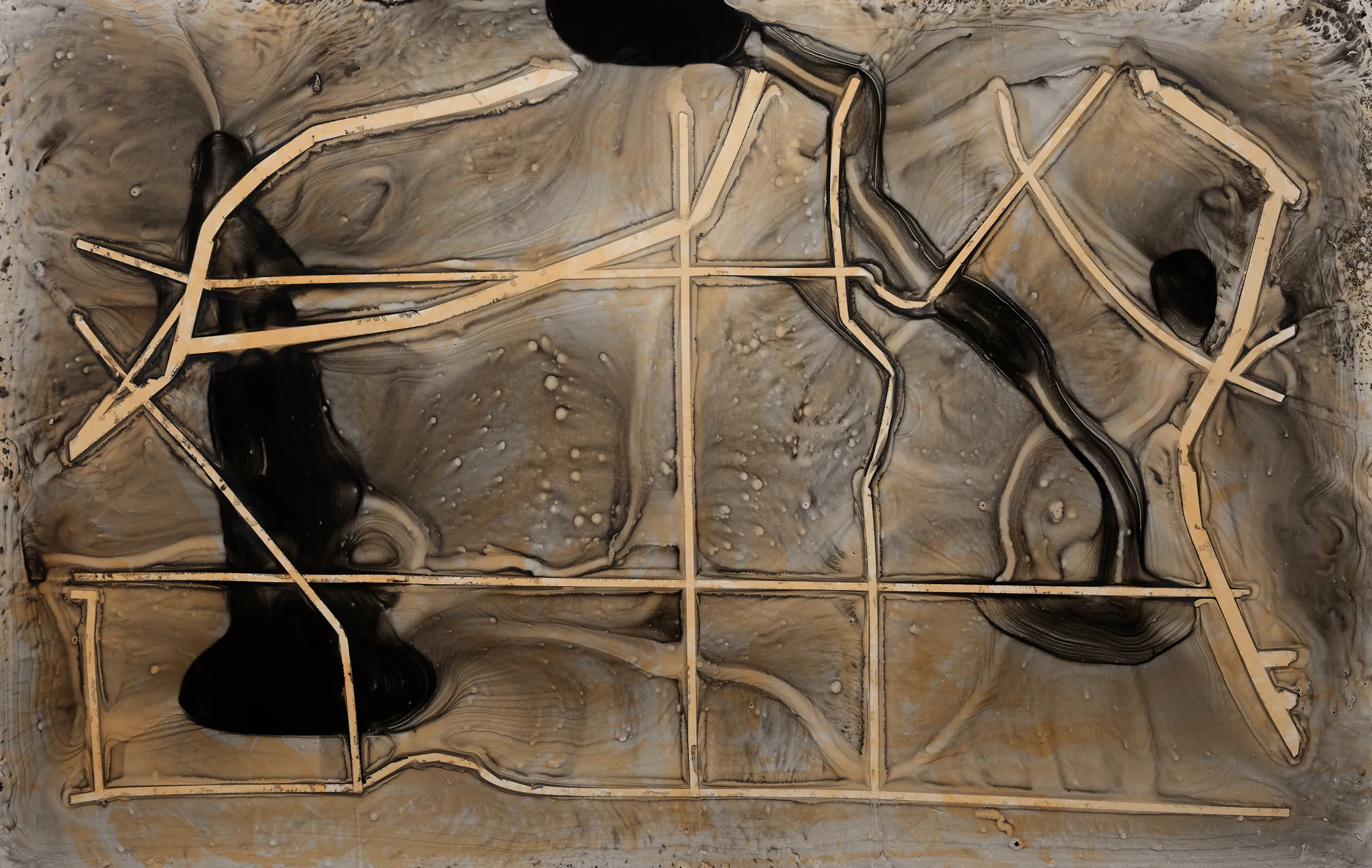
Palimpsest: Stack, Ink and clay on paper, 26 x 40in 2025
C: It’s easy to feel despondent within the culture of the Global North, which in pursuit of its own comfort, consistently ignores the value of water. I would imagine that you must be thinking about all these considerations in terms of your future projects?
D: These are the considerations of my daily life, so they certainly appear in my work. One thing that gives me hope is the numerous wins by grassroots efforts resisting data centres. It’s hard to comprehend this scale of harm: noise-, air-, water- pollution, soaring energy prices, heavy industrial traffic, the list goes on. Data centers are perhaps the most visible contemporary examples of what money can buy. Clean air and water are all-too-often luxury items in America. An estimated 48% of homes on US tribal lands lack access to clean drinking water or sanitation services. Sacrifice zones are a long-accepted American reality that many are lucky enough to not know about. This disconnect is where my work lives: inside the sticky, complex heart of where everything is connected. Here is where colonization, immigration, segregation and climate concerns meet every individual’s basic right to safety and a healthy life. This is why my work evolves as a multimodal practice. The complexity of these ideas and actions requires complex approaches to create not only objects, but opportunities for gathering, reflecting and sharing embodied experiences that help us feel more connected to one another and to the more-than-human world.
For an upcoming project, Mother, I am studying salt as a bridge between human and oceanic worlds. The ocean is the largest active carbon sink on Earth. The exploitation and warming of the ocean are, I believe, our most underestimated climate concern.
Mother will point to a particular point in ocean geography. I’m currently researching the Clarion-Clipperton Zone which is under threat from deep sea mining. Polymetallic nodules form over millions of years on the ocean floor. Often composed of nickel, copper, manganese and other rare metals, the ocean floor is the new gold rush. These nodules develop in a world beyond light, within an ecosystem of which we have scant knowledge. They contain the memory of evolution and geological time. The hubris of thinking we have a right to mine the deep sea, to pillage millions of years of evolutionary history for capital gain makes me sick to my stomach.
While the project title Mother is inspired by Carson’s words, it also refers to the fact that we share DNA with all living systems; Carson refers specifically to our elemental similarity to ocean water. My next residency in the Brazilian Amazon will explore land and water based ecologies under threat from mining and deforestation. This region is a beating heart with centuries-old growth and a complex natural architecture, capturing carbon and supporting life across the globe. The region is protected largely by Indigenous peoples fighting for their lives, and saving ours at the same time.
As so many incredible people are working to protect these endangered ecosystems, I aim to partner with a policy expert and/or non-profit, so we can simultaneously support those working for real-world change.
C: This sounds like an important project! I’m glad you brought it up, because I also wanted to ask how you partner with city governments, non-profits etc…I imagine this process can be challenging. Your recent work feels most suited to the realm of public art, and yet, bringing these projects to life requires much time and energy, and overcoming many bureaucratic hurdles. You were the first artist in residence in the Santa Monica Public Works Department (2023-26). I’m curious how that position came about and what your experience was like. Do you feel as though it was a vehicle for meaningful civic engagement? Perhaps I’m being cynical, but I often feel as though these opportunities don’t end up having the community participation or engagement that an artist might hope for (through no fault of their own), and I’m wondering about why that is.
D: My recent residency was a gift and a challenge in equal measure. I’m immensely grateful to Santa Monica Cultural Affairs and Public Works for their collaboration. This three-year residency was focused in the Water and Waste (Resource Recovery and Recycling) Divisions. In addition to working with essential workers and creating new artworks, I was tasked with writing systemic recommendations for future embedded artists. I had no idea how much I would love doing this! Being the first is a blessing and a curse—it hasn’t been done before, so there are endless possibilities, and you also have to invent everything! Bureaucracy was definitely challenging, but people were overwhelmingly curious, supportive, and collaborative.
Much of my career is scaffolded by the relationships that I’ve built and maintained over the years. This is slow work built from curiosity and care. In my experience, this is what it takes to create meaningful work. Even on a three-year timeline, I feel like I only scratched the surface.
C: Were there any areas that felt particularly meaningful?
D: The first was getting to know essential workers. Because I’m Italian, the way I do this is by feeding people! So we had lots of breakfasts and lunches—donuts, pizza, tamales, sandwiches. Whatever works as a way for folks to share space and time while still being supported within the work day. This was a precursor to photoshoots in celebration of essential workers which led to banners, a sanitation truck exhibition, and workers being star-spotted while on their route. It was fulfilling for staff to see themselves recognized for their expertise and dedication, and to hear residents say that they regard essential workers differently after these very public exhibitions.
In terms of my practice, this process encouraged huge evolutions. As I was attempting to map water that begins in the earth, this was the perfect opportunity to work with clay. In parallel, I was invited to be a Visiting Artist at Pitzer College Ceramics, where I became totally immersed in earth, water, and fire. I taught an undergraduate course reflecting this material and pedagogical research, and interconnected lines of scientific and philosophical thought. I also began working with unprocessed earth as a material. I completed adobe and natural dye residencies in New Mexico, and tested methods to convert extracted local earth to clay and ink.
Having now worked with multiple civic bodies, I will say that everything will take four times longer than you think it will. I still refuse to give in to this—I get excited by possibilities and want to try everything. I’m learning to be more gentle with myself when I accomplish a fraction of my initial vision, as long as the integrity and intention remain. When I look now at my initial residency proposal, I realize it’s impossible for one person to complete when there are so many unknowns. But if we all push and expand even a little, we’re encouraging the systems to change. So I’d rather keep pushing and chasing, keep imagining than give in to logistics and mediate the dream of what could be possible.
C: I’m encouraged by this answer, as I’m sure many artists would be. Do you have any advice for artists wanting to get into public art for the first time? It’s vital work; so often the sanctioned public art we see is “safe,” even though it’s exactly the arena where we need to see more works of resistance. It feels especially important now. Do you think that’s even possible?
D: The best advice I can give is to stay in community with people that inspire you. That, more than anything, has kept me going over the years. Make no assumptions. Working with folks from different disciplines means you are often the only artist in the room. Most people don’t understand what we do or how we do it, so a little hand-holding may be required. (And vice-versa for artists to understand their interdisciplinary partners.) Last thing is do not compare yourself to other people. Art is all smoke and mirrors. I promise 99% of the people that appear to be doing great are fighting their own battles.
I agree that acts of resistance are more critical now than ever before (in my lifetime at least). We can’t rely on commissions for this work—being nimble and in control is key. While it’s an honor to work with cities and counties, it’s equally important to create what a friend refers to as “unapproved actions”. Ask for forgiveness, not permission.
C: Unapproved Actions. Love that! Thank you so much for your richly considered responses. This conversation has been inspiring. One final question: what are you reading at the moment?
D: Thank you for your inspiring questions! I recently finished rereading The Message by Ta-Nehisi Coates. His candor and thoughtfulness give me so much hope. I’m always dipping into The Sea Around Us by Rachel Carson for inspiration. And lastly, since this is a space for poetry, I often revisit the poem Navel by Robin Coste Lewis.
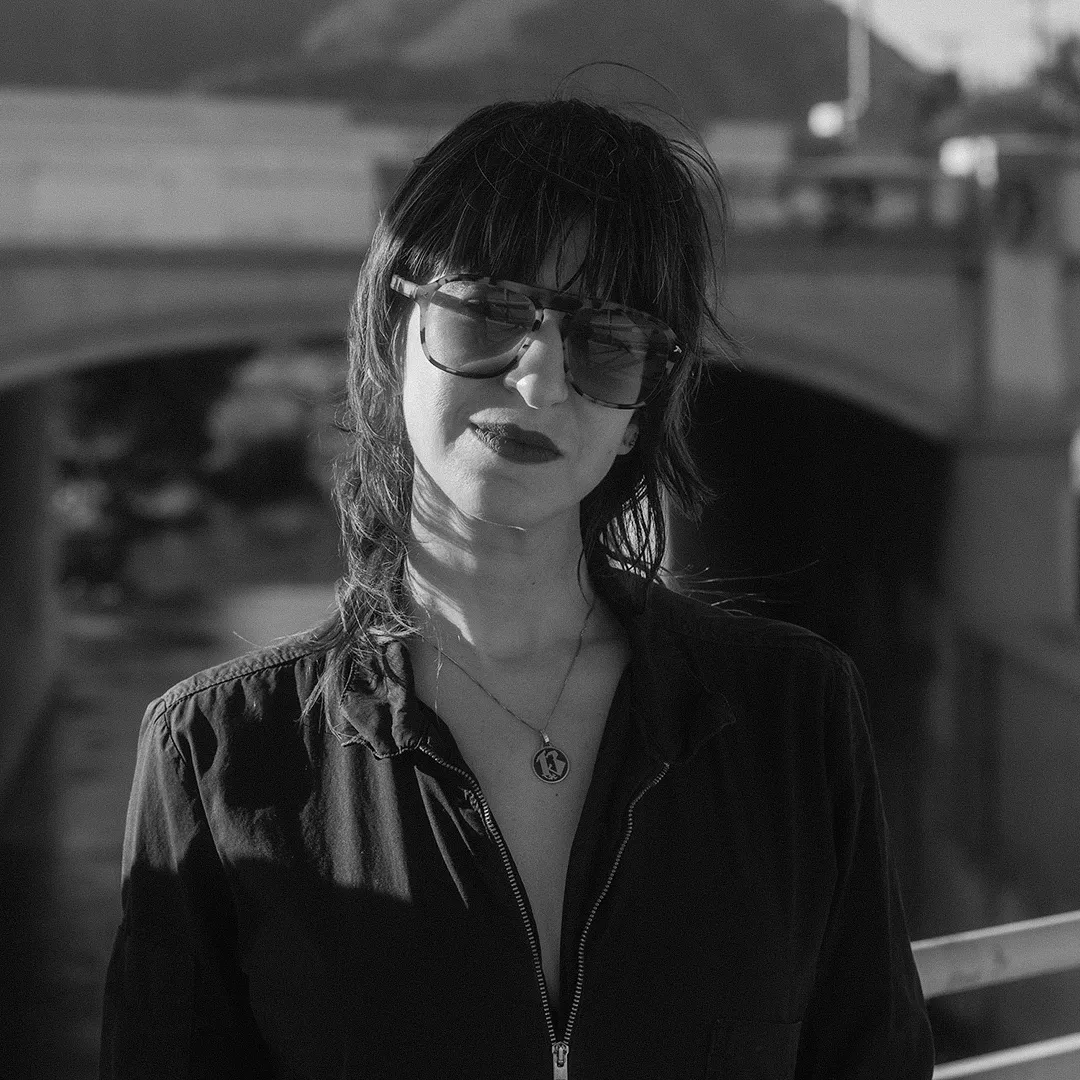
Interdisciplinary artist Debra Scacco investigates the ecological and cultural consequences of human activity. Fusing rigorous research with personal narrative, her work maps the histories of land, water, and the beings transformed by human intervention. She was the inaugural artist-in-residence at the City of Santa Monica Public Works (2023–26) and the first artist-in-residence at the Ellis Island Museum (2012). Scacco is co-founder of the Getty PST ART Climate Impact Program (2022-) and founded climate-focused residency Air Projects (2016–20). She is the recipient of a City of Los Angeles Master Artist Project (2024). Her work is featured in collections and Los Angeles County Museum of Art (LACMA) and the Hammer Museum, and has been supported by the National Endowment for the Arts, Los Angeles County Department of Arts and Culture, the Durfee Foundation and many others.
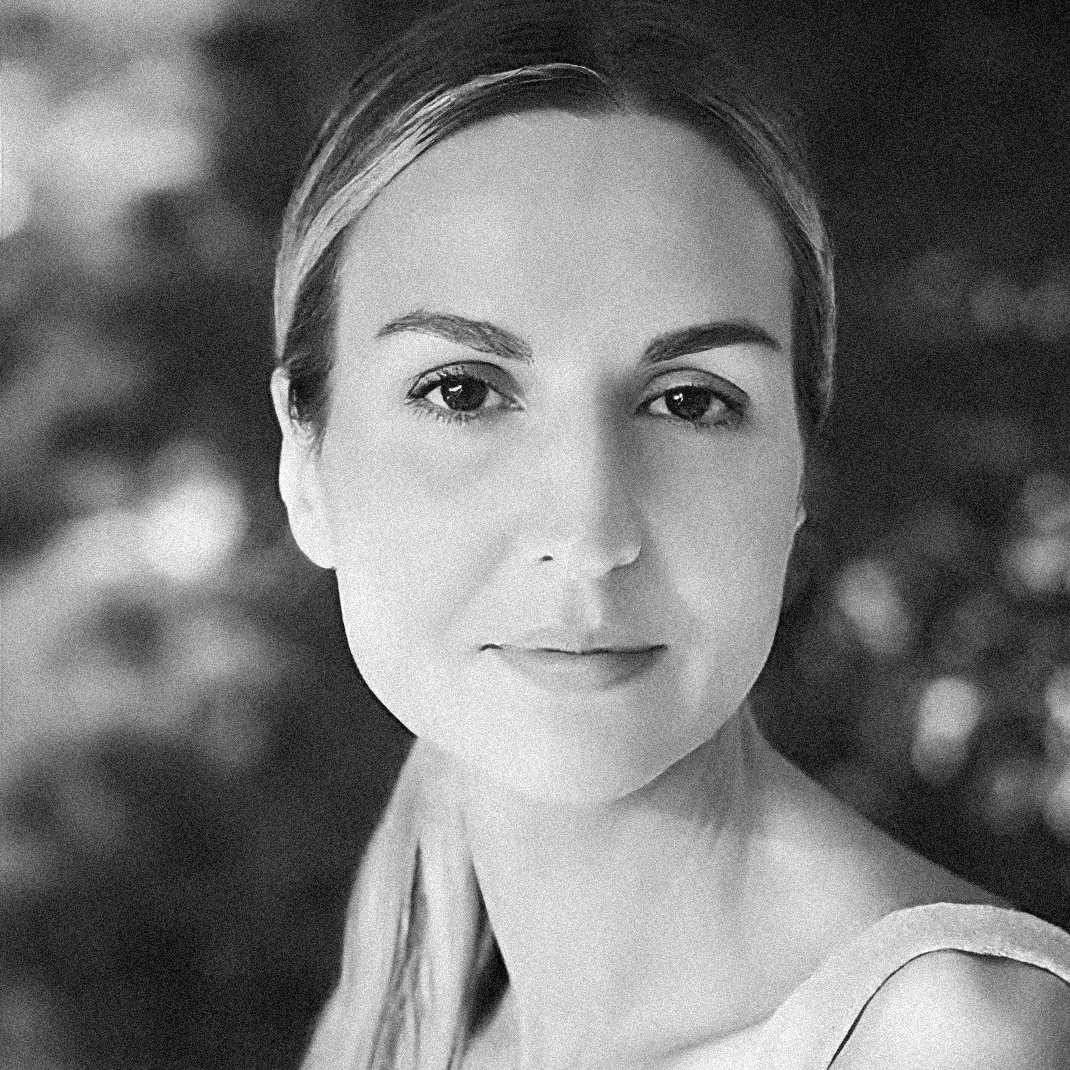
Claressinka Anderson is the co-editor-in-chief at Bear Review.
Anderson has worked as an art dealer, advisor and curator, and was the founder of the gallery and art salon, Marine Projects. Her curatorial work has been reviewed in numerous publications, including Art Forum, The Los Angeles Times, Vogue, Elle, and Modern Painters. She holds an MFA in writing and literature from Bennington College.
© Bear Review 2025
ALL RIGHTS RESERVED
Site Design + Build
October Associates
