Bear
Reviews
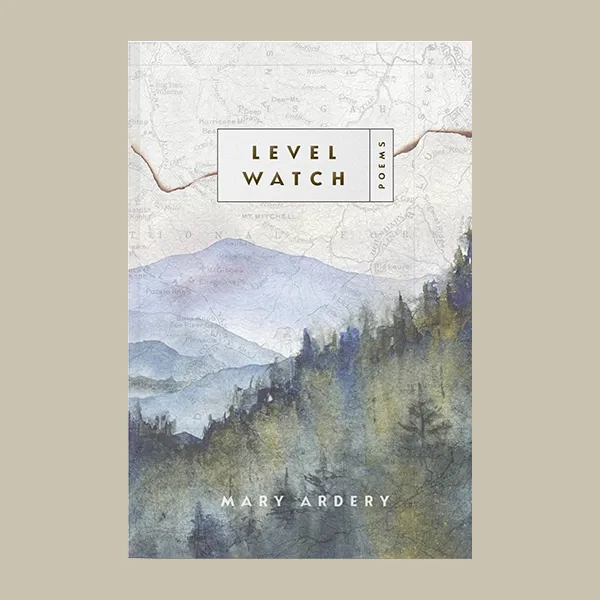
Level Watch
Mary Ardery
—
“Where the wilderness alone can’t reach”
Amidst the stunning vistas of the Blueridge Mountains, the opulence of the Biltmore Estate, and even the “little trapezoid of light … trembl[ing] on the warming water” that Mary Ardery’s Level Watch (June Road Press, September 2025) explores, there’s an entirely different image from this debut collection that sticks with me most. It’s when the collection’s speaker, a wilderness guide for women recovering from substance abuse, reflects on playing on a church’s jungle gym alongside the women she’s in charge of before they make the hour-drive drive back to base camp:
We were women
pulling ourselves up and through
a child-sized geometry. We were trying
to solve some sort of proof. The logic
was the eponymous call of the whippoorwill
and the creaking of old trees in the wind.
While these lines strike me for their meaning and language even more than their imagery, I can’t help but imagine the scene: adult women limbo-ing beneath brightly-colored jungle gym overhangs half their size and scooting down plastic slides so short their toes are almost touching the ground before they’ve begun their descent. The beauty of this scene is palpable; instead of seeing a group of struggling, discontented women in recovery, stuck outside in the heat in what is presumably the middle of nowhere, we witness a scene of communal and childlike joy. Moreover, this moment testifies to the strength of these women, finding said joy and togetherness in an unlikely place within a world where, presumably, much has conspired to wound them.
In one sense, Level Watch, which is “[b]ased on [Ardery’s] experience as a wilderness guide for women in a substance-abuse treatment program,” reads as an elegy to these women. More specifically, it functions as an elegy mourning the overdose and death of an unnamed client-turned-friend (the boundaries are often unclear in the backwoods—or, as Ardery puts it in “Learning of Your Overdose,” “There are as many shades of therapeutic rapport as there are / lipsticks at CVS”). Later in the same poem, she continues:
I was smiling into my mirror
as your boyfriend called the ambulance and the hospital
called your parents, your father called your sister and
your sister told your nephews in fragile, inadequate words,
then phoned base camp to tell the rest of us what happened.
I hid in the bathroom mirror as tears ruined my mascara and I stared
at my reflection—that sick fascination we’d both had with pain,
so often confusing it for beauty.
It’s fitting, then, that this collection chronicles the speaker’s grief in the wake of losing a loved one. Taken in a broader sense, though, the collection reveals itself as a more expansive elegy both to the broken pasts and traumas that led these women to where they are as well as a clear-eyed gaze at the speaker’s own troubled relationship with alcohol, examined individually (“The years I’d spent / blacking out—waking up in strangers’ beds”), and in relation to her father’s past alcoholism (“All the Saturday mornings he drove us drunk, three daughters / in the backseat, our small hands sticky from McDonald’s // hotcakes”). Whoever the poems primarily center—the women in recovery, her deceased friend, herself, or others—each poem remains sharp and enlightening as the “blue pockets of lakes and bald gray rock faces // scattered throughout the forest.”
Despite the layers of elegy Ardery weaves throughout this collection, Level Watch is anything but a one-note collection. To the contrary—what makes the elegizing all the more effective is the way in which it simultaneously functions as an ode to these same women and the courage and strength they demonstrate in their efforts to move from addiction towards healing and wholeness. And what more apt inroads to track the complexities of recovery than the switchback and muddied paths of mountainous hiking trails? Within the pages of this collection, readers follow as these women contest with “rivers … too high to cross,” “trails [that] were black holes that might suck us in / for good,” and “frigid water / flood[ing] boots.” The simultaneously beautiful and brutal natural world evoked within these poems reveal how these women themselves up are up against brinks both literal as well as emotional and psychological. There’s an implied question, here, both for these women and the speaker as well as for the reader: How far are we willing go through not only mud, water, rain, and snow, but also through an excavation of our pasts and presents, if it means we can get closer to articulating and realizing our hoped-for futures?
Part of what makes this collection so rich is Ardery’s aptitude for cataloguing the whole of the human experience: the ugly, the beautiful, and the many fragile places between. This commitment to witnessing, of course, is neither a passive nor an uncomplicated pursuit, something Ardery tackles this directly in poems like “Compassion Fatigue”:
Countless times,
women asked me simple enough questions, but I was winding
through mountain roads. I was treading water. I was barely
afloat. I told them Not now and I turned up the music,
spinning the knob too fast, volume rising, every
dam I had built breached. I knew I would break.
Even with our sometimes heartbreakingly human limitations in the face of problems and forces larger than ourselves, this collection returns again and again to the importance of witnessing. The collection’s longest poem, “Shift Work,” is written in sections that oscillate in narrative between the speaker’s present work as waitstaff at a “five-star breakfast” and her past work as a wilderness guide where, one night, she and her co-guide slept with a woman who had been self-harming sandwiched between them while waiting for her to be “transfer[red] to a higher level of care.” That night, the speaker becomes aware of the way that the natural world, too, witnessed the human scene unfolding before it: “The moon / probed through the sycamore leaves like a searchlight. / It found us but was powerless to help.” The moonlight could not, of course, make the woman stop self-harming, or give the speaker and her co-guide the power to know what to do in this situation. But, it could at least behold each of them: both of the likely helpless-feeling guides as well as the woman who had begged them not to send her to a higher level of care. Put simply, they may all be struggling due to reasons both interconnected and distinct, but at least they are not alone or invisible.
Despite the sometimes-maddening limits of our human abilities to witness and to feel compassion for others and the world around us, Level Watch offers a crucial reminder: “Even flawed, it’s always been / a human tenderness that changes us / where the wilderness alone can’t reach.” Even when only “treading water” and feeling unable to fully support those around us who need it, Level Watch serves as a testament to the power of people caring for each other. What’s more, it ultimately argues that these imperfect and all too human connections, while sometimes the reason we are deep in the mud in the first place, are precisely what can get us out of it.

Review by
Matt Del Busto
01.13.26
Matt Del Busto is a poet from Indiana. He received his MFA from the Helen Zell Writers’ Program, where he was also a Zell Postgraduate Fellow in Creative Writing. His work has appeared in Copper Nickel, Image, The Cincinnati Review, Ninth Letter, and elsewhere. He lives with his family in Lafayette and works at the Purdue OWL as a Professional Writing Specialist.
© Bear Review 2025
ALL RIGHTS RESERVED
Site Design + Build
October Associates
